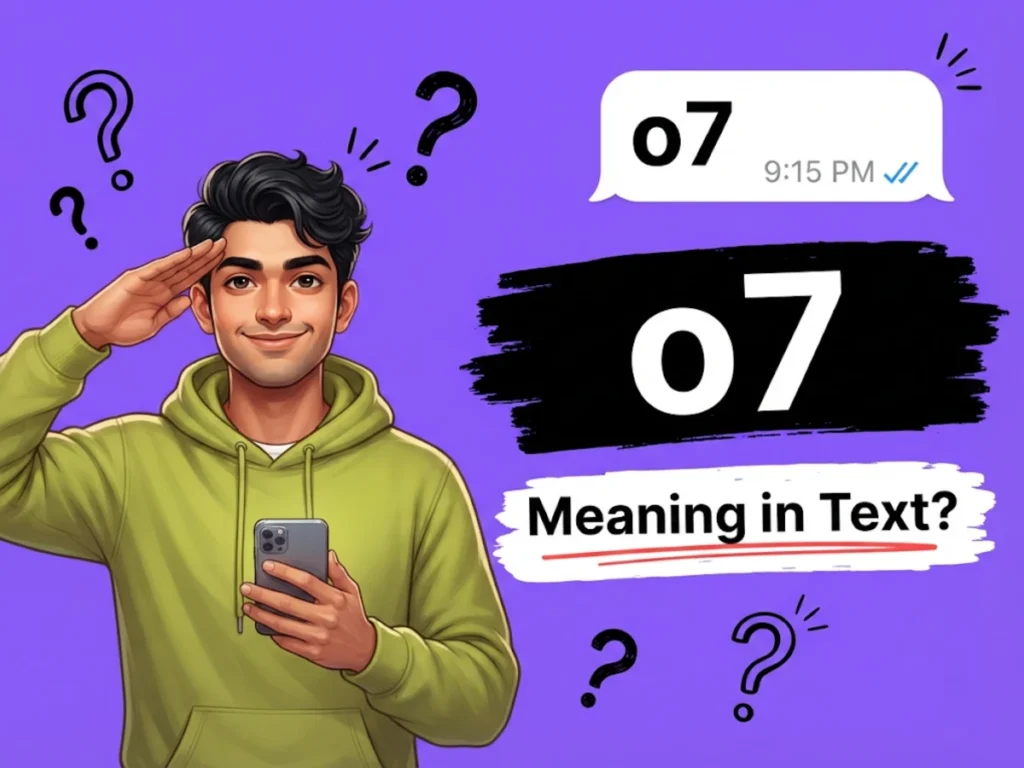
The o7 meaning is a salute. In a text, “o7” is a tiny sideways picture: the “o” is a head and the “7” is an arm bent up to the forehead. So when someone sends you “o7,” they’re saluting you, usually out of respect, as a goodbye, or as a playful “yes, sir” to a plan.
People search it because it looks like a random code, or like someone typed “07” by mistake. Once you tilt your head, though, you can’t unsee the little person saluting. And that small image carries more meaning than it seems.
READ MORE: CYA Meaning: A Friendly Goodbye or an Office Warning
What o7 Actually Is
O7 isn’t an acronym or an abbreviation, and the letters don’t stand for words. Instead, it’s an emoticon, a picture made from keyboard characters, like 🙂 or <3. Wikipedia’s list of emoticons lists o7 with the meaning “salute” and pairs it with the saluting face emoji, 🫡.
Since a salute can say several things, the o7 meaning stretches in a few related ways:
- Respect or tribute: honoring someone’s effort, sacrifice or bravery.
- Goodbye: a friendly sign-off when someone leaves a chat, a game or a job.
- Acknowledgment: a playful “understood” or “on it,” like answering a captain’s orders.
Ultimately, all three come back to the same picture. You’re standing straight and raising your hand to your brow.
Reading the Shape: Why o7 Looks Like a Salute
In fact, this is the part that confuses most people. Emoticons like 🙂 are read by tilting your head left. O7 doesn’t need that. You read it upright, facing you: the lowercase “o” is the head and the “7” is the right arm, bent at the elbow, with the hand touching the forehead.
That’s also why the spelling matters, by the way. A capital “O7” still works, but “07” with a zero looks less like a face and more like a number. Meanwhile, “o/” is a different emoticon entirely. According to the same Wikipedia list, “o/” and “\o” mean waving hello, and “\o/” means cheering.
Where o7 Shows Up in Messages
On SMS, iMessage and WhatsApp, o7 is less common than emoji, yet it still appears among friends who game or spend time online. For instance, it’s a quick way to sign off a group chat at night or salute a friend who just finished a tough exam.
In Discord servers, the emoticon is right at home. People type it when someone logs off, when a teammate takes one for the team or when a long-running member leaves. Similarly, you’ll spot it in Instagram DMs and Snapchat chats, though there it often gets replaced by the 🫡 emoji.
The o7 Meaning in Different Moods
A salute can be heartfelt or tongue-in-cheek. Here’s how the mood changes.
Funny
Roommates
A: I’m going to attempt to cook tonight
B: o7 brave soldier
A: if the alarm goes off, call for help
Sarcastic
Coworkers on WhatsApp
A: I volunteered to take notes for the 3-hour meeting
B: o7 your sacrifice will be remembered
A: please send coffee
Playful
Friends planning a trip
A: you’re in charge of snacks for the road trip
B: o7 understood
A: no raisins
B: wouldn’t dream of it
Serious
Old classmates in a group chat
A: Mr. Patel is retiring after 30 years of teaching
B: o7 best teacher I ever had
C: o7 he believed in all of us
Notice the serious example. Here, the emoticon works as a small, sincere tribute rather than a joke.
Real Chat Examples of o7
Below, for example, are realistic text and DM exchanges across different relationships.
1. Gaming friends on Discord
A: ok I’m logging off for the night
B: o7
A: same time tomorrow
B: o7 captain
2. Best friends
A: heading into my driving test now
B: o7 you’ve got this
A: hands are shaking
B: deep breaths, text me after
3. Coworkers
A: Today’s my last day here, thanks for everything
B: o7 it’s been great working with you
A: Keep in touch!
B: Absolutely
4. Siblings
A: I’m telling mom we broke the vase
B: o7 it was nice knowing you
A: you’re coming with me
B: absolutely not
5. Partners
A: going to the grocery store, need anything?
B: ice cream please
A: o7 mission accepted
B: my hero
6. Parent and adult child
A: What does “o7” mean? Your cousin sent it to me
B: it’s a salute, like respect
A: Oh! That’s sweet then
B: yeah he’s saying thanks
7. Teammates
A: I’ll take the early shift on Saturday
B: o7 legend
A: you owe me one
B: noted
8. Stranger in a community server DM
A: thanks for answering my question earlier
B: no problem, happy to help
A: o7
B: o7
9. Friends in a group chat
A: who’s picking up the cake?
B: I got it
C: o7 thank you for your service
B: I accept payment in frosting
10. Classmates
A: I finally submitted my thesis
B: o7 congratulations
A: I’m going to sleep for a week
B: you earned it
11. Cousins
A: I’m leaving the group chat, too many notifications
B: o7
C: o7 we’ll miss you
A: ok fine I’m muting it instead
Grammar: How o7 Fits Into a Text
O7 works like an interjection or a reaction. On its own, it can stand as a complete reply, which is how it’s most often used. Plus, it can open or close a sentence, as in “o7 good luck” or “good luck o7.”
Because it’s an emoticon, it doesn’t really have a formal register. Still, it’s informal and best kept for friends, gaming groups and relaxed team chats. Capitalization barely matters, but using a lowercase “o” keeps the little head visible.
How to Reply When Someone Sends o7
Usually, the easiest reply is simply another “o7.” Beyond that, you have options.
- Funny: “At ease, soldier.”
- Serious: “Thank you, that means a lot.”
- Flirty (with a partner): “Salute accepted. Now come back safe.”
- Neutral: “o7” or the 🫡 emoji.
In a goodbye moment, returning the salute is polite. In a thank-you moment, a short “thanks” works well too.
o7 Compared With Similar Terms
People often confuse o7 with other emoticons and sign-offs. Here’s a quick comparison.
| Term | Meaning | Usage Context | Tone | Popularity | Confusion Risk |
|---|---|---|---|---|---|
| o7 | salute | Respect, goodbyes, “understood” | Respectful or playful | Medium | High (looks like “07”) |
| 🫡 | saluting face emoji | Same uses as o7 | Respectful or playful | High | Low |
| o/ | waving hello | Greeting someone | Friendly | Low | Medium |
| \o/ | cheering | Celebrating good news | Excited | Low | Medium |
| GG | good game | Ending a match or a task | Sporting | High | Low |
| CYA | see you | Casual goodbye | Friendly | High | Low |
Who Uses o7
In practice, the o7 meaning is best known in gaming communities, Discord servers and online forums, where text emoticons never went out of style. As a result, many users are Gen Z and Millennial gamers. Others recognize it because the saluting face emoji has made the idea of a text salute more familiar.
Since it’s a picture rather than a word, it isn’t tied to one language or country. People across the US, UK and beyond understand it, as long as they’ve spent time in online spaces. In everyday family texts, however, it can still confuse people.
Is o7 Rude or Okay to Use?
Simply put, o7 isn’t rude at all. It’s actually a gesture of respect. There’s no profanity, nothing explicit and no hidden insult.
Even so, context still matters. If someone shares serious news, such as a job loss or a loss in the family, a bare “o7” might feel too casual unless your group already uses it that way. In a work chat, it’s fine with friendly coworkers, but in a message to a manager you barely know, “thank you” is clearer.
A Salute Without a Uniform
What’s interesting about o7 is that it brings a formal military gesture into the most casual space possible. Nobody in a group chat is in uniform, yet the salute still works, because it says “I respect what you just did” without needing a whole sentence. It’s also one of the few emoticons that reads correctly without tilting your head. That makes it surprisingly durable: it’s quick to type, it needs no emoji keyboard, and it carries both a joke and a real feeling at the same time.
FAQs About the o7 Meaning
What does o7 mean from a guy or girl?
The o7 meaning doesn’t change with gender. It’s always a salute. If a crush sends it, they’re probably saying goodbye, “got it” or showing respect for something you did. Look at the message before it to tell which one.
Is it rude to reply with just o7 in a text?
No, replying with just “o7” is completely normal. In fact, the emoticon is designed to stand alone. However, if someone shared something emotional, adding a few words shows you care. Otherwise, a single “o7” is a perfectly friendly answer.
What’s the difference between texting o7 and saying it out loud?
You don’t say “o7” out loud at all. In person, you would simply salute, or say “respect” or “good luck.” So o7 only exists in writing. It’s a way to bring body language into a text.
Does o7 mean the same thing in a group chat vs a 1-on-1 text?
Overall, the meaning stays the same. In a group chat, though, several people often reply “o7” in a row, especially when someone leaves. That chain of salutes feels like a mini farewell ceremony. In a one-on-one chat, it’s more personal, like a quick nod.
Is o7 the same as 07?
Not quite, although they’re close. “07” with a zero is often a typo for o7, and many people still read it as a salute. However, the lowercase “o” looks more like a head, so o7 is the standard form. Using a zero can make it look like a number or a date.
What is the emoji version of o7?
The closest emoji is the saluting face, 🫡. Wikipedia’s emoticon list pairs the two. Many people now send the emoji instead, but o7 is faster for anyone typing on a keyboard.
Can o7 be used as a goodbye?
Yes, and that’s one of its most common uses. People send it when logging off, leaving a server or finishing a job. It’s a respectful way of saying “see you” without writing a full goodbye.
Final Thoughts on the o7 Meaning
So the o7 meaning is a salute made from two keyboard characters: a head and a raised arm. It shows respect, says goodbye or answers “understood,” often with a wink.
Usage tips:
- Use a lowercase “o” so the head is clear.
- Send it when someone logs off, leaves or tackles something tough.
- Return the salute when someone sends o7 to you.
- Swap in 🫡 if the other person isn’t familiar with emoticons.
Common mistakes:
- Typing “07” with a zero, which can look like a number.
- Mixing it up with “o/,” which is a wave, not a salute.
- Using it alone in response to serious bad news.
- Sending it to older relatives who may not know what it means.
When to use it: goodbyes, thank-yous, gaming chats and playful “yes, captain” moments. When to avoid it: formal messages and sensitive conversations where words matter more than a symbol.