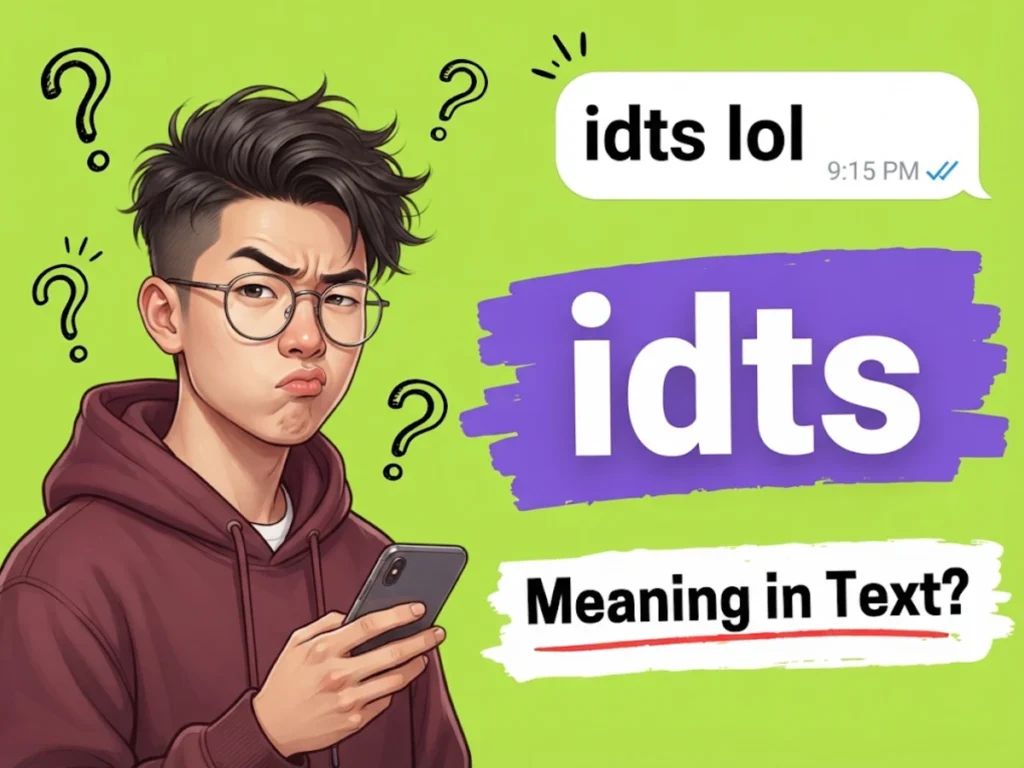
The IDTS meaning in texting is simple: it stands for “I don’t think so.” When someone sends you “idts,” they’re saying no, doubting what you said, or gently pushing back without typing a full sentence.
That sounds easy enough. However, the tone can swing from a polite “probably not” to a sarcastic “yeah, right.” That’s why so many people look it up after getting it as a one-word reply, especially when they can’t tell if the other person is joking or annoyed.
READ MORE: Idek Meaning: What It Means in Text
IDTS Meaning: The Short Version
IDTS is an acronym, and the full expansion is “I don’t think so.” Dictionary.com’s entry for IDTS describes it as a way to say “I don’t think so” in social media and texting, often to convey sarcasm.
There’s only one real expansion. Even so, it does two different jobs in conversations:
- A soft no. “Are you coming tonight?” “idts, I’m wiped.” Here it declines without sounding harsh.
- Doubt or disbelief. “I could totally beat him in a race.” “idts 😂” Here it questions a claim, often with a smirk.
The first use is more common in private texts. The second appears more in playful back-and-forth between friends.
The Hedge Hidden Inside IDTS
Here’s the term-specific detail most explanations miss. “I don’t think so” is a hedged no. It leaves a small door open, because “think” suggests an opinion rather than a final decision.
That’s exactly why people choose it over a flat “no.” For instance, “idts” to an invitation signals you’re probably out, yet it doesn’t slam the door. In contrast, “nope” closes it. So when you get an “idts,” it’s often worth reading the next message too, since people sometimes add a reason or a maybe.
Where You’ll Actually See It
In text form, it’s mostly found in iMessage, SMS and WhatsApp chats between friends. After that, it turns up in Instagram and Snapchat DMs and in Discord chats. Dictionary.com’s examples also show it as a hashtag (#idts) tacked onto posts, usually for sarcasm.
Spelling and variants
Lowercase “idts” is standard. Uppercase “IDTS” looks firmer or more dramatic, but the meaning stays the same. People rarely add punctuation, though “idts…” with dots can feel hesitant, while “idts!!” feels emphatic. Some people simply type the full phrase when they want to sound clearer.
How the IDTS Meaning Shifts With Tone
Tone does most of the work here, since the letters never change. As a result, the IDTS meaning can feel warm in one chat and cutting in another.
Funny
A: I’m gonna start waking up at 5am to run
B: idts
A: wow, zero faith
B: you snoozed 4 times today
Sarcastic
A: the group project will be done by Friday for sure
B: idts but ok
A: Mark said he’s on it
B: Mark hasn’t opened the doc
Playful
A: you secretly love my cooking
B: hmm idts
A: you had seconds
B: that was politeness 😌
Serious
A: do you think I should text her again
B: idts. she said she needs space
A: yeah, you’re right
B: give it a week at least
A Dozen Everyday Chats With IDTS
Friends deciding on plans
A: you down for the movie at 10?
B: idts, I have a shift at 7
A: fair
B: next weekend though
Partners
A: did you eat the last cookie?
B: idts
A: there are crumbs on your shirt
B: ok I might have
Coworkers (casual chat)
A: is the meeting still at 3?
B: idts, I think it moved to 4
A: thanks, checking the invite
B: yep, 4pm
Parent and teen
A: is your room clean?
B: idts mom
A: what does that even mean
B: it means no lol
Siblings
A: can I borrow your hoodie
B: idts
A: please, I’ll wash it
B: fine. returned by Sunday
Strangers on a Discord server
A: is this the best build for beginners?
B: idts, try the starter loadout first
A: oh ok
B: it’s way easier to learn
Roommates
A: did you pay the internet bill?
B: idts… let me check
A: it’s due tomorrow
B: paying it now
Friends debating sports
A: my team’s winning the title this year
B: idts 😂
A: watch
B: I’ll screenshot this
Classmates
A: is the quiz open book?
B: idts, she said notes only
A: notes are basically the book
B: try telling her that
Cousins
A: is grandma coming to the reunion
B: idts, her knee is still bad
A: we should call her
B: good idea
Dating app match
A: so pineapple on pizza: yes or no?
B: idts it belongs there
A: first red flag
B: debatable
Gym partners
A: leg day today?
B: idts, I’m still sore
A: that’s the point
B: tomorrow, I promise
Grammar and Placement
Grammar also shapes the IDTS meaning. The acronym works as a full clause. It contains a subject, a verb and an object, so it can stand alone as a complete reply. In fact, that’s how it’s used most of the time.
It also fits at the start of a longer message, as in “idts, I’m busy.” Mid-sentence use is rarer, although “I mean… idts” works for a hesitant tone. It rarely appears at the end, except as a sarcastic tag or hashtag.
Capitalization doesn’t change the meaning. Still, caps can add weight. It’s strictly informal, so you’d write out “I don’t think so” in an email, a school message or anything professional.
Smart Replies When Someone Texts IDTS
Funny
- “Bold of you to doubt me.”
- “Screenshotting this for when I’m right.”
- “Your confidence in me is touching.”
Serious
- “Okay, no worries. Maybe another time?”
- “Got it. Is something making you unsure?”
Flirty (when it fits the chat)
- “You’ll change your mind.”
- “We’ll see about that 😏”
Neutral
- “fair”
- “ok, no problem”
- “noted”
IDTS Meaning Compared With Similar Acronyms
| Term | Meaning | Usage Context | Tone | Popularity | Confusion Risk |
|---|---|---|---|---|---|
| IDTS | I don’t think so | Soft no or doubt | Hedged, sometimes sarcastic | Moderate | Medium |
| IDK | I don’t know | Uncertainty | Neutral | Very high | Low |
| IDC | I don’t care | Indifference | Casual or cold | High | Low |
| IDEK | I don’t even know | Confusion or disbelief | Exasperated | Moderate | Medium, often mixed up with IDTS |
| NVM | Never mind | Dropping a topic | Neutral | High | Low |
| FS | For sure | Strong agreement | Positive | High | Low, the opposite of IDTS |
Who Uses IDTS
It’s most common among teens and young adults who already rely on “idk” and “idc,” since it follows the same “I don’t…” pattern. Gen Z tends to use it casually as a quick reply. Millennials more often spell out “don’t think so” or just say “nah,” though many still recognize the acronym.
There isn’t solid data on regional differences, so we won’t guess. What we can say is that Dictionary.com’s examples show it circulating on social media by late 2017. Across platforms, it lives in direct conversations far more than in public captions.
Where IDTS Comes From
IDTS comes straight from texting culture rather than a meme. Like “idk” and “brb,” it’s the result of trimming a common phrase to its first letters, a habit that grew from early SMS days, when typing was slow and characters were limited.
Dictionary.com doesn’t credit a specific origin or person. Therefore, it’s best seen as natural shorthand that spread through chats and social posts, not a viral moment.
Is IDTS Rude?
On its own, no. There’s no profanity and nothing explicit. However, a bare “idts” can feel curt when someone asked a sincere question, especially about plans or feelings.
For school or work, use the full words. Texting a teacher or boss “idts” may look careless. Also, be aware that in some contexts it can read as mocking, especially when paired with laughing emojis.
What Makes IDTS Work in a Conversation
Its strength is that it lets you say no while sounding thoughtful. Because the phrase contains “think,” it frames the refusal as an opinion, which feels softer than a flat denial. On the other hand, that same hedge makes it a favorite for sarcasm. When the claim is obviously silly, “idts” becomes a dry, polite way of calling it out.
FAQs on the IDTS Meaning
Is it rude to reply with just “idts” in a text?
It depends on the question. As a reply to “want to grab food?”, it’s a normal, polite decline. As a reply to something personal, though, it can feel cold. Adding a short reason, like “idts, I’m exhausted,” makes it much warmer.
What’s the difference between texting IDTS and saying it out loud?
Out loud, people say the full phrase, and their voice shows whether it’s playful or serious. In a text, the acronym loses that cue. As a result, the same four letters can look sarcastic even when you meant them kindly.
Does IDTS mean the same thing in a group chat vs a 1-on-1 text?
The meaning stays identical. In a group chat, however, it’s more often playful doubt, like responding to someone’s bold claim. In a private text, it’s more likely to be an honest no to a plan or request.
Does IDTS mean no?
Mostly, yes. It’s a softened no. The hedge leaves a little room, so the person might still change their mind, but you should generally treat it as a decline.
How is IDTS different from IDK?
IDK means “I don’t know,” which signals uncertainty. IDTS means “I don’t think so,” which leans toward no. So “idk” is neutral, while “idts” already has an answer in mind.
Can IDTS be flirty?
It can, in a teasing way. For example, if someone says “you’re obsessed with me,” replying “idts 😏” plays along without agreeing. That works best when you already have a playful dynamic.
Wrapping Up IDTS
IDTS stands for “I don’t think so.” It’s a hedged no, a gentle way to decline, and a handy tool for playful doubt.
Quick tips:
- Add a reason to soften a decline.
- Use emojis to show when you’re joking.
- Save it for friends and casual chats.
- Read the follow-up message, since “idts” often leaves room for a maybe.
Mistakes to avoid:
- Sending a bare “idts” to a heartfelt question.
- Using it with a boss or teacher.
- Confusing it with IDK, which means you’re unsure.
- Overusing it for sarcasm until it feels dismissive.
Use IDTS for quick, low-stakes replies. Meanwhile, avoid it when someone needs a clear, kind answer, or when the conversation is formal.