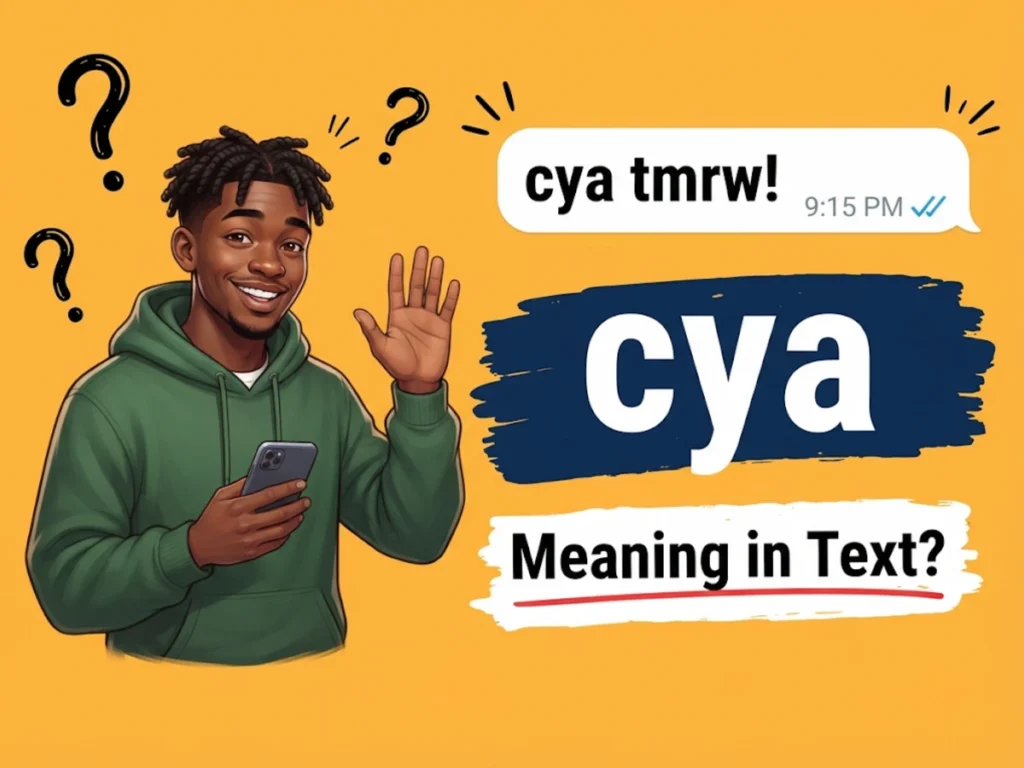
In most texts, the CYA meaning is simply “see ya,” a casual way of saying goodbye or “see you later.” So when someone texts you “cya,” they’re wrapping up the chat or confirming they’ll see you soon. In office talk, however, CYA can also mean “cover your a**,” which is about protecting yourself from blame.
People search for it because those two meanings feel worlds apart. A friend’s “cya tmrw!” is friendly. Meanwhile, a coworker saying “send a CYA email” means something completely different. Knowing which one you’re looking at saves a lot of confusion.
READ MORE: GN 3 Meaning in Text: Is It a Hidden Heart?
CYA Meaning at a Glance
- “See ya” – the everyday texting meaning. It’s a quick goodbye.
- “Cover your a“** – a workplace and legal expression. It means documenting things so you can’t be blamed later.
In personal texts, the first meaning wins almost every time. In emails and work chats, by contrast, the second one is far more likely.
“See Ya”: The Goodbye Version
CYA is a phonetic abbreviation. The letter “C” stands in for “see,” and “ya” is the relaxed spelling of “you.” Put together, it sounds exactly like “see ya” when you read it out loud.
Dictionary.com’s entry for CYA lists “see you” as a farewell used in text messages and emails, and labels that sense British. Even so, you’ll see “cya” from English speakers far beyond the UK, because it’s short, easy and friendly.
Where the goodbye CYA appears
You’ll find it most in SMS, iMessage and WhatsApp chats, usually at the very end of a conversation. It’s also common in Snapchat and Instagram DMs. Gamers use it on Discord too, often when leaving a voice channel or logging off for the night.
Most people type it lowercase as “cya.” Some add extras like “cya!”, “cyaa” or “cya later.” In addition, “cya tmrw” (see you tomorrow) is a popular combo.
“Cover Your A**”: The Office Version
The second CYA meaning comes from work culture. Here, CYA means taking steps to protect yourself, like saving emails, getting approvals in writing or copying your manager on a decision.
For example, a “CYA email” is a message you send to create a record. That way, if a project goes wrong, you can show you raised the issue. Dictionary.com marks this sense as American slang that is sometimes vulgar.
This version usually appears in capitals, as “CYA.” It shows up in emails, Slack messages and conversations about bosses or legal risk.
Where CYA Came From
The goodbye CYA fits into old-school texting shorthand. Back when phone keyboards were tiny and messages had character limits, people swapped words for single letters: “c” for “see,” “u” for “you,” “r” for “are.” “Cya” belongs to that same family as “cu” and “l8r.”
It’s not a TikTok or meme invention. Instead, it grew out of early chat rooms, instant messaging and SMS, where speed mattered more than spelling.
The office version is older. Dictionary.com dates CYA to the 20th century without a precise year. It has long been used to describe self-protective paperwork in businesses and government offices.
How CYA Works Grammatically
The goodbye CYA acts as an interjection, like “bye” or “later.” Because of that, it can stand alone as a full message. It also usually sits at the end of a conversation or sentence: “ok heading out, cya.”
The office CYA works more like a noun or adjective. You’ll hear “That’s just CYA” or “send a CYA email.” In this case it rarely stands alone.
Capitalization is a handy clue. Lowercase “cya” almost always means goodbye. All-caps “CYA” in a work message usually means the protective meaning. Still, some people type everything in caps, so check the context too.
Register matters as well. The goodbye version is informal but harmless. The office version contains a mild swear word in its full form, so it’s informal and a bit edgy.
The Many Moods of CYA
Funny
A: ok I’m leaving before you make me do the dishes
B: the dishes miss you already
A: cya never 😂
B: rude
Sarcastic
A: I’ll be there in 5 minutes
B: you said that an hour ago
A: ok cya soon for real
B: sure, cya next year
Playful
A: last one to the café pays
B: you have a head start!!
A: cya at the finish line 😘
B: cheater
Serious
A: I think we should take a break for a while
B: if that’s what you need
A: I’m sorry. cya.
B: take care of yourself
Real Texts Using CYA
Friends after a hangout
A: that was so fun tonight
B: same, we need to do it again
A: next friday?
B: deal, cya then
Partners heading to work
A: just left, traffic is awful
B: drive safe ❤️
A: will do, cya at 6
B: cya babe
Coworkers on Slack
A: client wants changes again
B: get it in writing before you start
A: good call, CYA as always
B: exactly
Parent and college student
A: are you coming home for thanksgiving?
B: yes, bus gets in at 4
A: dad will pick you up
B: perfect, cya soon
Siblings
A: mom says you took my charger
B: I borrowed it
A: bring it back by tonight
B: fine fine, cya at dinner
New friends from a class
A: thanks for the notes
B: anytime
A: see you thursday?
B: yep cya!
Gamers on Discord
A: one more round?
B: nah I’m dead tired
A: ok cya tmrw
B: gn
Manager and employee via text
A: did you send the client the updated quote?
B: yes, and I cc’d you
A: great, that keeps us covered
B: CYA 101 😅
Roommates
A: I’m out for the weekend
B: have fun, water my plant?
A: you water your plant
B: lol cya Monday
Stranger after selling an item online
A: I’ll be there at 3 to pick it up
B: sounds good, I’ll leave it on the porch
A: thanks, cya
B: 👍
Cousins after a family event
A: so good seeing you today
B: same!! it’s been forever
A: let’s not wait another year
B: agreed, cya soon
How to Answer When Someone Says CYA
Funny replies
- “Not if I see you first 👀”
- “cya, wouldn’t wanna be ya”
- “I’ll start counting the minutes”
Serious replies
- “Take care, see you soon.”
- “Talk tomorrow, have a good night.”
- “Thanks for today, get home safe.”
Flirty replies
- “Already looking forward to it 😉”
- “Don’t keep me waiting too long.”
Neutral or unbothered replies
- “Later!”
- “👋”
- “Bye!”
If CYA is about the office meaning, just reply normally. For example, “Agreed, I’ll save that email” works fine.
CYA Compared With Related Terms
| Term | Meaning | Usage Context | Tone | Popularity | Confusion Risk |
|---|---|---|---|---|---|
| CYA | See ya / cover your a** | Ending chats or protecting yourself at work | Casual or cautious | Very high | Medium |
| TTYL | Talk to you later | Ending a text chat | Friendly | Very high | Low |
| L8R | Later | Quick goodbye | Casual | Medium | Low |
| BRB | Be right back | Short break in a chat | Neutral | Very high | Low |
| GTG | Got to go | Leaving quickly | Neutral | High | Low |
| HMU | Hit me up | Inviting contact (opposite of signing off) | Friendly | High | Low |
Who Uses CYA
Millennials grew up with “cya” from early chat rooms and flip-phone texting, so it often feels natural to them. Gen Z still uses it, though many younger texters lean toward “bye,” “later” or a simple emoji. Meanwhile, the office meaning is more common among working adults who deal with email trails and approvals.
Regionally, Dictionary.com files the goodbye sense under British usage and the protective sense under American usage. In practice, people in both places understand both. It mostly depends on the setting.
Is CYA Appropriate?
The goodbye CYA is completely safe. You can send it to friends, family and even a casual coworker. With a boss or teacher, though, “see you tomorrow” sounds more polished.
The office CYA is a little riskier. Its full form contains a mild swear word, so avoid spelling it out at work. Saying “I’ll document that” is a cleaner choice in formal settings. It’s also worth noting that calling someone’s email “CYA” can sound like you think they’re avoiding blame.
Why CYA Hangs On in Texting
What makes CYA interesting is where it lands: almost always in the very last message. That position gives it extra weight. A warm “cya tmrw!! 😊” closes a chat on a high note. A flat “cya.” with a period, however, can feel like a door closing. People often read more into that final message than any other part of the conversation. So the three letters carry a lot of emotional signal for something so short, and the punctuation after them matters more than the letters themselves.
CYA Meaning FAQs
Is it rude to reply with just “cya” in a text?
Not usually. “Cya” is a normal way to end a chat. However, if the conversation was emotional or unfinished, a bare “cya” can feel abrupt. Adding “talk soon” or an emoji makes it warmer.
What’s the difference between texting CYA and saying it out loud?
Out loud, people just say “see ya,” and tone does the work. In a text, the letters look the same whether you’re happy or annoyed. As a result, punctuation and emojis become your tone of voice. “cya!” sounds friendlier than “cya.”
Does CYA mean the same thing in a group chat vs a 1-on-1 text?
Either way, it usually means goodbye. When you send it in a group chat, it often signals that you’re leaving the conversation for now. In a one-on-one text, it can also confirm plans, as in “cya at 7.” The meaning stays the same, but the purpose shifts slightly.
What does “CYA email” mean?
A CYA email is a message sent to create a written record. People send them to confirm decisions, flag risks or show they followed instructions. Then, if something goes wrong later, they have proof. It’s common in offices and project teams.
Is CYA a bad word?
The goodbye version isn’t a bad word at all. The office version stands for a phrase with a mild swear word. Because of that, some people avoid saying it in formal settings. Most workplaces still understand and use the abbreviation.
What does “cya l8r” mean?
It means “see you later.” “L8r” is another classic texting shortcut that swaps “ate” for the number 8. Together they make a quick, friendly goodbye. You’ll see it more from millennials than younger texters.
Can CYA be flirty?
Yes, depending on what comes with it. A “cya tonight 😉” clearly has flirty energy. On its own, though, CYA is neutral. The emoji and the plans around it decide the mood.
Before You Sign Off: The CYA Meaning in Short
The CYA meaning in texts is almost always “see ya,” a quick goodbye. At work, it can also mean “cover your a**,” which is about protecting yourself with a paper trail. Capitalization and setting usually reveal which one you’re dealing with.
Usage tips
- Use lowercase “cya” for friendly goodbyes.
- Add “tmrw” or a time to confirm plans.
- Pair it with an emoji when you want to sound warm.
- Say “I’ll document this” instead of CYA in formal work messages.
Common mistakes
- Ending an emotional conversation with a flat “cya.”
- Using “CYA” in an email to a client.
- Assuming a coworker’s “CYA” is a goodbye.
- Spelling out the office meaning in front of a boss.
In short, send “cya” freely to friends and family, and save the office meaning for casual chats with colleagues who already use it.