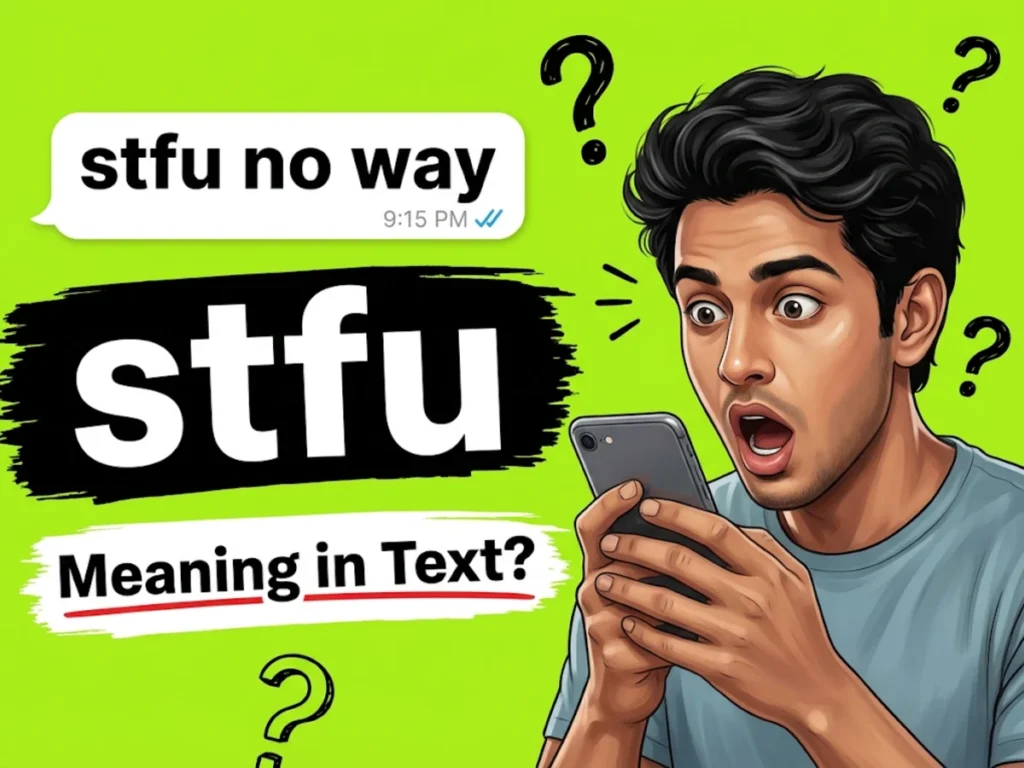
What does STFU mean in a text? It stands for “shut the f*** up,” and it can either tell you to stop talking or, between friends, mean “no way, I can’t believe it!” So if a friend replies “STFU you got the job??”, they’re thrilled for you. However, “stfu, nobody asked” is plainly hostile.
Most people look it up because the same four letters can feel like a slap or a hug. Because the word includes profanity, the stakes of misreading it are higher than with most slang. The good news is that the surrounding words, punctuation, and your relationship with the sender usually make the meaning obvious.
READ MORE: GTFO Meaning: Angry Exit or “No Way” Excitement?
What Does STFU Mean When Someone Texts It to You?
First, First, it’s an acronym for a profane phrase. Merriam-Webster lists STFU as an abbreviation used especially in texts or posts as an emphatic way to say “shut up,” and labels it informal and sometimes offensive. That label matters, because the word can wound or amuse depending on who sends it.
Meaning 1: “Stop Talking”
To begin with, the literal sense is the most common in arguments and public replies. Someone who sends “stfu” mid-fight wants you to stop, and they’re being rude on purpose. Similarly, a curt “STFU” under a post is a dismissal, not an invitation to chat.
Meaning 2: “No Way!”
Among friends, it often expresses surprise. This works because “shut up!” itself has long been used that way out loud. In fact, Merriam-Webster’s entry for “shut up” includes a sense used to express surprise or shock. So the acronym followed by “you’re engaged??” means “I’m amazed,” not “be quiet.”
How It’s Typed
You’ll see it in lowercase, in caps, and occasionally with stretched letters with stretched letters for extra drama. Generally, lowercase feels casual and jokey. All caps can read as shouting in a fight, yet in an excited text it simply adds volume. In addition, some people add a softening word, like “omg stfu,” which nearly always signals surprise.
Reading the Tone: Clues That Tell You Which STFU It Is
- Question marks and exclamation points point to surprise, as in “STFU?!”
- Emojis like 😭, 😂 or 😱 almost always mean the friendly sense.
- A period, or nothing after it, can feel colder, especially in a disagreement.
- Above all, your relationship counts. A best friend reacting to big news is not the same as a stranger in a comment thread.
Here’s a detail that’s specific to this acronym: in the excited sense, it’s usually followed by a repeat of the news. A reply like “omg you got tickets” restates what you just said, because the sender is echoing the surprise. In the angry sense, it tends to stand alone or come with an insult.
STFU Meaning in Four Tones
Funny
A: I finally finished my 1,000-piece puzzle
B: stfu that took you 4 months
A: it’s called patience
B: it’s called a cry for help
Sarcastic
A: I’m going to start waking up at 5 a.m.
B: stfu, you can’t wake up at 10
A: new me
B: I’ll believe it when I see it
Playful
A: guess who just booked Paris
B: STFU 😭
A: two weeks!!
B: bring me back a croissant
Serious
A: can you stop sending me those messages
B: stfu
A: I’m not doing this, I’m muting you
B: (no reply)
Where STFU Shows Up in Messages
For instance, in SMS, iMessage, and WhatsApp, it mostly appears between close friends, and it’s usually the surprised sense. Typically, people are reacting to news, gossip, or something unbelievable a friend just shared.
In Instagram, Snapchat, and Discord DMs, both senses show up. Discord servers, for example, may see the angry version during heated gaming sessions. Meanwhile, in public comment sections on X or TikTok, the hostile sense is more common because people are reacting to strangers.
Grammar and How STFU Fits a Sentence
It works as an interjection or as an imperative verb phrase. In the angry sense, it’s a command: “stfu and listen.” In the surprised sense, it behaves like “wow” or “no way,” usually at the start of a reply: “stfu, really?”
Also, it can stand alone as a full reply. In fact, a single all-caps reply is one of the most common ways people react to shocking news. As for register, it’s strictly informal and contains profanity, so it never belongs in formal writing.
Real Chat Examples of STFU
Best friends sharing news:
A: I got into the program
B: STFU!! congratulations
A: I’m still shaking
B: we’re celebrating tonight
Siblings:
A: mom said you can have the car this weekend
B: stfu are you serious
A: dead serious
B: best sibling ever
A couple bickering, half joking:
A: you snore like a leaf blower
B: stfu 😂
A: I recorded it
B: delete that immediately
Coworkers who are close friends:
A: Dave is leaving the company
B: stfu, since when
A: told me this morning
B: wow, end of an era
An argument between friends:
A: you always do this
B: stfu, I’m done talking
A: fine
B: talk tomorrow
A teen and a parent:
A: Stfu I passed my driving test
B: Language! But congratulations!!
A: sorry, I’m just excited
B: I’m proud of you
Group project partners:
A: the professor extended the deadline
B: stfu no way
A: check your email
B: I could cry
A stranger in DMs:
A: your opinion on that game is trash
B: and you are?
A: stfu
B: blocked
Old friends reconnecting:
A: guess who moved back to town
B: STFU you’re back??
A: as of yesterday
B: coffee this week, no excuses
Roommates:
A: I found $40 in the couch
B: stfu that’s mine
A: finders keepers
B: we’re splitting it
Friends watching a game:
A: he scored from half court
B: STFU
A: rewatching it now
B: unreal
How to Reply When Someone Texts STFU
Funny Replies
- “Make me 😌”
- “Rude. Accurate, but rude.”
Serious Replies
- “Okay, I’m going to give this some space.”
- “I don’t want to be spoken to like that. Let’s talk when we’re calmer.”
Flirty Replies
That said, only use this with someone you’re already close to and only when it’s clearly the joking sense.
- “You love when I talk, admit it.”
- “Never, you’d miss me.”
Neutral or Unbothered Replies
- “Haha I know, right?”
- “Yep, still processing it too.”
STFU Compared With Related Terms
| Term | Meaning | Usage Context | Tone | Popularity | Confusion Risk |
|---|---|---|---|---|---|
| STFU | Shut the f*** up; “no way!” | Friends, arguments, comments | Hostile or excited | High | High |
| GTFO | Get the f*** out; “no way!” | Friends, arguments | Hostile or excited | High | Medium |
| SMH | Shaking my head | Texts, comments | Disapproving | High | Low |
| OMG | Oh my God | Texts, DMs | Surprised | High | Low |
| NFW | No f***ing way | Friends, reactions | Shocked | Moderate | Low |
| TMI | Too much information | Texts, DMs | Mildly uncomfortable | High | Low |
| Go on | Keep talking | Texts and speech | Encouraging | High | Low (the opposite of stfu) |
Is STFU Rude or Offensive?
The acronym contains a profanity, so it can be offensive even when used kindly. In the angry sense, it’s rude by design. In the surprised sense, close friends usually won’t mind, but plenty of people still dislike seeing swearing in texts.
For school and work, therefore, avoid it. Texting it to a boss, teacher, or client is almost never a good idea, even if you mean “wow.” If you want the surprised sense without profanity, “no way,” “shut up!” or “omg” do the same job.
Culturally, attitudes to swearing differ between families and communities. So if you’re unsure how someone feels about it, choose a cleaner word.
Who Uses STFU
Overall, people of many ages use it, but in different ways. Younger texters often lean on the excited “no way” sense with friends. By contrast, older users may only know the literal “shut up” meaning and could take it badly. That gap is why a parent might react to “stfu I passed” with a lecture rather than a high five.
Regionally, meanwhile, it’s used across English-speaking countries. There’s no reliable evidence of a different meaning in the UK, US, or elsewhere.
Where STFU Came From
It’s a written shortcut for a phrase people already said aloud. Like many profane acronyms, it let people swear quickly while typing, and it spread through early online chats and texting. Dictionary.com’s entry cites online examples from 2009 and 2012. As for the surprised sense, it borrows directly from spoken “shut up!”, which English speakers already used to mean “I can’t believe it.”
Why STFU Survives in Texts
The acronym stays popular because it compresses a big reaction into four letters. In real chats, friends reach for it when news is too good or too wild for a calm reply, and the swear word adds intensity that “wow” can’t match. That same intensity is the risk. Because there’s no tone of voice in a text, the word leans on emojis, punctuation, and shared history to land correctly, and when those are missing, an excited reply can read like a fight.
STFU FAQs
Is it rude to reply with just “stfu” in a text?
Ultimately, it depends on the conversation. If a friend just shared exciting news, a lone reply of those letters reads as amazed and supportive. If you’re in a disagreement, the same reply is a clear insult. When in doubt, add an emoji or a follow-up like “congrats!!” so the tone is unmistakable.
What’s the difference between texting STFU and saying it out loud?
Out loud, people rarely spell out the letters. They say “shut up!” or the full profane phrase, and tone of voice makes the meaning obvious. In a text, there’s no voice, so the letters lean on punctuation and emojis. That’s why the typed version is easier to misread than a spoken one.
Does STFU mean the same thing in a group chat vs a 1-on-1 text?
The meanings stay the same, but group chats raise the stakes. A playful “stfu” aimed at one friend can look harsher when everyone else sees it. Meanwhile, in a 1-on-1 text, your shared history makes the joking sense easier to read. If tension is already high in a group, avoid it entirely.
Is STFU a swear word?
Yes, mainly because it abbreviates a phrase containing a swear word. Merriam-Webster labels it informal and sometimes offensive. Many people treat the acronym as milder than the full phrase. Still, it isn’t suitable for school, work, or polite company.
What does STFU mean from a girl or a guy?
Again, the meaning doesn’t change with gender. From anyone, it either means “stop talking” or “no way!” Look at the context, punctuation, and emojis rather than who sent it.
Can I say STFU to my parents?
Generally, no. After all, even in the excited sense, many parents will hear the swear word first. If you’re sharing good news with family, “no way!” or “shut up!” without the extra letters is safer.
What’s a polite alternative to STFU?
Instead, try “no way,” “you’re kidding,” or “omg” for surprise. For the other sense, “please stop” or “I need a break from this conversation” sets a boundary without swearing. Both options keep the message clear without risking offense.
Final Thoughts: What Does STFU Mean?
So, what does STFU mean in a text? It’s either a rude “shut up” or an excited “no way!”, and the context tells you which.
Usage tips:
- Add an emoji or exclamation point when you mean the excited sense.
- Use it only with people who are comfortable with swearing.
- Follow it with a real reaction, like “congrats!!”
- Switch to “no way” with family, teachers, or coworkers.
Common mistakes:
- Assuming every STFU is an insult.
- Sending a bare “stfu” during a tense moment.
- Using it in work or school messages.
- Forgetting that older relatives may only know the literal meaning.
Use it with close friends for big reactions. Avoid it in arguments you want to calm down, and anywhere professional or formal.