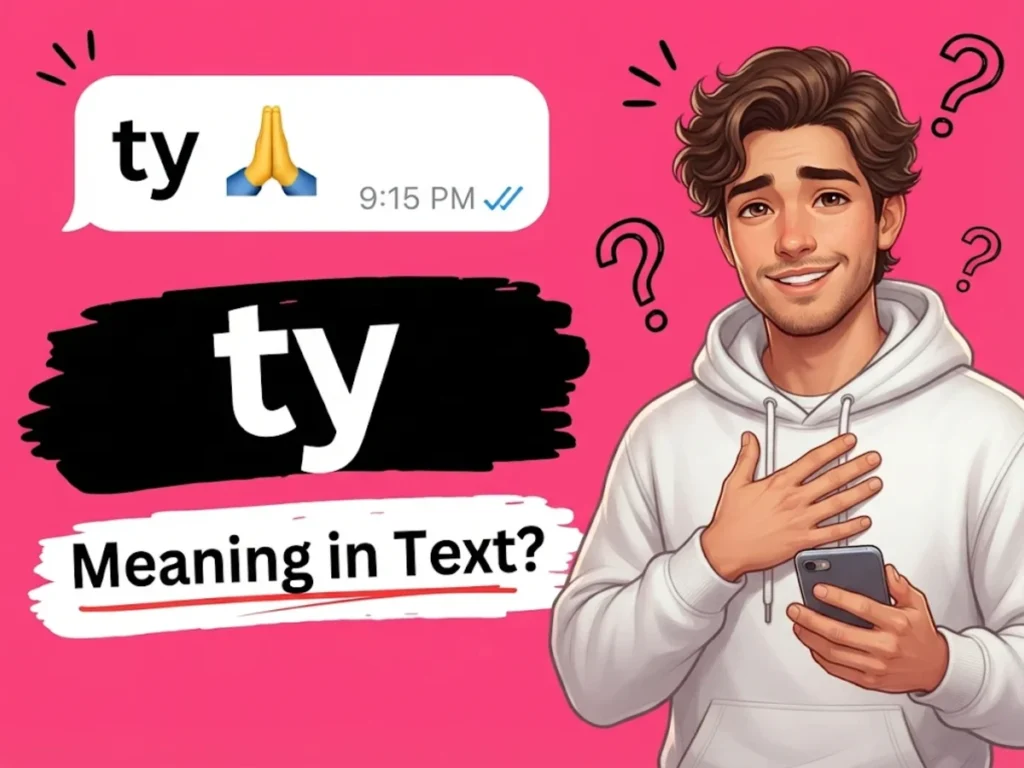
The TY meaning in text is “thank you.” If someone texts you “ty,” they’re thanking you for something you just did, said, or sent. It’s quick, friendly, and one of the oldest abbreviations in chat culture.
Even so, people still search for it. For one thing, sometimes the letters arrive with no context, so it’s easy to wonder if they mean a name or a typo. Other times, the question is about tone: is two-letter gratitude warm or a little lazy? Both answers are below.
READ MORE: YW Meaning in Text — What Does YW Mean?
What TY Means When Someone Texts It
TY is an initialism. Specifically, the T stands for “thank” and the Y stands for “you.” Dictionary.com lists it simply as an acronym for “thank you,” with casual examples from social posts.
Typically, you’ll get it right after you help someone. You send a file, share a recipe, or hold the elevator via text, and back comes “ty!” In short, it closes a small favor neatly.
Other Things TY Can Mean
Outside texting, the letters mean different things. In Ireland, for instance, TY is common shorthand for Transition Year, an optional school year. And “Ty” with a capital T is also a first name. If the message is about school schedules or a specific person, one of these is likely the meaning instead.
Where It Shows Up
The TY meaning stays the same across private messages. You’ll see it in SMS, iMessage, and WhatsApp, as well as Instagram, Snapchat, and Discord DMs. Online game chats use it constantly, especially after a teammate helps out.
TY Meaning Next to Other Ways to Say Thanks
Of course, thanks comes in many sizes online. Here’s how this one compares with its relatives.
| Term | Meaning | Usage Context | Tone | Popularity | Confusion Risk |
|---|---|---|---|---|---|
| TY | Thank you | Small favors, quick replies | Friendly, brief | Very high | Low (also a name) |
| TYSM | Thank you so much | Bigger favors, excitement | Warm, enthusiastic | High | Low |
| THX | Thanks | Casual replies | Very casual | High | Low |
| YW | You’re welcome | Responding to thanks | Polite | High | Low |
| NP | No problem | Responding to thanks | Easygoing | High | Low |
| NTY | No thank you (opposite: declining) | Turning down offers | Polite to blunt | Moderate | Medium |
Is a Two-Letter Thank You Rude?
Not usually, since the TY meaning is plainly polite. Among friends and family, “ty” is perfectly polite. However, size matters with gratitude. If someone spent an hour helping you, a bare “ty” can feel undersized. In that case, “thank you so much” or a full sentence shows real appreciation.
There’s no profanity or hidden meaning here, so it’s fine in school chats. At work, though, it depends. In a quick team chat, “ty” is common. With a manager, client, or teacher, on the other hand, write “Thank you” in full.
Spelling: ty, TY, and tysm
Usually, people type it in lowercase, “ty,” because it’s fast. All caps, “TY,” looks the same in meaning but slightly more emphatic. Adding an exclamation point, as in “ty!”, makes it cheerful.
When people want to sound extra grateful, they stretch it to “tysm,” short for “thank you so much.” Wiktionary records that form as well. Emojis also change the feel: “ty 🙏” reads sincere, while “ty 💕” reads affectionate.
Grammar and Sentence Position
Grammatically, TY works as an interjection, just like “thanks.” It can stand alone as a complete message, and it often does. You can also attach it to a longer sentence: “ty, that helped a lot” or “got it, ty.”
Generally, its natural spot is the start or end of a message. In contrast, putting it mid-sentence feels clumsy. The register is informal, so keep it out of formal emails and official letters.
Real Chat Examples
A friend sharing notes:
A: Sent you the lecture notes
B: ty!! lifesaver
A: you owe me coffee
B: deal, tomorrow
A partner bringing dinner:
A: Picked up your favorite noodles
B: ty babe 🥺
A: extra spicy like you like
B: marry me again
A coworker fixing a file:
A: I fixed the formula in row 12
B: ty, it works now
A: no problem
B: you saved my afternoon
A parent sending money for groceries:
A: Sent $40 for groceries
B: ty mom ❤️
A: buy real vegetables
B: I’ll try
Siblings and a phone charger:
A: Left my charger on your bed
B: ty, mine just died
A: you owe me
B: put it on my tab
A stranger returning a lost wallet:
A: Found your wallet at the café, I’m at the front desk
B: Omg thank you so much, coming now
A: No rush
B: ty again, seriously
Gaming friends:
A: dropped you a med kit
B: ty
A: behind you!
B: got him, ty for the callout
A neighbor watching a pet:
A: Fed the cat, she’s happy
B: ty!! she’s dramatic but grateful
A: she sat on my lap the whole time
B: she likes you more than me
A classmate sharing a link:
A: here’s the form link
B: ty
A: due Friday btw
B: oh no, ty for warning me
A friend recommending a show:
A: Start with episode 3, the first two are slow
B: ty for the tip
A: you’ll thank me
B: already did lol
Four Tones of TY
Funny
A: I ate the last cookie so you wouldn’t have to
B: ty for your sacrifice
A: it was hard
B: a true hero
Sarcastic
A: Reminder: you’re on dish duty
B: wow ty for the reminder 🙃
A: you forgot last week
B: …fair
Playful
A: You look great in that photo
B: ty ty 😌
A: humble too
B: always
Serious
A: I’m here if you want to talk about it
B: ty, that means a lot
A: anytime
B: I’ll call you tonight
How to Reply to TY
After all, thanks rarely needs a long answer. Still, these options cover most moods.
Funny Replies
- “I accept payment in snacks”
- “Put it on my tab”
- “I’ll add it to my list of good deeds”
Serious Replies
- “You’re welcome!”
- “Anytime, happy to help”
- “Of course, let me know if you need anything else”
Flirty Replies
Flirting only fits between partners or people already flirting. For instance:
- “You can thank me in person 😉”
- “Anything for you”
Neutral or Unbothered Replies
- “yw”
- “np”
- “👍”
Who Uses TY
Practically everyone who texts uses it, because gratitude never goes out of style. Teens, college students, and parents all understand it at a glance. Some people, however, prefer “thx” or the full word. That’s mostly personal habit rather than a generational rule.
As for regions, it’s common wherever English is texted. The main regional twist is in Ireland, where TY can also mean Transition Year in school contexts.
Where the TY Meaning Comes From
TY grew out of early chat and texting shorthand, when typing speed and short messages mattered. According to How-To Geek, the related abbreviation NTY spread through message boards and IRC chats, likely as a spin-off of TY. That suggests TY was already familiar in those early online spaces.
Later, phones made it a texting staple. Today it sits alongside “thx” and “tysm” as one of the standard ways to say thanks in a hurry.
How TY Actually Works in Conversations
What’s distinctive about TY is that people scale it to match the favor. A tiny favor gets “ty,” a bigger one gets “tysm,” and a real lifesaver earns “thank you so much!!” in full. As a result, the length of the thanks quietly tells the helper how much it mattered. TY also comes with a built-in reply pattern, since “yw” or “np” usually follows. That neat two-step exchange is a big part of why it never fades.
FAQs About the TY Meaning
What does TY mean from a guy or a girl?
It means “thank you,” regardless of who sends it. The tone comes from context and emojis, not gender. “ty 💕” from a crush feels warmer than a plain “ty.” Read the rest of the conversation for clues.
Is it rude to reply with just “ty” in a text?
For small favors, it’s perfectly fine. For big favors, however, it can feel too brief. Adding a few words, like “ty, that really helped,” fixes that. Matching your thanks to the effort is the easiest rule.
What’s the difference between texting it and saying it out loud?
People don’t say “tee-why” out loud; they just say “thank you” or “thanks.” Spoken thanks carries warmth through your voice. Texted, the two letters rely on emojis or punctuation for warmth. That’s why “ty!” feels friendlier than “ty.”
Does it mean the same thing in a group chat vs a 1-on-1 text?
The meaning doesn’t change. In group chats, though, “ty” often thanks someone for sharing info with everyone. In a 1-on-1 text, it feels more personal. Either way, it’s simple gratitude.
What’s the difference between TY and TYSM?
TY means “thank you,” while TYSM means “thank you so much.” So TYSM signals bigger gratitude or excitement. People use it for larger favors or good news. Think of it as the upgraded version.
How do you respond to TY?
Common replies include “yw,” “np,” and “anytime.” You can also use an emoji, like 👍 or 😊. For more formal contacts, “You’re welcome” works best. Often, though, no reply is needed at all.
Is TY professional?
In casual workplace chats, many people use it. In emails or with senior colleagues, however, write “Thank you” instead. Spelling it out shows extra care. When unsure, choose the full words.
Final Thoughts on TY Meaning in Text
To sum up, the TY meaning in text is “thank you,” a fast and friendly way to show gratitude. It works best for small favors and casual chats.
Usage Tips
- Use “ty” for small favors and quick help.
- Upgrade to “tysm” or a full sentence for bigger favors.
- Add an emoji like 🙏 or ❤️ for extra warmth.
- Spell it out in professional messages.
Common Mistakes
- Sending a bare “ty” after someone went far out of their way.
- Using it in formal emails.
- Confusing it with NTY, which means “no thank you.”
- Assuming “Ty” is always thanks when it may be a name.
When to Use It and When to Avoid It
Use it with friends, family, classmates, and casual coworkers. On the other hand, avoid it in formal messages or after a big kindness, where full words show real appreciation.