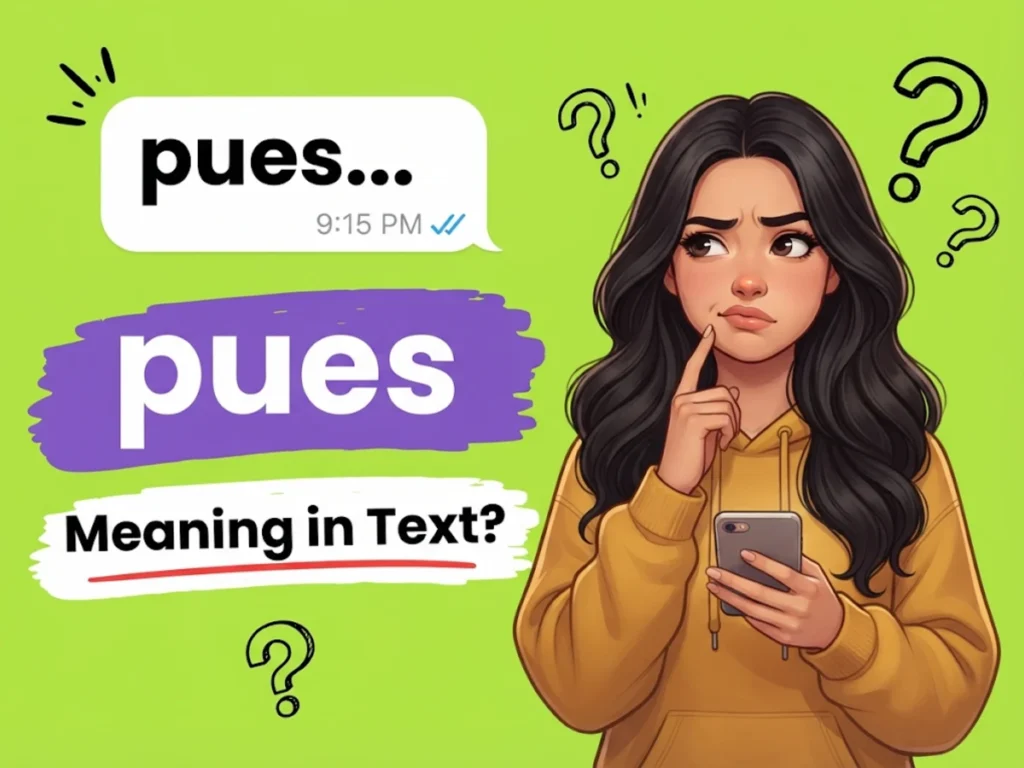
The pues meaning in text is “well,” “so,” “then” or “because,” depending on where it lands in the message. It’s a real Spanish word, not slang, and texters use it constantly. So if a friend replies “pues… no sé,” they mean “well… I don’t know.” If they write “vamos, pues,” they mean “let’s go, then.”
People search it because the word is tiny but slippery. English speakers in bilingual group chats see it everywhere and can’t pin it down, while Spanish learners know the textbook “because” and then find it doing something else entirely. Below, each job pues does is broken down with real chat examples, so you can read it correctly and use it yourself.
READ MORE: Wey Meaning in Text: Slang Meaning, Examples & Usage Guide
Pues Meaning in Text: The Four Jobs It Does
Pues is a Spanish conjunction and adverb. It isn’t an acronym or an abbreviation, so there’s nothing to expand. However, it shifts meaning with position, and the senses below run from most to least common in casual chats.
“Well…” at the start of a reply
This is the version you’ll see most in texts. When pues opens a reply, it works like the English “well,” buying a second before an answer. For example, “pues claro” means “well, of course.” That exact example appears in the Cambridge Spanish–English dictionary entry for pues, which lists “well” as the emphatic sense used when answering a question.
“So” or “then” to show a result
Next, pues can link a situation to what follows from it. “You’re coughing a lot? Pues go to the doctor” uses it as “so” or “then.” At the end of a sentence, it often means “then,” as in “¿nos vamos, pues?” (“shall we go, then?”).
“Because” or “since”
In more careful writing, pues explains a reason: “no fui, pues estaba enfermo” (“I didn’t go, because I was sick”). You’ll see this sense less in quick texts, though. Most people reach for “porque” instead when they mean “because.”
A filler while thinking
Finally, pues can just fill a pause. “Pues… no sé” is the text version of a shrug. Here, it carries hesitation more than meaning.
Where you’ll actually see it
On WhatsApp, SMS and iMessage, pues shows up in everyday chats between Spanish speakers and in bilingual threads. It also appears in Instagram and Snapchat DMs, mostly as a quick opener or closer. In most cases, people type it lowercase, and they often add ellipses (“pues…”) to show they’re thinking. A casual spelling, “pos,” also turns up in informal chats, and it means the same thing.
How Pues Works in a Sentence
Grammatically, pues is a conjunction when it connects ideas and an adverb when it adds emphasis. That’s why its position matters so much. At the start of a reply, it softens or emphasizes. In the middle of a sentence, it connects a cause to a result. At the end, it nudges someone along, like “then.”
Can it stand alone? Yes, but only in a specific way. A lone “pues…” means “well…” with a pause, often because the person disagrees or doesn’t want to commit. As a result, a one-word “pues” reply usually signals hesitation, not agreement.
Capitalization barely matters. “Pues” and “pues” read the same, while “PUES” just adds volume, often in a playful “SO?!” sense. Since it’s an ordinary Spanish word, it fits both informal and fairly formal writing. Still, the filler use belongs in casual chat only.
Pues Meaning in Text by Tone
The same word sounds very different depending on mood. Here’s how it shifts across four common tones.
Funny
A: did you eat my leftover tacos
B: pues… define “your” tacos
A: they had my NAME on them
B: pues I didn’t read it 😇
Sarcastic
A: I’m going to start the diet tomorrow
B: pues sure, like last Monday
A: this time is different
B: pues ok 🙂
Playful
A: guess what I bought
B: pues tell me
A: concert tickets for both of us
B: PUES LET’S GOOO
Serious
A: I think I should tell him how I feel
B: pues if you’re sure, do it
A: I’m scared it’ll be awkward
B: pues awkward is better than wondering forever
Real Chat Examples of the Pues Meaning in Text
These ten exchanges cover different relationships. In each one, notice where pues sits, since that tells you which meaning it carries.
1. Mom checking in
A: Mom: ¿ya comiste?
B: pues no, I just got home
A: Mom: pues come algo
B: ok ok
2. Best friends making plans
A: movie or dinner
B: pues why not both
A: rich behavior
B: pues it’s Friday
3. Partners deciding
A: where do you want to eat
B: pues you pick this time
A: you always say that
B: pues because you always pick well
4. Coworkers on WhatsApp
A: the client moved the meeting to 3
B: pues we’ll need the slides by 2
A: on it
B: thanks
5. Siblings
A: can I borrow your charger
B: pues where’s yours
A: lost it
B: pues buy another one lol
6. Classmates
A: did you study for the quiz
B: pues… a little
A: so no
B: so no
7. Stranger selling a bike
A: is it still available?
B: sí, pues come see it today if you want
A: 5pm works?
B: perfect
8. Cousins in a bilingual family chat
A: are we doing Christmas at grandma’s
B: pues that’s what she said
A: I’ll bring the flan
B: pues bring two
9. Friend asking for advice
A: should I take the job
B: pues does it pay more?
A: a lot more
B: pues there’s your answer
10. Roommates
A: we’re out of coffee
B: pues let’s go, then
A: now?
B: vamos, pues
How to Reply When Someone Texts Pues
Your reply depends on whether their pues was a hesitation, a nudge or a cheer.
Funny replies
- “Pues… that’s not an answer 😂”
- “The ‘pues…’ is doing a lot of work there.”
- “Pues pues pues. Spit it out.”
Serious replies
- “Take your time, no rush.”
- “Okay, what’s making you unsure?”
- “Got it, so we’re going?”
Neutral or unbothered replies
- “Pues ok.”
- “Bueno.”
- “Dale.”
As for flirty replies, pues isn’t a flirty word by itself. If the conversation is already flirty, the tone comes from everything around it, not from pues.
Pues Meaning in Text Compared With Similar Words
These words get confused with pues because they all connect thoughts. The table below shows the differences.
| Term | Meaning | Usage Context | Tone | Popularity | Confusion Risk |
|---|---|---|---|---|---|
| Pues | Well / so / then / because | Replies, nudges, explanations | Neutral to emphatic | Very high | High (many senses) |
| Pos | Casual spelling of pues | Fast, informal texts | Relaxed | Medium | Medium |
| Bueno | Well / okay / good | Starting a reply, agreeing | Neutral | Very high | Medium |
| Entonces | So / then | Drawing a conclusion | Neutral | High | Low |
| Porque | Because | Giving a reason | Neutral | Very high | Low |
| Aunque (contrast) | Although / even though | Introducing an objection | Neutral | High | Low |
Aunque is the contrast pick here. Pues leads to a result, whereas aunque introduces a “but.”
Who Uses Pues in Texts
Spanish speakers of every age use pues, since it’s a standard word rather than a trend. That makes it different from most slang on this site, which rises and fades with a single generation. Grandparents and teenagers type it in exactly the same way.
In English-language chats, it mostly appears in bilingual conversations. People who switch between English and Spanish often drop pues into English sentences because it does a job no single English word does. Meanwhile, Spanish learners use it as soon as they notice native speakers leaning on it.
Where Pues Comes From
Pues comes from the Latin “post,” meaning “after.” Over time, that sense of “what comes after” turned into “what follows from this,” which explains the “so” and “then” meanings. In other words, the word’s history is still visible in how people use it today.
It isn’t internet slang, and it didn’t come from memes or TikTok. Instead, texting simply carried an old spoken habit into chat. People say “pues…” out loud while thinking, so they type it the same way.
Is Pues Rude or Inappropriate?
Pues isn’t rude, profane or explicit. It’s a normal word you can use with a teacher, a boss or your grandmother. That said, tone can still sting. A flat “pues ok” after a long message can read as cold, much like a dry “ok” in English.
At work, pues is perfectly fine in Spanish messages. However, if your boss doesn’t speak Spanish, mixing it into an English email may just confuse them. Also, keep the filler “pues…” for casual chats rather than formal writing.
What “Pues…” Really Signals in a Chat
Here’s the detail that trips people up: when pues opens a reply, the answer that follows often pushes back. “Pues, I don’t think so” or “pues, it depends” is far more common than “pues, yes!” So a reply that starts with “pues…” is usually a soft warning that the person is about to disagree or hedge. That’s also why it lasts in texting. It lets people slow down a response without sounding rude, which plain text otherwise makes hard.
Pues Meaning in Text: FAQ
Is it rude to reply with just “pues” in a text?
It isn’t rude, but it can feel vague. A lone “pues…” often means “well, I’m not sure,” so the other person may wonder what you really think. If they asked something important, add a few words. Otherwise, they might read hesitation you didn’t intend.
What’s the difference between texting pues and saying it out loud?
Out loud, tone of voice tells you whether pues means “well,” “so” or “come on.” In text, you lose that tone, so punctuation does the work instead. “Pues…” with dots signals thinking, while “pues!” reads as emphatic. As a result, the same word can look more hesitant on a screen than it sounds in person.
Does pues mean the same thing in a group chat vs a 1-on-1 text?
The meaning stays the same in both. However, in group chats it often nudges the whole group, as in “vamos, pues” to get everyone moving. In one-on-one texts, it’s more often a thinking pause before a personal answer. Either way, the position in the sentence still decides which sense you’re reading.
Is “pos” the same as pues?
Yes. “Pos” is a casual spelling of pues that shows up in informal Spanish texting. It means exactly the same thing, so treat it as a relaxed version rather than a new word. Just avoid it in formal messages, where the standard spelling looks more polished.
Is pues a slang word?
No, pues is standard Spanish found in every major dictionary. It only feels like slang because English speakers usually first meet it in casual chats. In fact, you’ll also find it in books, news writing and formal speeches.
What does “pues claro” mean in a text?
It means “well, of course” or “obviously.” People use it to answer a question with a clear yes, often with a little emphasis. For example, “¿vienes?” (“are you coming?”) might get “pues claro” in reply.
Can I use pues if I’m not a native Spanish speaker?
Yes, and it’s a great word to start with. It instantly makes your Spanish sound more natural, especially at the start of replies. Just make sure you use it in the right spot, because “pues” in the wrong position can sound a little odd.
Final Thoughts on the Pues Meaning in Text
In short, the pues meaning in text is “well,” “so,” “then” or “because,” and its position in the sentence tells you which one you’re reading. It’s ordinary Spanish, not slang, and it’s never rude by itself.
Tips for using pues
- Use it at the start of a reply to sound more natural.
- Put it at the end (“vamos, pues”) to nudge someone along.
- Add dots (“pues…”) when you want to show you’re thinking.
- Use “pos” only in very casual chats.
Common mistakes to avoid
- Reading “pues…” as agreement when it usually signals a hedge.
- Sending a lone “pues ok” after a long, heartfelt message.
- Using it with someone who doesn’t understand Spanish.
- Treating it as an acronym; it’s a full word.
Use pues whenever you’d say “well” or “so” in a casual Spanish or bilingual chat. On the other hand, skip the filler version when you need a clear, direct answer.