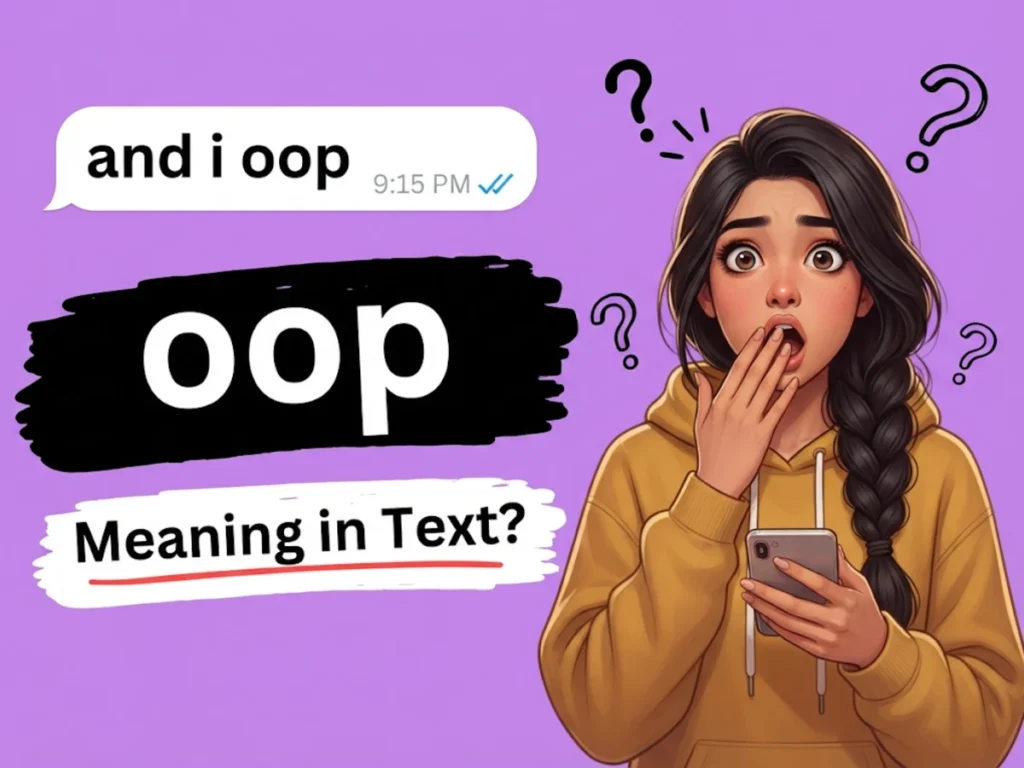
Oop meaning in text: it’s a tiny reaction word that signals surprise, mild embarrassment, or “well, that was awkward.” If someone texts you “oop,” they’ve just noticed something unexpected, whether that’s a mistake they made, a juicy bit of gossip, or a message that landed weirdly.
In fact, most people search it because the word looks like a typo. Was “oops” cut short? Is it a meme? Both guesses are partly right. Below, you’ll find the real meaning, where the famous “and I oop” came from, and how to answer without missing the joke.
READ MORE: Womp Meaning in Text: The Sad Trombone You Can Type
Oop Meaning in Text: A Quick Definition
Oop isn’t an acronym, so there’s nothing to expand. Instead, it’s an interjection, like “oops,” “ope,” or “whoa.” Dictionary.com describes it as a word used to show surprise or to acknowledge a mistake.
Overall, there are three common shades:
- Surprise: reacting to unexpected news or a plot twist in the chat.
- Self-catch: owning a small slip, like a typo or sending the wrong photo.
- Awkward pause: noticing tension, for example after someone overshares.
In practice, the first two make up most texts. The third is subtler; it often works as a polite way to say “I see what just happened here.”
The Story Behind “And I Oop”
The longer phrase has a clear starting point. According to Dictionary.com’s write-up on “and I oop”, it comes from drag queen Jasmine Masters, who competed on RuPaul’s Drag Race. In an October 2015 YouTube video, she interrupted her own rant with a sudden “and I oop” after a small mishap.
Years later, in March 2019, the clip spread on Twitter as a reaction to near-slip-ups. Then, by summer 2019, the phrase became tied to the “VSCO girl” stereotype, often alongside “sksksk.” As a result, a moment from drag culture turned into a mainstream reaction word.
Today, many people also drop the “and I” and just type “oop.” The meaning barely changes, although the full phrase feels more theatrical.
How People Type It
Spelling stays fairly consistent, but small changes add flavor:
- “oop” is the plain, everyday form.
- “OOP” in caps feels louder, like a real gasp.
- “oop-” with a dash suggests being cut off mid-thought.
- “oopsie” or “oops” is the older, softer relative.
In general, it lives mostly in casual texting. For instance, on iMessage and WhatsApp, it appears in replies to screenshots, gossip, or slip-ups. Similarly, in Instagram and Snapchat DMs, it often answers a story reply that went somewhere unexpected. Likewise, Discord servers use it when someone accidentally pings the wrong channel.
How Tone Shifts the Oop Meaning
Funny
A: i just waved at someone who was waving at the person behind me
B: oop 💀
A: i’m moving to another country
Sarcastic
A: i definitely didn’t eat your leftovers
B: then why is there sauce on your shirt
A: oop
Playful
A: you looked cute in that story btw
B: oop, didn’t expect that 😳
A: just saying
Serious
A: i think i accidentally told her about the surprise party
B: oop. ok, how much did she hear?
A: enough. help me fix this
Everyday Conversations With Oop
Friends sharing gossip:
A: guess who’s dating again
B: tell me
A: your ex
B: oop
Coworkers in a team chat:
A: that email went to the whole company
B: oop, wasn’t that just for the managers?
A: yes. yes it was
Siblings:
A: mom found your report card
B: oop
A: good luck at dinner
Partner apologizing:
A: you forgot our anniversary dinner reservation?
B: oop… i’m so sorry, rebooking now
A: you better
Parent texting:
A: Did you take the car keys?
B: oop, they’re in my bag
A: Bring them back please
Group project:
A: who submitted the draft with the placeholder text?
B: oop that was me
A: we can fix it before friday
Gaming friends:
A: you just knocked me off the map
B: oop my bad
A: revenge incoming
Roommates:
A: why is there glitter everywhere
B: oop. craft night got out of hand
A: vacuum is in the closet
New acquaintance:
A: wait, you’re friends with my cousin?
B: oop small world
A: seriously
Best friends after a text slip:
A: you just sent that to me instead of him
B: OOP
A: i’m screenshotting this forever
Grammar Behind the Oop Meaning
As an interjection, oop doesn’t need a subject or verb. Therefore it can stand alone as a full reply, and it often does. It also sits at the start of a sentence, followed by a comma or ellipsis: “oop, wrong chat.”
Similarly, capitalization changes intensity, not meaning. For example, “oop” feels casual, while “OOP” signals real shock. Because it’s so playful, it belongs only in informal register; it would look odd in a work email or school assignment.
Replying to Oop
Of course, the best reply depends on what triggered it.
- Funny: “oop is right, i’m framing this moment”
- Serious: “No worries, mistakes happen. Want help fixing it?”
- Flirty: “oop indeed, guess you’ll have to make it up to me 😏”
- Neutral: “lol it’s fine”
Generally, a light reply works best, since the oop meaning itself is light. However, if it follows a real mistake, reassurance is kinder than teasing.
Oop vs Similar Reaction Words
Here’s how the oop meaning compares with other surprise words people search.
| Term | Meaning | Usage Context | Tone | Popularity | Confusion Risk |
|---|---|---|---|---|---|
| Oop | Surprise or small mistake | Gossip, slip-ups | Playful | High | Medium (looks like a typo) |
| Oops | Admitting a mistake | Everyday errors | Light | Very high | Low |
| Ope | Mild surprise, “excuse me” | Bumping into things, interruptions | Polite | Medium | Medium |
| Womp | Disappointment | Letdowns | Sarcastic | Medium | Low |
| Yikes | Alarm or second-hand cringe | Bad news, awkward moments | Concerned | High | Low |
| Nice | Approval (opposite reaction) | Good news | Positive | Very high | Low |
Who Types Oop?
The word took off on Twitter in 2019, so it’s most familiar to people who were deep in meme culture at that time, which skews toward Gen Z and younger millennials. Because of the VSCO-girl link, some people still connect it with teen girls, although everyone uses it now. Meanwhile, older texters are more likely to type “oops.”
Also, its spread came through English-language Twitter and YouTube culture rather than a single country. So, you’ll see it wherever people share those memes.
Is Oop Rude or Inappropriate?
No. In fact, it isn’t profane, explicit, or insulting. Still, timing matters.
- At work, “my mistake” sounds more professional.
- After someone shares bad news, “oop” can seem flippant.
- With teachers, skip it and write a full sentence.
Culturally, it’s worth knowing the phrase came from drag culture through Jasmine Masters. So, treat its origin with respect, and avoid using it to mock anyone.
What Makes Oop Stick
The clever thing about oop is that it lets people react without judging. Unlike “omg” or “yikes,” it doesn’t say whether the news is good or bad; it simply marks the moment. That neutrality makes it perfect for gossip, since you can respond without picking a side. It also gives people an easy way to own small mistakes, so a slip-up becomes a joke instead of a big apology. In fact, a single “oop” often ends a potential argument before it starts.
FAQs About the Oop Meaning
Is it rude to reply with just “oop” in a text?
Usually not, because a lone “oop” reads as a quick, honest reaction. However, if someone just shared something painful, it can feel dismissive. In that case, follow it with a kinder message.
What’s the difference between texting oop and saying it out loud?
Out loud, “oop” is often a reflex, like when you nearly bump into someone. In a text, by contrast, it’s a deliberate choice, so it reads more like commentary. That’s why texted versions often feel a little sassier.
Does oop mean the same thing in a group chat vs a 1-on-1 text?
The core meaning is the same. In a group chat, though, it often reacts to gossip or someone else’s slip, which can feel like playful teasing. In a private chat, it’s more often about your own mistake or a personal surprise.
Is oop short for oops?
Not exactly, although they’re close cousins. Oops focuses on admitting an error, while oop also covers surprise and awkwardness. Plus, the popular “and I oop” phrase gave oop its own meme history.
What does “and I oop” mean?
In short, it’s a dramatic way of saying “whoa, didn’t see that coming” or “oh no, I messed up.” The phrase traces back to Jasmine Masters’ 2015 video. Today, people use it for comic shock.
Is oop still used in 2026?
Yes, it’s still common in casual texts and DMs. The meme peak has passed, but the word itself settled into everyday chat. Indeed, most people now use it without thinking about the original clip.
Is oop the same as ope?
They overlap but aren’t identical. For instance, ope is often a polite “excuse me” when you bump into someone. Oop leans more toward surprise and gossip reactions.
Final Thoughts on the Oop Meaning
In summary, oop is a small, flexible reaction word for surprise, slip-ups, and awkward moments. Its most famous form, “and I oop,” came from drag queen Jasmine Masters before spreading online in 2019.
Usage tips:
- Use it to own small mistakes with humor.
- React to gossip without taking sides.
- Try caps for a bigger gasp.
- Follow up when the moment calls for a real response.
Common mistakes:
- Replying “oop” to serious bad news.
- Using it in work emails.
- Assuming it’s always a typo for “oops.”
- Forgetting the word’s roots in drag culture.
So, use it with friends for light surprises and slip-ups. Avoid it when someone needs support or a clear answer.