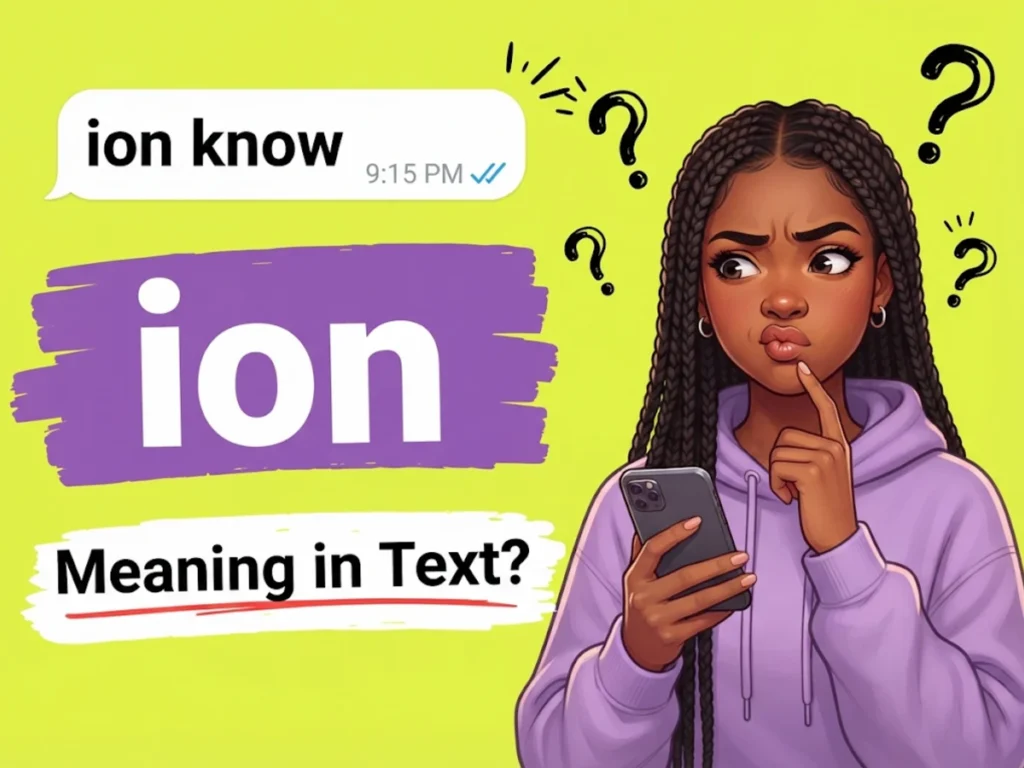
The ion meaning in a text message, on an iPhone or any phone, is almost always “I don’t.” So if someone texts you “ion know” or “ion care,” they mean “I don’t know” or “I don’t care.” In other words, it is slang spelled the way the phrase sounds when it’s said fast, not a chemistry term. Less often, however, capitalised “ION” stands for “in other news.”
People search for it because it is a real dictionary word with a completely different meaning, so a message like “ion even want to go” can look like nonsense the first time. On an iPhone, it can be even more confusing because the keyboard often capitalises it to “Ion” at the start of a message, which makes it look like a name. Still, once you read it out loud, it usually clicks.
READ MORE: Idek Meaning: What It Means in Text
Ion Meaning in Text Messages: The Two Versions
1. ion = “I don’t” (the one you’ll see most)
This is slang rather than an acronym. It squeezes “I don’t” into one word, mirroring relaxed speech where the “d” and “t” sounds nearly disappear. However, Also, it almost never appears alone. Instead, it sits in front of a verb: “ion know,” “ion care,” “ion think so,” “ion get it.”
2. ION = “in other news”
This one is an acronym, and it works as a topic-changer. For example, someone finishes one subject and jumps to another: “ION I finally booked the dentist.” Even so, it is far less common in everyday texting than the “I don’t” meaning, and it tends to be written in capitals.
The quick test: if a verb comes right after it, it means “I don’t.” If it opens a new subject, it is probably “in other news.”
Where Ion Comes From
According to Dictionary.com’s slang entry for ion, the spelling is based on the colloquial pronunciation of “I don’t,” especially in Black English, and it started showing up in online writing in the 2000s. In other words, it is a written version of how many people, particularly in African American Vernacular English (AAVE), actually say the phrase.
That matters because ion isn’t a lazy misspelling; rather, it records real speech. From there it moved through music and social media into group chats far from where it started. Dictionary.com points to Memphis rapper Moneybagg Yo’s 2018 song “Ion Get You” as one example of the spelling in mainstream culture. For that reason, it is good practice to know that background, and to avoid using it as a put-on “accent.”
Ion in a Text Message on iPhone (and Other Keyboards)
This is where the iPhone part of the ion meaning in text message searches comes in. Because “ion” is a normal English word, spellcheck has no reason to flag it, and autocorrect usually leaves it alone. What iOS does do, however, is capitalise the first word of a message, so “ion know” often arrives as “Ion know.” In other words, that capital I is just the keyboard, not a sign of a name or the acronym.
There is also a small trap: on a standard QWERTY keyboard, “i” and “o” sit right next to each other. As a result, now and then “ion” is a fat-finger typo for “on” or “in” (“I’m ion my way”). If “I don’t” makes no sense in the sentence, a typo is the likely explanation.
Outside the iPhone question, you’ll mostly meet it in SMS and iMessage, WhatsApp, and DMs on Instagram, Snapchat and Discord. Meanwhile, spellings vary a little: “ion,” “Ion,” and sometimes “iont” or “ian” for the same idea, though “ion” is the most common.
Ion Meaning in Text, Shown in Real Message Threads
Best friends deciding on dinner
A: pizza or tacos
B: ion care just feed me
A: tacos it is
B: perfect
Partner, mild tension
A: you seemed off at dinner
B: ion know, just tired I think
A: want to talk about it
B: maybe tomorrow. thanks for asking
Coworker, direct message
A: do you know where the Q3 slides are
B: ion have them, check with Priya
A: will do
B: she uploaded something Friday
Mom and teenager
A: what does “ion” mean? you keep sending it
B: I don’t. like ion know = I don’t know
A: why not just type the d and t
B: it’s faster mom
Older brother and younger sister
A: are you coming to Grandpa’s Sunday
B: ion think I can, I have a shift
A: he’ll ask about you
B: tell him I’ll call him tonight
Stranger, buying something online
A: does the couch have any stains
B: ion think so, it’s been in the guest room
A: can you send a close-up of the cushions
B: sure, one sec
Group chat, topic change
A: anyway that’s why I’m never camping again
B: valid
A: ION I got the apartment!!!
C: WAIT congrats
Friend venting
A: he left me on read again
B: ion get why you still text him
A: me neither honestly
B: mute him for a week, see how you feel
Roommates
A: did you pay the wifi bill
B: ion remember doing it
A: so no
B: so no. paying it now
Gaming squad on Discord
A: we running ranked tonight
B: ion know, my internet’s been lagging
A: try a restart
B: if it works I’m in
Dating app match
A: favorite movie?
B: ion have one, I rewatch the same 5
A: ok that’s a better answer anyway
B: name yours then
Ion in Four Different Tones
Funny
A: what’s your 5 year plan
B: ion even have a 5 minute plan
A: respect
B: currently planning a snack
Sarcastic
A: did you eat my leftovers
B: ion know what you’re talking about
A: there’s sauce on your shirt
B: circumstantial evidence
Playful
A: admit you missed me
B: ion miss anybody
A: you texted me first
B: ok that was a strategic text
Serious
A: are you ok? you left early
B: ion feel great tbh
A: want me to bring anything over
B: maybe soup. thank you
How to Reply to Ion
Because “ion” is just part of a sentence, you’re really replying to the whole message, not the word. Some options:
Funny
- To “ion know”: “Me neither, let’s both guess.”
- To “ion care”: “Bold. I respect it.”
Serious
- “That’s ok, want me to find out?”
- “Fair. Let me know if you change your mind.”
Flirty (only if it fits the chat)
- To “ion miss you”: “Your double text says otherwise.”
Neutral or unbothered
- “ok”
- “no worries”
- “fair enough”
How Ion Works Grammatically
Ion functions as a contraction of a pronoun plus a negative helper verb, like “I don’t.” So it needs a verb after it: “ion know,” “ion want,” “ion like.” Consequently, it can’t really stand alone as a full reply. If someone asks “you coming?” and you send just “ion,” it reads as cut off. The one exception is the acronym ION, which opens a sentence on its own.
Capitalisation doesn’t change the meaning of the “I don’t” version. “ion” and “Ion” are the same; the capital is usually the phone. All caps “ION” leans towards “in other news.” Above all, it is strictly informal. Keep it out of emails, applications and anything you’d send to a boss or teacher.
Ion vs Similar Terms
| Term | Meaning | Usage Context | Tone | Popularity | Confusion Risk |
|---|---|---|---|---|---|
| ion | I don’t | Casual texts and DMs, before a verb | Relaxed | High | High: also a real word and an acronym |
| ION | In other news | Changing the subject | Light, chatty | Low to moderate | Medium |
| IDK | I don’t know | Any uncertain answer | Neutral | Very high | Low |
| IDC | I don’t care | Showing indifference | Can be blunt | High | Low |
| IDEK | I don’t even know | Extra confusion or frustration | Exasperated | Moderate | Low |
| IK | I know | Agreeing or confirming | Neutral | High | Low: opposite of “ion know” |
Who Uses Ion
Ion’s roots are in Black American speech, and it reached a wider audience through music and social media. Today it turns up most in younger people’s texts: Dictionary.com notes it “baffles many a high school teacher,” which tells you who tends to send it. Gen Z texters often use it without thinking twice, while many Millennials recognise it but still type “idk” or the full phrase. Wherever you see it, whether in a text message on an iPhone, on WhatsApp or in DMs, the ion meaning stays “I don’t”; the acronym version is simply rarer.
Is Ion Rude or Inappropriate
No. Ion isn’t offensive or explicit. Instead, the only thing that can sound rude is what follows it: “ion care” can feel cold if someone shared something important. Even so, because it’s casual, skip it with teachers, managers and clients.
There’s also a cultural point. Ion comes from AAVE, and some people find it uncomfortable when others use AAVE spellings as a joke or a costume. In short, using it naturally in casual texts is common; mocking the way people speak is not.
What Makes Ion Stick
Ion is durable because it does exactly what texting rewards: it turns a phrase people say constantly into one quick word, and it keeps the rhythm of speech. “ion know” reads like the way a friend actually talks, while “I do not know” sounds stiff. Interestingly, its biggest weakness, looking like a science word, hardly matters to regular users. Once you’ve learned it, your brain reads “ion” as sound, not spelling, which is why people who use it rarely notice the double meaning at all.
Ion Meaning in Text: Questions People Ask
Is it rude to reply with just “ion” in a text?
A lone “ion” usually looks unfinished, because it needs a verb after it. As a result, most people would assume you meant “ion know” and sound a bit dismissive. If you mean “I don’t know,” type “ion know” or “idk.” If the conversation matters to the other person, a full sentence is kinder.
What’s the difference between texting ion and saying it out loud?
Out loud, “ion” is simply how many people pronounce “I don’t” in fast, relaxed speech. In fact, nobody hears it as slang. In text, writing it that way is a deliberate choice that signals a casual, conversational tone. Written down, moreover, it’s more confusing, because readers may see the chemistry word first.
Does ion mean the same thing in a group chat vs a 1-on-1 text?
Yes, lowercase “ion” means “I don’t” in both. The main difference, though, is that in group chats you’re more likely to see capital “ION” used as “in other news,” because group conversations jump between topics. In a one-on-one text, “ion” is nearly always “I don’t.”
Why does my iPhone change ion to Ion?
iOS automatically capitalises the first word of a sentence. Because “ion” is a real dictionary word, the keyboard treats it as normal text and capitalises it at the start of a message. Either way, it doesn’t change the meaning. You can turn off auto-capitalisation in your keyboard settings if it bothers you.
Is ion an acronym?
The common one isn’t. “ion” for “I don’t” is a phonetic slang spelling. Only “ION,” meaning “in other news,” is an acronym. In practice, whether ion shows up in a text message on an iPhone or anywhere else, its meaning depends on context, especially whether a verb follows.
What does “ion even know” mean?
It means “I don’t even know.” People use it to show confusion or frustration, like “ion even know why I’m awake.” It’s close in meaning to IDEK. In this case, the “even” adds emphasis.
Can ion be a typo?
Sometimes. The “i” and “o” keys sit next to each other, so “ion” can slip out when someone meant “on” or “in.” So if reading it as “I don’t” makes the sentence strange, assume a typo.
Wrapping Up Ion
The ion meaning in a text message is “I don’t,” written the way it sounds, whether it lands on an iPhone or an Android. Capital “ION” occasionally means “in other news.” On iPhones it often shows up as “Ion” simply because of auto-capitalisation.
Usage tips
- Always follow it with a verb: “ion know,” “ion think so.”
- Keep it for friends, family and casual chats.
- Use “ION” in caps only if you mean “in other news.”
- Add a full sentence when the topic is serious.
Common mistakes
- Sending “ion” alone as a reply.
- Using it in work emails or messages to teachers.
- Reading every “Ion” as a name because of the capital.
- Using it to imitate or mock AAVE speakers.
When to use it: quick, relaxed texts where “I don’t” fits naturally. When to avoid it: formal messages, people who may not know slang, and moments where “ion care” could hurt.