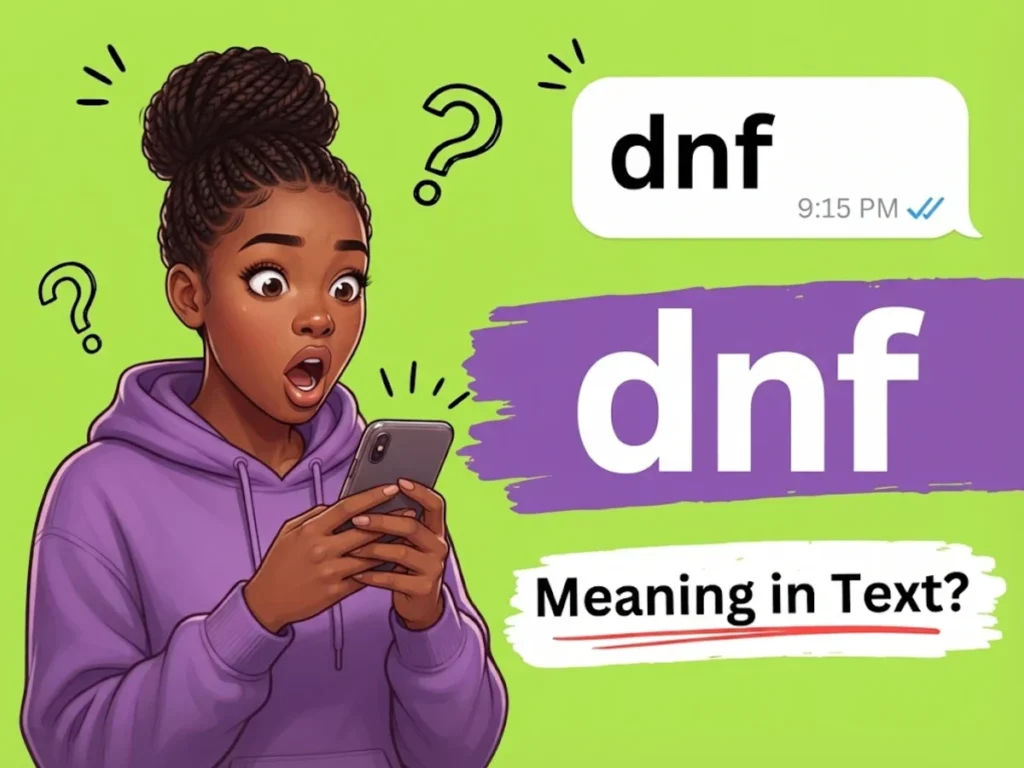
The DNF meaning in text is “did not finish.” People use it when they quit something before the end, whether that is a race, a book, a show or even a plan for the night.
If your friend texts “I DNF’d that book,” they stopped reading partway through. Likewise, “DNF at mile 18” means they dropped out of a marathon. Readers and runners use it constantly; therefore, the term confuses people who meet it outside those circles. On top of that, it looks a lot like DNI, which means something else entirely.
READ MORE: DNI Meaning in Text — What Does DNI Mean?
Where This Shorthand Comes From
DNF started in sports, not texting. Dictionary.com defines DNF as an abbreviation for “did not finish,” used especially for a race or sporting event. Indeed, it appears in results tables for Formula 1, marathons, triathlons and skiing whenever an athlete starts but doesn’t cross the line.
Later on, readers borrowed it. Goodreads even has a “DNF” shelf described as a place for books that were started but not read to the end. Consequently, the term now moves easily between race results, book reviews and ordinary chats.
DNF Meaning: Noun, Verb and Everything in Between
DNF is an abbreviation, so you read it as “did not finish.” What makes it interesting, though, is how flexible it has become in grammar.
- As a noun: “That race was my first DNF.” Here it names the event of not finishing. The plural is “DNFs.”
- As a verb: “I’m going to DNF this book.” In the past tense, people write “DNF’d,” “DNFed” or “dnfed.”
- As a label: “Book 3: DNF” in a reading list or review, which is common in posts and chats about books.
It can stand alone as a full reply. For instance, if someone asks “did you like that thriller?”, a one-word “dnf” answers the question completely. Capital letters are standard; still, lowercase “dnf” is just as common in casual texts and doesn’t change the meaning.
DNF in Texts, DMs and Group Chats
In SMS, iMessage and WhatsApp, the term mostly turns up between friends who read or run together. A quick “dnf, too slow” after someone asks about a book is typical.
Instagram and Discord DMs are where book clubs and running groups often chat, so it shows up there as well. In those spaces, however, nobody explains it because everyone already knows. That is exactly why outsiders end up searching for it.
Four Ways DNF Sounds in a Chat
Even so, a plain abbreviation picks up different tones. Here is how it shifts.
With a Laugh
A: how’s the 900-page fantasy book going
B: dnf, the map alone took me a week
A: lmao
B: I’ll watch the show instead
Dry and Sarcastic
A: you finished that “life-changing” self-help book?
B: dnf. my life remains unchanged
A: shocking
B: truly
Teasing a Friend
A: are you coming to my party or is this another dnf
B: rude but fair
A: I’m saving you cake either way
B: ok now I’m coming
Serious
A: how did the half marathon go?
B: DNF, my knee gave out at mile 9
A: oh no, are you ok?
B: just sore, seeing a doctor tomorrow
DNF Meaning in Real Conversations
These exchanges show the DNF meaning across different relationships and moods. Also notice how the thing being “not finished” changes from one chat to the next.
Everyday DNF Meaning Examples
Book club friends
A: are we still discussing the mystery on Thursday?
B: I have to admit I’m a DNF
A: same honestly
B: let’s pick something shorter
Running partner
A: saw your name in the results with DNF next to it
B: yeah, heat was brutal
A: smart call stopping
B: next one for sure
Partner
A: did you finish the show without me??
B: no! dnf, I fell asleep at episode 2
A: good, we restart tonight
B: deal
Coworker
A: did you get through that training video?
B: dnf, it froze twice
A: same thing happened to me
B: I’ll email IT
Sibling
A: mom asked if you read the book she gave you
B: tell her it’s a “work in progress”
A: so dnf
B: don’t you dare
Parent learning the term
A: what does DNF mean on your race page?
B: did not finish
A: oh honey, you ok?
B: yes mom, just cramps
DNF Meaning Examples Online and Beyond
Stranger in a reading Discord
A: is the sequel worth it?
B: I DNF’d at 40%
A: oof, why?
B: pacing dragged, but others loved it
Gaming friend
A: did you beat the final boss?
B: dnf, I uninstalled
A: that bad?
B: I’m at peace with it
Roommate
A: you never finished that puzzle on the table
B: it’s a DNF, feel free to box it
A: finally, my table back
B: enjoy
Friend checking in
A: how was the hike yesterday?
B: technically a dnf, we turned back at the storm
A: good call
B: we’ll go again next month
Mixing it up with DNI
A: why is your bio saying dnf?
B: it says DNI lol
A: oh, do not interact?
B: yep, different thing
Replying When Someone Says They DNF’d
Of course, a good reply depends on what they quit. A book or show invites jokes, while a race might involve an injury. So read the situation before you answer.
- Funny: “respect, life’s too short for boring chapters”
- Serious: “That’s tough. Are you hurt, or was it just not your day?”
- Flirty (if it fits): “dnf the book, but don’t dnf our date”
- Neutral or unbothered: “fair, what are you reading next?”
DNF vs DNI and Other Look-Alikes
Because the letters are so similar, a few terms get confused with this one. The table below sorts them out, including an opposite.
| Term | Meaning | Usage Context | Tone | Popularity | Confusion Risk |
|---|---|---|---|---|---|
| DNF | Did not finish | Books, races, shows | Neutral to wry | High | Medium |
| DNI | Do not interact | Social bios, boundaries | Firm | High | High (looks like DNF) |
| DNS | Did not start | Race results | Neutral | Low | Medium |
| TBR | To be read | Reading lists | Hopeful | Moderate | Low |
| WIP | Work in progress | Unfinished projects | Neutral | Moderate | Low |
| Finished | Completed, the opposite of DNF | Any task or book | Satisfied | Very high | Low |
Who Uses DNF?
In general, two groups use it most: athletes in timed events and readers. Runners, cyclists, triathletes and motorsport fans see it in official results, so they use it naturally in texts. Meanwhile, readers on Goodreads and in book clubs use it to track books they abandoned.
Beyond those groups, the meaning is easy to pick up, so friends often borrow it for shows, games or projects. Likewise, it is used the same way in the US, the UK and elsewhere because it comes from international sports results, not local slang.
Is DNF Rude or Unprofessional?
No. DNF has no profanity and no hidden insult. As a result, it is safe with teachers, parents and coworkers. Still, telling an author or a friend who recommended a book that you DNF’d it can sting a little, so soften it if feelings are involved. At work, writing “I didn’t finish” is clearer for anyone outside running or reading circles.
The “Permission to Quit” Effect
DNF works in texting because it turns quitting into a neutral fact. On a race results page, it is just a status, not a judgment. Readers carried that tone over, so saying “dnf” feels less like admitting defeat and more like logging a result. That is why people happily type it about a book they hated, yet would hesitate to say “I gave up.” In other words, three letters borrowed from scoreboards make walking away sound reasonable.
DNF Meaning: FAQ
Is it rude to reply with just “DNF” in a text?
Usually not, because if someone asked how a book or race went, “dnf” answers it completely. However, if they recommended the book or trained with you, a one-word reply can feel cold. Adding a reason, like “dnf, not my genre,” keeps it friendly.
What’s the difference between texting DNF and saying it out loud?
Spoken aloud, people often say “D-N-F” in running or book circles, but most others just say “I didn’t finish.” Typed, by contrast, the abbreviation feels lighter and faster. As a result, it shows up far more in texts than in speech.
Does DNF mean the same thing in a group chat vs a 1-on-1 text?
Yes, the DNF meaning stays “did not finish” in both. In a group chat, it often starts a discussion, such as a book club deciding whether to keep going. In a private text, on the other hand, it’s more of a quick status update.
What does DNF mean in books?
In books, it means the reader started but stopped before the end. Goodreads has a DNF shelf for exactly that purpose. Readers also add a percentage, like “DNF at 30%,” to show how far they got.
What does DNF mean in racing?
In racing, it marks a competitor who started but did not reach the finish line. Dictionary.com’s examples include Formula 1, marathons and Ironman events. For example, it can happen because of injury, mechanical failure or a decision to stop.
How do you spell the past tense of DNF?
To be clear, there is no single official spelling. “DNF’d” and “DNFed” are both common, and Dictionary.com lists “DNFed” and “DNFing” as verb forms. Either way, pick one and stay consistent.
Final Thoughts on the DNF Meaning
In short, DNF means “did not finish.” It began in sports results, spread to readers, and now works for anything you started but dropped.
Usage Tips
- Add a percentage or mile marker for context.
- Give a short reason if someone recommended the thing.
- Use the verb form “DNF’d” in casual texts.
- Explain it once to people outside reading or running.
Common Mistakes
- Mixing it up with DNI in someone’s bio.
- Using it bluntly with an author or a gift-giver.
- Assuming it always means someone failed; often they chose to stop.
- Treating it as an insult; it’s a neutral status.
Use DNF with friends, book clubs and training partners. On the other hand, avoid it in formal messages or with people who may take your quitting personally.