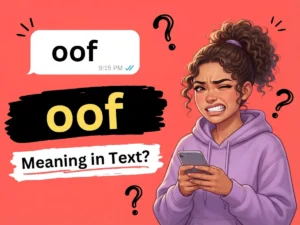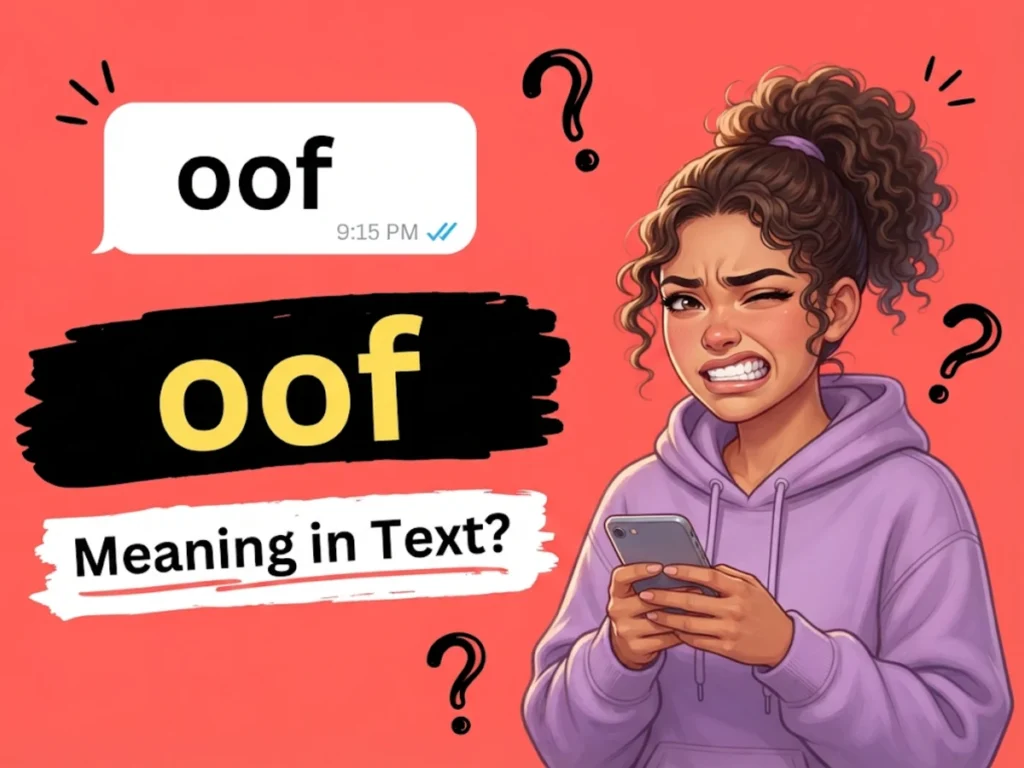
The oof meaning in a text is a sympathetic wince: “ouch,” “yikes” or “that’s rough.” When someone texts “oof” after you share bad news, they’re reacting to something painful, awkward or disappointing, usually with a mix of sympathy and humor.
Because it’s only three letters, though, people often wonder how serious it is. Is “oof” kind, or is it brushing you off? The answer depends on what came before it, and that’s what this guide unpacks.
READ MORE: Oop Meaning in Text: The Tiny Gasp With a Drag Queen Origin
Oof Meaning: More Than a Sound Effect
Oof is not an acronym or an abbreviation. Instead, it’s an interjection, a word that imitates a sound. Merriam-Webster’s entry for oof defines it as a word “used to express discomfort, surprise, or dismay,” and dates its first known use to 1777.
In texting, those three senses map onto everyday moments:
- Secondhand pain: “I failed my driving test again.” “oof.”
- Awkward surprise: “I waved back at someone who wasn’t waving at me.” “oof 😬”
- Dismay at bad news or prices: “rent went up $300.” “oooof.”
Of these, the first oof meaning is by far the most common in personal texts. It works like a quick, understanding grimace.
Typing It: One O, Two O’s or Ten
The standard spelling is “oof.” However, people stretch the vowels to show how bad something is. “Oooof” feels heavier, and “OOF” in caps reads like a dramatic, full-body cringe. You might also see “oof.” with a period, which feels flat and final.
Unlike acronyms, the letters don’t stand for anything. As a result, spelling variations change intensity rather than meaning.
Where it appears in text form
Above all, it shows up in private chats: iMessage, SMS and WhatsApp. It’s also common in Instagram and Snapchat DMs as a reply to a story, and in Discord, where gamers often react to a loss or a bad play with it.
Shades of Oof Across Different Tones
Funny
A: I just sent “love you” to my manager instead of my mom
B: OOF
A: she replied “thanks?”
B: frame that screenshot
Sarcastic
A: I only spent $90 on takeout this week
B: oof, budget king
A: it was a hard week
B: clearly
Playful
A: your fantasy team lost by 2 points
B: don’t
A: oof
B: I said don’t
Serious
A: I didn’t get the job
B: oof, I’m really sorry
A: thanks, I thought the interview went well
B: it’s their loss. want to talk later?
How People Actually Use Oof in Chats
These everyday exchanges show the oof meaning across different relationships, so you can see how much context shapes it.
Best friends
A: tripped on the stairs in front of my whole class
B: oof 😭 are you ok
A: my pride isn’t
B: nobody will remember by Monday
Partners
A: forgot our anniversary dinner reservation
B: oof
A: I’ll fix it
B: you better 😂
Coworkers
A: the client wants the whole deck redone by tomorrow
B: oof
A: yeah
B: I can help with slides 5 to 10
Parent and adult child
A: car needs new brakes, $600
B: oof, that’s a lot
A: I know
B: let me know if you need help
Siblings
A: dad saw my report card
B: oooof
A: he’s “not mad, just disappointed”
B: the worst kind
Strangers in a Discord voice-chat text channel
A: I just lost a 2-hour run to a glitch
B: oof, that’s brutal
A: no save point either
B: rip
Roommates
A: I left my laundry in the washer for three days
B: oof, the smell
A: rewashing now
B: open a window
Group chat
A: he replied “k” to my long message
B: OOF
A: should I say something
B: nope, let him think about it
Classmates
A: the final is worth 60% of our grade
B: oof
A: and it’s cumulative
B: double oof
Old friends catching up
A: my flight got canceled and I’m stuck in Denver
B: oof, how long
A: overnight
B: get some good food at least
Gym buddies
A: did leg day yesterday and now stairs are my enemy
B: oof
A: I took the elevator one floor
B: valid
Neighbors
A: power’s been out since 6
B: oof, ours too
A: fridge is getting warm
B: I’ve got a cooler if you need it
Where Oof Comes From
To begin with, the word itself is old. Merriam-Webster traces it back to 1777, long before texting existed, as a natural sound people make when hit or surprised.
Its modern online fame, however, comes largely from gaming. According to Wikipedia’s article on the “Roblox oof,” the sound originated in the 2000 game Messiah, and Roblox later used it as its default death sound. Soon after, it became a widely remixed meme. Roblox removed the sound in July 2022 over a licensing issue, and then brought the original back on July 18, 2025.
That gaming history explains why so many younger texters hear “oof” in their heads as that exact sound. In other words, the texting meaning comes from the old interjection, while the meme gave it a huge popularity boost.
The Grammar of Oof Meaning in a Sentence
Grammatically, oof is an interjection. That means it doesn’t need a subject or verb, so it can stand alone as a complete reply. In fact, that’s the most common way to use it.
Besides that, it can open a longer response: “oof, that’s rough.” Occasionally it’s used as a noun-like reaction (“big oof,” “double oof”), which adds humor. Mid-sentence use is rare.
Capitalization matters a little. Lowercase is sympathetic and casual, whereas all caps exaggerates the reaction for comic effect. It’s informal, so you’d avoid it in essays or work emails. That said, many people do say it out loud too.
Replying to an Oof
Funny
- “Yeah, my dignity left the chat.”
- “Thank you for your deepest condolences.”
- “Big oof indeed.”
Serious
- “Yeah, it’s been a rough day.”
- “Thanks. I’m okay, just frustrated.”
Flirty (with someone you’re close to)
- “You could make it better, you know.”
- “Come cheer me up then.”
Neutral
- “lol yeah”
- “it is what it is”
- “pretty much”
Oof Meaning vs Other Reaction Words
| Term | Meaning | Usage Context | Tone | Popularity | Confusion Risk |
|---|---|---|---|---|---|
| Oof | Ouch, yikes, that’s rough | Reacting to bad news or awkward moments | Sympathetic, comic | Very high | Low |
| Oop | Small gasp after a slip or surprise | Catching a mistake or tea | Playful | High | High, often mixed up with oof |
| Yikes | Alarm or embarrassment | Awkward or bad situations | Stronger cringe | High | Low |
| RIP | Rest in peace, used jokingly | Something lost or ruined | Mock-mourning | High | Low |
| SMH | Shaking my head | Disapproval | Judging | Very high | Low |
| W | A win | Good news | Celebratory | High | Medium, the opposite of oof |
The key difference between oof and oop is direction. Oof reacts to someone else’s misfortune or pain. Oop, by contrast, is usually a small “whoops” about a surprise or a slip.
Who Uses Oof
Generally, almost every age group recognizes it, since it’s both an old interjection and a meme. Gen Z often types it with gaming in mind, or stretches it to “oooof” for comedy. Millennials tend to use it as a straightforward sympathetic reaction. Even many older texters use it naturally, simply because it’s a sound people make anyway.
There isn’t solid data comparing US and UK usage, so we won’t speculate. On platforms, it’s strongest in private texts and DMs, followed by Discord gaming chats.
Is Oof Rude or Insensitive?
First, it’s not rude or explicit. Still, context matters a lot. Answering serious news, such as a breakup, illness or loss, with just “oof” can feel dismissive. In those moments, add real words of support, or skip it entirely.
At work, a quick “oof” to a coworker about a tough deadline is usually fine in casual chat. However, it’s best avoided with bosses in formal channels, with teachers, or in any message where you need to sound professional.
Why One Small Word Says So Much
Here’s what makes oof special in texting: it’s a sound, not a statement. Because of that, it gives empathy without advice. When someone shares a bad moment, they often don’t want solutions, they want acknowledgment. A single “oof” says “I see it, that hurts,” in less than a second. For the same reason, it fails with serious news. The lightness that makes it comforting for a spilled coffee can feel careless after real loss.
Questions People Ask About the Oof Meaning
Is it rude to reply with just “oof” in a text?
For everyday mishaps, no. It’s a normal, sympathetic reaction. For serious news, though, a bare “oof” can feel cold. When in doubt, add one more line, like “oof, I’m sorry, that’s awful.”
What’s the difference between texting oof and saying it out loud?
Out loud, “oof” is usually a reflex, often when lifting something heavy or watching someone get hurt. In a text, it becomes a deliberate choice, which makes it feel more like a comment. As a result, texted oof often carries more humor or sympathy than the spoken version.
Does oof mean the same thing in a group chat vs a 1-on-1 text?
The meaning is the same. In a group chat, though, it’s often a collective reaction, with several people piling on “oof” for comedy. In a private text, it usually feels more personal and sympathetic.
What does “big oof” mean?
Basically, it’s an intensified version. “Big oof” signals that something is especially rough or embarrassing. People also say “double oof” when bad news gets worse.
Is oof from Roblox?
Not originally. The word dates to 1777, according to Merriam-Webster. Still, the Roblox death sound made it a meme and gave it new life online, so many people associate the two.
Is oof a real word?
Yes. In fact, it’s listed in Merriam-Webster as an interjection. So it’s not just internet slang, even though the internet made it far more popular.
Wrapping Up the Oof Meaning
Oof is a sympathetic wince in word form. It means “ouch,” “yikes” or “that’s rough,” and it’s used for pain, embarrassment and disappointing news.
Tips:
- Use it for small fails and awkward moments.
- Stretch it (“oooof”) for comic emphasis.
- Add a kind line for anything more serious.
- Pair it with an offer to help when it fits.
Common mistakes:
- Sending a bare “oof” after serious or sad news.
- Mixing it up with “oop,” which reacts to a slip, not pain.
- Using it in formal work messages.
- Overusing it until it feels like you’re not really listening.
Text oof when someone shares a minor misfortune and you want to show you get it. On the other hand, skip it when they need real comfort or when the setting is formal.