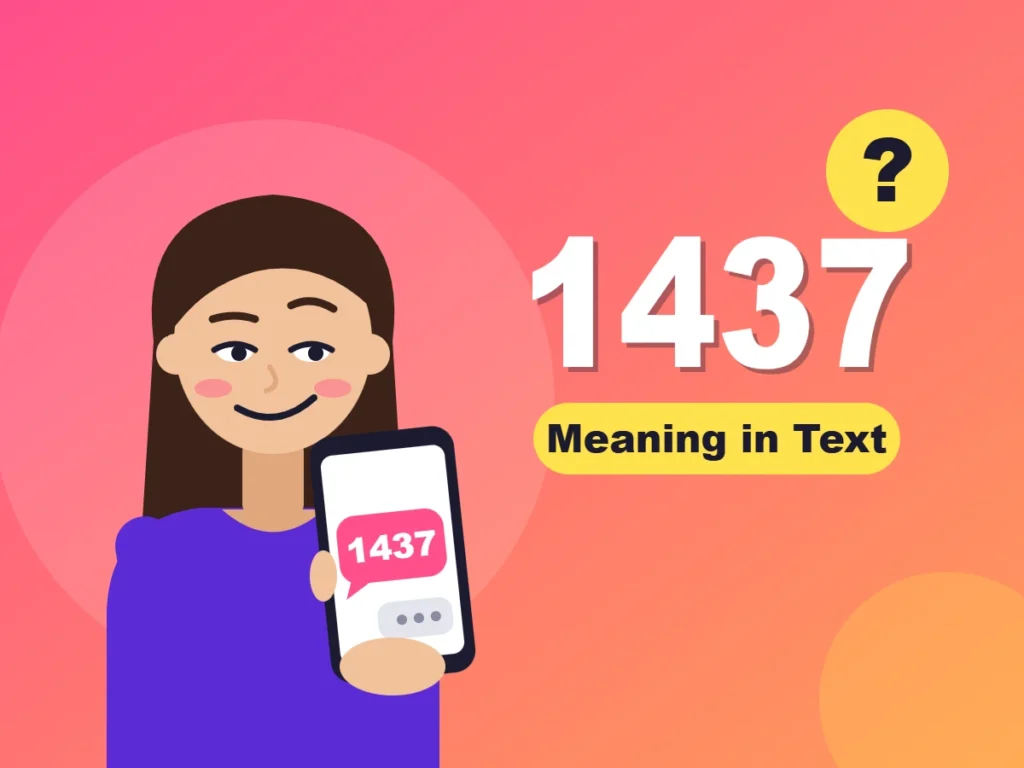
The 1437 meaning in text is “I love you forever.” Each digit counts the letters in one word: I (1), love (4), you (3), forever (7). So when someone texts you 1437, they are telling you they love you and plan to keep loving you, just written in code.
Most people look this up after a bare “1437” lands in their messages with no explanation, usually from a partner, a crush or a close friend who likes a bit of mystery. Four digits on their own look like a time, a PIN or a mistyped number, which is exactly why the message gets missed. In texting there is only one widely used meaning, so the real question is not what it says but how seriously the sender means it.
READ MORE: IMY Meaning: What It Stands For & How to Respond
Cracking the Code: The 1437 Meaning in Text, Digit by Digit
1437 is not an acronym, and it is not a slang word either. It is a letter-count code, the same system behind the older code 143 (“I love you”). Every number tells you how many letters are in the matching word:
- 1 = I
- 4 = love
- 3 = you
- 7 = forever
The first three digits are the classic 143. The extra 7 is what turns a feeling into a promise. Wikipedia’s entry on the number 143 notes that 143 was a popular pager code for “I love you,” and that Fred Rogers famously tied the number to the same phrase. 1437 takes that well-worn idea and adds one word.
Can 1437 Mean Anything Else?
Not in texting, where the 1437 meaning in text stays the same in every app. Outside a love-code context, though, 1437 is just a number: 2:37 p.m. on a 24-hour clock, a flat number, a price, or the last four digits of an order. A simple rule works almost every time. If it arrives on its own from someone close to you, read it as “I love you forever.” If it sits inside a plan, like “be at the gate by 1437,” it is a time.
Where 1437 Shows Up in Your Messages
Its natural home is the private one-on-one text. On SMS and iMessage it usually arrives alone or with a single heart emoji, often as the last message of the night. WhatsApp chats use it the same way, especially between couples and long-distance partners.
Similarly, in Instagram and Snapchat DMs it does the same job: a quick, low-key way to sign off a conversation. The 1437 meaning in text does not change from app to app, because the code depends on English spelling, not on any platform.
How People Actually Type It
Here is the part that makes 1437 different from letter slang: it cannot be capitalised. With slang like “ILY” versus “ily,” caps can make a message feel louder or softer. Digits have no caps, so senders add tone in other ways: a heart after it, a sent-twice “1437 1437,” a lot of exclamation marks, or writing the phrase out in full the next time to show they meant it. Spaced versions like “14 37” are rare and can make it look even more like a time.
Tone Changes Everything: Four Ways 1437 Lands
Serious
A: Today was the anniversary of my dad passing. Thank you for staying on the phone with me so long.
B: Always. 1437.
A: 1437. I really mean it tonight.
Funny
A: Mom, Ali texted you 1437 and you replied “ok noted”
B: I thought it was the new Wi-Fi password
A: It means he loves you forever
B: Oh no. Tell him 1437 back, quickly
Sarcastic
A: I booked the 6 a.m. flight because it was $40 cheaper
B: So I am waking up at 3:30. Wonderful. 1437 I guess
A: Was that sarcastic
B: Extremely
Playful
A: You ate the last slice, didn’t you
B: 1437 🥺
A: That is not an answer
B: It is the only answer you are getting
1437 in Real Text Conversations
These eleven exchanges show the 1437 meaning in text across different relationships, including a couple of moments where it gets misread.
1. Partners saying goodnight
A: home safe, going to sleep
B: good. night x
A: 1437
B: 1437 back 😴
2. Long-distance couple
A: 9 more days till I land
B: I have a countdown on my lock screen, don’t laugh
A: 1437
B: 1437. Bring the good chocolate
3. Best friends after a fight
A: sorry about last night, I was out of line
B: you were. but we’re fine
A: 1437 though
B: lol 1437. don’t make it weird
4. Parent and college student
A: Did you eat something real today?
B: define real
A: 1437. Now go eat a vegetable
B: 1437 mum 🙄
5. A crush, early on
A: 1437
B: is that your locker combination
A: look it up
B: …oh. OH. okay hi
6. Siblings
A: saw “1437 Jake” on the family iPad
B: DELETE THAT
A: too late, screenshotted
B: I am telling mum about the car
7. Coworkers (the misread)
A: Can you send the deck by 1437?
B: For a second I thought you were confessing something
A: It’s 2:37, Daniel
B: Google it later, trust me
8. Grandparent learning the code
A: Your cousin taught me a secret code. 1437!
B: Nani!! 1437 too
A: Did I do it right?
B: You are officially cooler than me
9. Wrong number
A: 1437 babe
B: I think you have the wrong number
A: oh no, so sorry
B: no worries, hope they say it back
10. Making up after an argument
A: still annoyed with me?
B: a little
A: 1437 even when you’re annoyed
B: …fine. 1437
11. Exes, staying kind
A: saw the news about your new job. proud of you
B: that means a lot, thank you
A: 1437 in the old-friends way, if that makes sense
B: it does. same here
Grammar: What Kind of Word Is 1437?
Grammatically, 1437 behaves like a complete sentence squeezed into four characters. “I love you forever” already has a subject, verb, object and adverb, so the code needs nothing around it. That is why it so often stands alone as a full reply.
However, when it does sit inside a message, it usually goes at the end, after the practical part: “landing at 6, see you soon, 1437.” Placed mid-sentence (“1437 even when you snore”) it still reads as the full phrase. It is informal by nature, so it belongs in chats and never in formal writing, cards to colleagues or emails.
How to Reply When Someone Texts You 1437
If you feel the same (serious)
- “1437. Always.”
- “I love you forever too.” Writing it out in full shows extra effort.
- “1437, and I don’t say that lightly.”
Flirty
- “Forever is a long time… good thing I like you a lot.”
- “1437, and I am holding you to the forever part.”
Funny
- “Did you just send me your bank PIN?”
- “Calculating… 1437 back.”
Neutral, or not there yet
If the feeling is not mutual, don’t send the code back to be polite. Something like “That is really sweet of you. I care about you, I am just not there yet” is kinder than a mirrored number you don’t mean.
1437 vs Similar Codes People Search For
| Term | Meaning | Usage Context | Tone | Popularity | Confusion Risk |
|---|---|---|---|---|---|
| 1437 | I love you forever | Partners, close friends, family | Deeply affectionate | Common | Medium (looks like a time or PIN) |
| 143 | I love you | Same circles as 1437, shorter | Affectionate | Common | Medium |
| 831 | I love you (8 letters, 3 words, 1 meaning) | Couples who like puzzles | Affectionate, coded | Niche | High |
| ILY | I love you | Everyday texting | Warm, casual | Very common | Low |
| IMY | I miss you | Distance, partners, friends | Longing | Very common | Low |
| 182 | I hate you (the opposite) | Teasing between friends | Joking, mock-angry | Niche | High |
Who Is Actually Sending 1437?
There is no reliable survey on who sends 1437, so here is what can honestly be said rather than an invented statistic. The code makes the most sense to two groups: people old enough to remember 143 from pagers and early phones, and younger texters who enjoy coded, low-pressure ways of saying big things. In addition, parents and grandparents pick it up too, usually after a younger relative explains it.
Because the digits come from English spelling, 1437 only works in English. Try the same trick with the Spanish “te quiero para siempre” and you get 2647, not 1437. That is why the code turns up wherever people text in English, while speakers of other languages tend to switch to English for the code itself.
Origin: From Pager Screens to Phone Screens
The 1437 meaning in text comes from texting and paging culture, not from a meme. Early pagers could only show numbers, so people built messages out of digits. 143 for “I love you” was one of the best known, which the Wikipedia page linked above describes as a popular pager number.
Later, when mobile phones and SMS took over, the letter-count system survived because it still had a purpose: it was short, it was private, and it felt a little like a secret handshake. 1437 is a later extension of 143. There is no documented date or person behind it, and anyone claiming otherwise is guessing.
Is 1437 Ever Inappropriate?
First of all, it is not rude, has no profanity and is not explicit. The only risk is weight. Sending “I love you forever” to someone you met last week, even in code, can feel intense, and some people will decode it straight away.
At work, however, keep it to its other job as a time. Texting 1437 to a boss, teacher or client as anything other than “2:37” could cause an awkward misunderstanding. For students, it is harmless but clearly romantic, so friends might tease. In families where romantic affection stays private, the code can actually be a respectful choice, because it says the words without putting them on display.
What 1437 Really Does in a Conversation
The numbers work as cover. Typing “I love you forever” in full can look heavier on a screen than it feels in the moment, while four digits let the sender say it without the whole sentence sitting there. The receiver has to decode it, which turns a declaration into something shared. It is private by default, since anyone glancing at the phone just sees a number, and it comes with a ready-made answer: the same four digits sent back. That small ritual of matching codes is what keeps 1437 alive in chats long after pagers disappeared.
FAQs: 1437 Meaning in Text
Is it rude to reply with just 1437 in a text?
No. Mirroring the code is the most common reply, and many couples treat it as a ritual. The only time it can feel thin is when the other person has sent a long, heartfelt message and gets four digits back. In that case, add a line of your own before or after it.
What is the difference between texting 1437 and saying it out loud?
Spoken aloud, “fourteen thirty-seven” sounds like a time, so almost nobody says the code itself. Out loud, people just say “I love you forever.” Some couples do say “one-four-three-seven” as an inside joke. The code is mainly a written thing, which is part of its appeal.
Does 1437 mean the same thing in a group chat vs a 1-on-1 text?
The meaning is identical, but the feel changes. In a group chat it is usually aimed at the whole group or a best friend in a lighthearted way, like “1437 you lot.” In a 1-on-1 text it reads far more personal and is more likely to be romantic. If you are unsure, the setting tells you a lot.
What does 143 mean, and how is it different from 1437?
143 means “I love you” and is the original version of this code, popular since the pager era. 1437 adds “forever.” Both use the same letter-count method. 1437 simply carries a stronger sense of commitment.
Is 1437 only for couples, or can friends use it?
Friends use it all the time. Between best friends it means a long-term, no-matter-what kind of love rather than romance. Parents send it to children and the other way round. The relationship around the message decides whether it is romantic.
Why do people use 1437 instead of typing the words?
For one thing, it is quicker, it is private, and it feels softer. Some people find the full phrase hard to type, especially early on. A code lets them say it while keeping the moment light, and the person receiving it gets the small fun of decoding it.
What should I do if someone sends 1437 and I don’t feel the same?
Be honest and kind rather than sending it back automatically. Thank them, say you care about them if that is true, and be clear about where you stand. A gentle, direct reply now is far better than a false “1437” that causes bigger hurt later.
Can 1437 have a negative meaning?
No. There is no negative or hidden meaning in texting. The only risk is confusion, because the number can be mistaken for a time, a code or a typo. Context almost always clears that up.
Final Take on 1437
In short, the 1437 meaning in text is a letter-count code for “I love you forever,” built on the older pager code 143. It is affectionate, private and safe to send, as long as the relationship can carry the weight of the word “forever.”
Usage tips
- Send it on its own for the biggest effect; it does not need extra words.
- Add a heart emoji if you worry it will be read as a time.
- Mirror it back to keep the ritual going with someone who uses it often.
- Write the full phrase occasionally so the code does not start to feel automatic.
Common mistakes
- Sending it too early in a relationship, when “forever” feels like pressure.
- Using 1437 as a time in a work message without context.
- Replying “1437” out of politeness when you don’t mean it.
- Mixing it up with 143, which means “I love you” without the forever.
When to use it, and when to avoid it
Use 1437 with partners, close friends and family who will understand it or enjoy decoding it. Avoid it with coworkers, teachers and new acquaintances, and anywhere a misread number could cause confusion or a moment you didn’t intend.