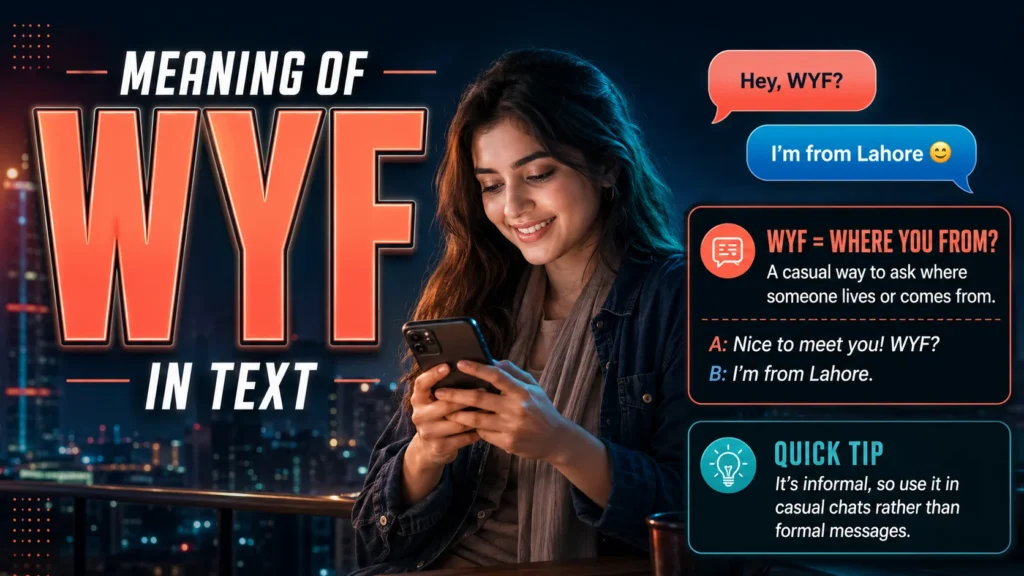
WYF usually means “Where You From?” When someone texts it to you, they are normally asking where you live, grew up, or come from. Less commonly, WYF can mean “What You Feeling?” or carry an explicit meaning in certain conversations.
People search for “WYF meaning” because the same three letters can represent different questions. A message such as “hey, wyf?” usually concerns location, while “wyf for dinner?” asks what you feel like having. The sender, topic, and words surrounding WYF reveal the intended meaning.
What Does WYF Mean?
WYF is an informal texting abbreviation or initialism. Its most common expansion is:
W = Where
Y = You
F = From
“Where you from?” omits the verb “are,” which is normal in casual speech and digital conversations. The complete standard-English question would be, “Where are you from?”
Someone may use WYF to ask about:
- Your hometown
- Your country or region
- The city where you currently live
- Your cultural or family background
- Whether you are local to an area
If a new contact sends “WYF?” without any additional context, “Where you from?” is the safest interpretation.
The Most Common Meaning: Where You From?
WYF frequently appears near the beginning of a conversation. It functions as a quick getting-to-know-you question, particularly between people who have just connected through a mutual friend, dating app, game, or social platform.
For example:
A: Hey, I saw you’re going to the concert too.
B: Yeah, I can’t wait. WYF?
A: I’m from Manchester, but I live in Leeds now.
B: Nice, I’m not far from there.
Here, WYF clearly asks about the person’s location or background.
“Where you from?” can be broader than “Where do you live?” A person might answer, “I’m originally from Pakistan, but I live in London.” If you are uncomfortable providing an exact location, naming only your country, state, province, or general area is sufficient.
WYF Can Mean “What You Feeling?”
WYF can also mean “What You Feeling?” In natural English, this usually represents “What are you feeling?” or “What do you feel like?”
This interpretation appears when friends are discussing a mood, meal, activity, outfit, song, or plan:
A: We could order pizza or make pasta.
B: Either works. WYF?
A: Pizza, honestly.
B: Same. I’ll place the order.
The food-related context makes “Where you from?” illogical, so WYF means “What are you feeling?” or “What do you feel like?”
This meaning is less universal than “Where you from?” Some people may not recognize it immediately. Writing “What are you feeling?” or “What do you feel like?” is clearer when the situation matters.
Can WYF Have an Explicit Meaning?
In some adult or highly informal conversations, WYF may represent “Who you f—ing?” It is a blunt question about someone’s sexual partner. This interpretation contains implied profanity and may sound invasive, disrespectful, jealous, or confrontational.
It is not the default meaning of an ordinary “WYF?” message. Consider it only when the surrounding conversation is explicitly about dating, sexual relationships, or accusations. Do not assume that a stranger asking “WYF?” intends this interpretation.
A safer response to an unclear message is: “Do you mean where I’m from?”
Other Claimed Meanings of WYF
User-generated slang sources occasionally list “Why You Flirting?” or “What’s Your Favorite?” as meanings of WYF. These readings are possible in a very specific exchange, but they are not dependable default definitions.
“What’s your favorite?” normally requires a subject, such as “WYF song?” Even then, many readers may be confused. “Why you flirting?” is an uncommon interpretation that depends heavily on a teasing or confrontational context.
The practical order is:
- Where You From? — the standard and most widely recognized meaning
- What You Feeling? — a contextual question about mood or preference
- Explicit adult interpretation — limited to relevant adult conversations
- Other personal or group-specific expansions — uncommon and potentially unclear
WYF Meaning on Different Platforms
WYF in SMS, iMessage, and WhatsApp
In ordinary text messages and WhatsApp chats, WYF most often means “Where you from?” It is commonly sent as a complete question when two people are getting acquainted.
In an established friend group, “What you feeling?” becomes more plausible, especially when the group is choosing food, music, or plans. The previous message normally makes the meaning obvious.
WYF in Instagram, Snapchat, and Discord DMs
In Instagram or Snapchat DMs, “WYF?” often asks where a new contact is from. It may serve as an icebreaker after someone accepts a request or responds to a Story.
On Discord, the meaning depends on the channel. A new gaming friend may be asking about your country or time zone, whereas friends arranging an activity may mean “What you feeling?”
WYF in TikTok or X Posts
WYF may appear in short public posts and replies, but it is more naturally associated with direct, conversational exchanges. In a public thread, the missing context makes it especially ambiguous.
Do not automatically read WYF as “What’s your favorite?” simply because it appears on TikTok or X. Look for a named category, poll, list, or direct question that supports that interpretation.
Capitalization and Variants
The common forms are:
- WYF
- wyf
- Wyf
- wyf?
Capitalization does not change the dictionary meaning. Lowercase “wyf” looks relaxed and conversational, while “WYF?” may appear more direct. Repeated question marks—“WYF??”—can suggest impatience, surprise, or emphasis.
Some people write “where u from?” or “whr u frm?” instead. These are clearer variations rather than separate meanings.
How Tone Changes the Meaning of WYF
Friendly or Playful Tone
A: You’ve never had proper New York pizza?
B: Nope 😂 WYF, the pizza police?
A: Brooklyn, so basically yes.
B: Okay, your reaction makes sense now.
WYF begins as a location question, but the joke makes it playful rather than intrusive.
Funny Tone
A: WYF?
B: Mentally? Somewhere on a beach.
A: I meant where are you from 😭
B: Oh—Birmingham.
The receiver deliberately chooses the wrong interpretation for humour.
Sarcastic Tone
A: I put ketchup on the pasta.
B: WYF, another planet?
A: Manchester, and we have freedom here.
B: Your cooking privileges are revoked.
Here, WYF still resembles “Where you from?” but is used rhetorically to tease someone.
Serious Tone
A: You’ve seemed quiet all day.
B: I’ve had a difficult morning.
A: WYF right now—angry, sad, or overwhelmed?
B: Mostly overwhelmed. Thanks for asking.
The emotional options establish that WYF means “What are you feeling?”
Realistic WYF Conversations
The following conversations show how relationship and context affect the meaning.
New Online Friend
A: Good game. You carried our team.
B: Thanks! You were great too. WYF?
A: Lahore. What about you?
B: Karachi.
Meaning: Where you from?
Dating-App Match
A: Your profile says you love hiking.
B: I do! There are some great trails near me.
A: Nice, WYF?
B: Originally Bristol, but I’m in Cardiff now.
Meaning: Where you from? The message may feel mildly flirty because it continues a getting-to-know-you conversation.
Coworker
A: Are we ordering lunch before the meeting?
B: Yes, probably from the café downstairs.
A: WYF—sandwich or salad?
B: Sandwich today.
Meaning: What are you feeling or what do you feel like having?
Parent and Adult Child
A: The weather report says your area has heavy rain.
B: It’s fine at the moment.
A: Remind me, WYF exactly?
B: About twenty minutes north of the city, but I’m staying indoors.
Meaning: Where are you located? The wording is unusually abbreviated for a parent, but the context makes it understandable.
Siblings
A: Movie night after dinner?
B: Sure.
A: WYF—comedy, horror, or something easy?
B: Comedy. I need something light.
Meaning: What are you feeling like watching?
Stranger in a DM
A: Hey, your photography is really good.
B: Thank you.
A: WYF?
B: I don’t share my exact location, but I’m from northern England.
Meaning: Where you from? The response maintains privacy without becoming unfriendly.
These six conversations, together with the four tone examples above, provide ten distinct real-chat uses of WYF.
Grammar and Language Role of WYF
WYF is an initialism used as an interrogative expression. Although people often call every shortened expression an acronym, an acronym is technically pronounced as a word. WYF is usually understood letter by letter or read mentally as the expanded question.
It can replace an entire sentence:
A: Nice to meet you.
B: WYF?
It can also be embedded in a longer message:
- “Hey, WYF originally?”
- “WYF about going out tonight?”
- “WYF—Thai or Italian?”
- “Before we plan the time zone, WYF?”
WYF naturally appears at the beginning or end of a casual question. A question mark is helpful but not compulsory in informal texting.
The expression belongs to an informal register. Avoid it in academic writing, formal email, official correspondence, or communication where ambiguity could cause a problem. “Where are you based?” is more appropriate in a professional setting.
How to Reply to WYF
First identify the likely meaning from the topic. If no context exists, interpret it as “Where you from?” or ask for clarification.
Funny Reply
“Planet Earth, last time I checked 😂 What about you?”
This works when the interaction already feels playful. It may sound evasive if the sender is asking a practical question.
Serious Reply
“I’m originally from Islamabad, but I currently live in Lahore.”
This answers both possible location interpretations without revealing an exact address.
Flirty Reply
“I’m from not too far away—are you planning to invite me somewhere? 😉”
Use this only when the conversation is already mutual and flirtatious.
Neutral or Unbothered Reply
“From Birmingham. You?”
This is brief, natural, and returns the question.
Clarifying Reply
“Do you mean where I’m from or what I’m feeling?”
Clarification is the best response when either interpretation fits.
Privacy-Conscious Reply
“I’m from the north, but I don’t share my exact location online.”
You never owe a stranger your city, neighbourhood, school, workplace, or live location.
Compared With Similar Texting Terms
| Term | Meaning | Usage Context | Tone | Popularity | Confusion Risk |
|---|---|---|---|---|---|
| WYF | Where you from?; sometimes what you feeling? | Introductions, location, preferences | Curious or casual | Moderate | High |
| WYA | Where you at? | Asking someone’s current location | Direct and casual | High | Low |
| WYD | What you doing? | Checking someone’s activity or starting a chat | Casual; sometimes flirty | Very high | Low |
| WYM | What you mean? | Requesting clarification | Neutral or challenging | High | Low |
| WBU | What about you? | Returning a question | Friendly and neutral | High | Low |
| ASL | Age, sex, location | Online introductions and older chat-room culture | Direct; dated | Lower today | Medium |
| IDK | I don’t know | Expressing uncertainty—the opposite of supplying information | Neutral or dismissive | Very high | Low |
WYF and WYA are especially easy to confuse. WYF normally asks about someone’s origin or home area; WYA asks where the person is at that moment.
Who Uses WYF?
Teenagers and Young Adults
Teenagers and young adults are most likely to encounter WYF in DMs, group chats, gaming communities, and dating conversations. However, it is not universally understood even within Gen Z. Many users simply type “where you from?” because it is clearer.
Gen Z Versus Millennials
Gen Z texting often relies on compressed questions, minimal punctuation, and conversational context. A lowercase “wyf” may therefore fit naturally into a rapid exchange.
Millennials are also familiar with abbreviated texting, having used SMS, instant messaging, and early social networks. However, they may be more likely to recognize established forms such as WYD, WYA, or WBU than the more ambiguous WYF.
These are broad tendencies, not fixed rules. Individual habits, friend groups, and platforms matter more than generation alone.
Regional Usage
“Where you from?” is widely understandable in the United States, United Kingdom, Canada, Australia, and other English-speaking online communities. WYF itself does not have a single verified regional ownership.
In British English, “What do you fancy?” is a common way to ask what someone wants, but this does not prove that British users generally interpret WYF as “What you fancy?” The full phrase is safer.
Origin and Internet Culture
WYF does not have one reliably documented inventor or launch date. It follows the broader practice of removing letters and grammatical words to type informal questions quickly.
Early SMS culture encouraged brevity because messages were commonly limited to 160 characters and phone keypads made typing slower. Instant messaging and chat rooms also normalised forms such as “u,” “r,” “wya,” and “wyd.” WYF fits this pattern more closely than a TikTok-born meme.
A user-submitted Urban Dictionary entry recorded “where you from” as WYF in 2014, demonstrating that the expansion was circulating online by then. That entry is evidence of usage, not proof of who created it. More recent texting guides, including Hushed’s explanation of WYF, also identify “Where You From?” as the usual interpretation.
WYF remains less stable than abbreviations such as LOL or BRB. Its letters can match several questions, so surrounding context continues to do much of the communicative work.
Is WYF Rude, Offensive, or Appropriate?
WYF meaning “Where you from?” is not inherently rude or offensive. Nevertheless, sending only three letters can seem abrupt, especially to someone you have never spoken to before.
Questions about origin may also feel personal. Avoid repeatedly asking after someone declines to answer, and do not pressure a person to reveal an exact location.
The “What you feeling?” interpretation is normally harmless. The explicit adult interpretation contains implied profanity and should not be used at school, at work, with minors, or in an unwanted sexual conversation.
For a boss, teacher, customer, or unfamiliar colleague, write the full question:
- “Where are you based?”
- “Where are you originally from, if you don’t mind me asking?”
- “Which option would you prefer?”
- “How are you feeling about the proposal?”
How WYF Functions in Real Conversations
WYF is culturally interesting because it demonstrates how texters rely on shared context instead of complete grammar. The letters alone provide limited information, but the conversation supplies the missing meaning. After “Nice to meet you,” WYF points toward origin; after “pizza or burgers,” it points toward preference. Its efficiency is also its weakness: when the sender and receiver do not share the same slang habits, three saved words can create more confusion than clarity.
Frequently Asked Questions About WYF
What does WYF mean when someone texts it to you?
WYF normally means “Where you from?” The sender is asking about your hometown, country, region, or current city. If you were discussing food, plans, or emotions, it may instead mean “What you feeling?”
Is it rude to reply with just WYF in a text?
Replying with only “WYF?” is not automatically rude, but it may sound abrupt. It works best in a relaxed conversation where both people use short slang. With a stranger, “Where are you from?” sounds clearer and more considerate.
Is WYF flirty?
WYF can be flirty when it appears in a dating-app conversation or a new DM, because asking where someone lives may signal personal interest. The abbreviation itself is neutral, however. The relationship, emojis, timing, and surrounding messages establish flirtation.
What is the difference between texting WYF and saying it aloud?
In a text, readers normally expand WYF mentally rather than pronounce it as a word. Saying the individual letters aloud may confuse someone because it is not a widely established spoken expression. In face-to-face conversation, people usually say the full question.
Does WYF mean the same thing in a group chat and a one-to-one text?
Not always. In a one-to-one conversation with a new person, it usually means “Where you from?” In a group choosing dinner, music, or an activity, “What you feeling?” may be more likely. Always examine the topic before answering.
What is the difference between WYF and WYA?
WYF usually asks where someone comes from, while WYA means “Where you at?” and asks for their present location. “I’m from Glasgow” answers WYF; “I’m at the station” answers WYA. The distinction matters when arranging a meeting.
Does WYF mean “What’s your favorite?”
It can be interpreted that way when a subject follows it, such as “WYF movie?” However, this use is not clear or universally recognized. Writing “What’s your favorite movie?” prevents unnecessary confusion.
How should I answer WYF from a stranger?
You can provide a broad location, ask what they mean, or decline to share. A safe response is, “I’m from the Midlands, but I don’t give out my exact location.” Never send an address, live location, school, or workplace merely because someone asks.
Conclusion
WYF most commonly means “Where You From?” It is an informal way to ask about someone’s hometown, country, background, or general location. In conversations about mood, food, entertainment, or plans, it may mean “What You Feeling?” Rare explicit and highly contextual interpretations also exist.
Usage Tips
- Assume “Where you from?” when WYF arrives during an introduction.
- Use the previous message to identify a mood or preference meaning.
- Answer with a broad location if privacy is a concern.
- Ask for clarification whenever two meanings could fit.
Common Mistakes
- Confusing WYF with WYA, which asks for a current location
- Assuming every WYF message is flirtatious
- Treating rare expansions as equally common definitions
- Using WYF in formal or sensitive communication
Use WYF in relaxed texts and DMs where the context is obvious. Avoid it in professional messages, conversations requiring precision, or situations where a location question could feel intrusive.

