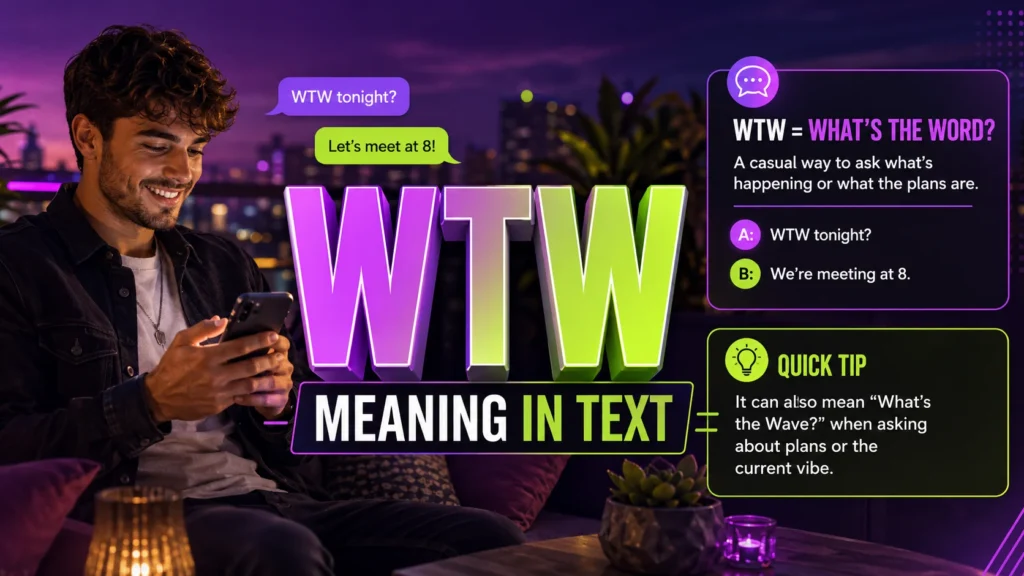
WTW most commonly means “What’s the word?” When someone texts it to you, they are casually asking what is happening, what you are doing, or what the plan is. It can also mean “What the what?” when expressing surprise.
People search for “WTW meaning” because the abbreviation does not translate into an obvious question. “What’s the word?” sounds as though the sender wants one specific word, but in texting slang, it functions more like “What’s up?”, “What’s going on?” or “Do we have a plan?”
What Does WTW Mean?
WTW is a texting abbreviation or initialism that usually stands for:
W = What’s
T = The
W = Word
“What’s the word?” is an informal greeting and request for information. Depending on the conversation, it can ask about someone’s general situation, recent news, availability, or plans.
If a friend sends only “WTW?”, they may be asking:
- What’s up?
- What’s happening?
- What are you doing?
- What’s the plan?
- Do you have any news?
- Are we still meeting?
- What are we doing today?
The intended question normally becomes clear from the relationship and previous messages.
The Main Meaning: What’s the Word?
“What’s the word?” is the standard texting meaning of WTW. It is not usually a request for a literal vocabulary word. It is a conversational invitation to share an update.
For example:
A: WTW tonight?
B: We’re meeting at Zara’s around eight.
A: Perfect. Should I bring anything?
B: Just some drinks.
Here, WTW means “What’s the plan tonight?”
In another conversation, it may work as a simple greeting:
A: Yo, WTW?
B: Not much. Just got home from work.
A: Same. I’m exhausted.
B: This week has been endless.
In this example, it means “What’s up?” or “How are things?”
WTW Can Ask for an Update
WTW is often used when a person expects news or confirmation. The sender may already know the general situation but need the latest information.
For example, “WTW with the tickets?” means “What is the latest information about the tickets?” Similarly, “WTW for tomorrow?” asks whether tomorrow’s arrangements have been confirmed.
This use is more specific than a general greeting. Look at any noun or time reference that follows WTW:
- “WTW tonight?” — What are the plans tonight?
- “WTW with the party?” — What is happening with the party?
- “WTW on that job?” — Is there any news about the job?
- “WTW for lunch?” — What are we doing or eating for lunch?
- “WTW, are you coming?” — What’s happening; are you joining us?
WTW Can Mean “What the What?”
A less common interpretation is “What the what?” This is a mild expression of shock, disbelief, or confusion. It works as a cleaner alternative to “WTF,” which contains profanity.
A: They cancelled the event ten minutes before it started.
B: WTW? We already drove an hour!
A: I know. They posted the announcement just now.
B: That’s ridiculous.
The surprising news shows that WTW expresses disbelief rather than asking about plans.
“What the what?” is a genuine alternative meaning, but it is considerably less common than “What’s the word?” Tone and punctuation help identify it. A shocked response such as “WTW?!” is more likely to express disbelief.
Can WTW Mean “What’s the Wave?”
Some people interpret WTW as “What’s the wave?” This means “What’s happening?”, “Where is everyone going?” or “What are we doing?” It is closely related to “What’s the word?” rather than an entirely different function.
For example, “WTW after the game?” could mean “What’s the wave after the game?” In practical terms, the sender still wants to know the social plan.
Because “What’s the word?” is more widely recognized, it should remain the default interpretation. The distinction rarely changes how you need to answer.
Can WTW Mean “What to Wear?”
WTW can occasionally mean “What to wear,” particularly in fashion notes, outfit discussions, event-planning boards, or search phrases. However, this is not the normal meaning of a standalone personal text.
If someone writes “WTW for the wedding?” immediately after discussing dress codes, “What to wear” is plausible. If a friend unexpectedly sends “WTW?”, they almost certainly mean “What’s the word?”
WTW Meaning Across Texting Platforms
WTW in SMS, iMessage, and WhatsApp
In SMS, iMessage, and WhatsApp conversations, WTW normally means “What’s the word?” Friends use it to begin a conversation or confirm plans without writing a complete question.
A person might send “WTW later?” to ask whether you are available or if the group has decided what to do. In an active group chat, “WTW?” may request a quick update from everyone.
The meaning does not fundamentally change between SMS, iMessage, and WhatsApp. The surrounding conversation remains the most important clue.
WTW in Instagram, Snapchat, and Discord DMs
WTW is common in casual Instagram and Snapchat DMs. A sender may use it as an opener after a period of silence:
“Hey, WTW?” means “Hey, what’s up?”
“WTW tonight?” means “What are the plans tonight?”
“WTW with you?” means “What’s going on with you?”
On Discord, WTW may ask what a gaming group is playing, whether people are joining a voice channel, or what the plan is for an online event.
WTW on TikTok and X
WTW can appear in TikTok comments, captions, and direct messages when someone is asking what is happening or requesting an explanation. On X, it may appear in posts reacting to news or discussing upcoming plans.
A public post such as “WTW with this update?” asks what is happening with a particular development. A surprised “WTW?!” may instead represent “What the what?”
Public posts provide less conversational context than private messages, so writing the complete phrase may prevent confusion.
Capitalization, Punctuation, and Variations
Common forms include:
- WTW
- wtw
- Wtw
- wtw?
- WTW?!
- wtw tonight
- wtw wit you
Capitalization does not officially change the definition. Lowercase “wtw” feels relaxed and conversational. Uppercase “WTW” can look more noticeable, while “WTW?!” may suggest stronger surprise or urgency.
The variation “wtw wit you?” uses “wit” as a highly informal spelling of “with.” It generally means “What’s going on with you?” rather than “What the what?”
How Tone Changes WTW in a Text
Funny Tone
A: WTW tonight?
B: Me, my blanket, and eight episodes of bad television.
A: That sounds strangely organised.
B: I take doing nothing very seriously.
WTW asks about the evening’s plan, while the exaggerated answer creates humour.
Sarcastic Tone
A: The manager scheduled another 7 a.m. meeting.
B: WTW with these sunrise conferences?
A: Apparently, sleep is no longer part of the company culture.
B: I’ll bring coffee and silent resentment.
Here, WTW means “What is going on with this situation?” Its sarcastic tone communicates annoyance.
Playful Tone
A: WTW this weekend?
B: Depends. Are you finally planning something fun?
A: Maybe. Clear your Saturday evening.
B: Mysterious—I’m listening.
WTW asks about plans and opens a playful exchange.
Serious Tone
A: You said the doctor would call today. WTW?
B: They called an hour ago. I need another test.
A: Are you okay? Do you want me to come over?
B: Yes, please.
In a serious context, WTW requests an important update. Writing the complete question may sound more considerate when the matter is sensitive.
Realistic WTW Conversations
The following conversations show how WTW works with friends, partners, relatives, coworkers, and unfamiliar contacts.
Between Friends
A: I’m finally free after six.
B: Good, WTW after that?
A: We could get dinner near campus.
B: I’m in. Send me the place.
Meaning: What is the plan after six?
Between Romantic Partners
A: I haven’t heard from you all afternoon.
B: Sorry, work got really busy.
A: Okay, WTW for dinner?
B: I’ll cook if you pick up groceries.
Meaning: What are we doing for dinner?
In a Work Chat
A: Has the client approved the revised design?
B: They replied, but I haven’t opened it yet.
A: Let me know WTW when you read it.
B: Will do.
Meaning: Let me know what the update or decision is. WTW is understandable here, but it may be too informal for formal business communication.
Between a Parent and Adult Child
A: Your brother said the train was delayed.
B: Yeah, we’re still at the station.
A: WTW now?
B: They expect it in twenty minutes.
Meaning: What is the latest update?
Between Siblings
A: Mum’s birthday is next week.
B: I know. WTW with the gift?
A: I found the bag she wanted.
B: Great—I’ll pay half.
Meaning: What is the plan or current situation regarding the gift?
From an Unfamiliar Contact
A: Hey, this is Daniel from the football group.
B: Hi.
A: WTW for practice tomorrow?
B: It starts at seven. The coach posted it in the group.
Meaning: What is the plan for practice?
Together with the four tone examples, these provide ten realistic text conversations using WTW in different relationships and situations.
Grammar and Language Role of WTW
WTW is an initialism used as an interrogative expression. People commonly call it an acronym, although it is usually read as its expanded phrase rather than pronounced as a single word.
It can replace a complete sentence:
A: WTW?
B: Nothing much. You?
It can also introduce a more specific question:
- “WTW tonight?”
- “WTW after work?”
- “WTW with the new schedule?”
- “WTW for your birthday?”
- “So, WTW—are we going or not?”
WTW most naturally appears at the beginning of a message, but it can follow a greeting:
- “Hey, WTW?”
- “Yo, WTW for later?”
- “Morning, WTW with the meeting?”
A question mark makes the expression easier to interpret. Without punctuation, “wtw” still functions as a question in casual texting.
The abbreviation belongs to an informal register. It can stand alone as a complete message between friends but should not replace a clear sentence in academic, legal, customer-service, or formal workplace communication.
How to Reply to WTW
Your response should match the sender’s likely intention. Decide whether they want a general update, a plan, confirmation, or a reaction.
Funny Reply
“Same word as yesterday: tired 😂”
This plays on the literal meaning of “word” while still answering casually.
Another funny option is:
“The word is snacks. Snacks are always the plan.”
Serious Reply
“The plan is still 7 p.m. at the main entrance. I’ll message you if anything changes.”
This is useful when WTW requests practical information.
Flirty Reply
“Not much—unless you’re about to make plans with me 😉”
Use this only when the conversation is already comfortable and mutually flirtatious. WTW itself is not automatically romantic.
Neutral or Unbothered Reply
“Nothing much. What’s up with you?”
This is the safest response to a general WTW greeting.
Reply When Plans Are Unclear
“No plan yet. I’m waiting to hear from everyone.”
This directly addresses the uncertainty without inventing an answer.
Reply When You Do Not Understand
“Do you mean what’s the plan?”
Asking for clarification is better than guessing, especially when “What’s the word?”, “What the what?” and “What to wear” could all fit.
WTW Compared With Related Texting Terms
| Term | Meaning | Usage Context | Tone | Popularity | Confusion Risk |
|---|---|---|---|---|---|
| WTW | What’s the word? | Greetings, updates, news, and plans | Casual and curious | Moderate | Medium |
| WSP | What’s up? | General greeting or check-in | Very casual | High | Low |
| WYD | What are you doing? | Asking about someone’s current activity | Casual; sometimes flirty | Very high | Low |
| WYA | Where you at? | Asking for someone’s current location | Direct and casual | High | Low |
| WSG | What’s good? | Greeting or asking what is happening | Friendly and informal | High | Medium |
| LMK | Let me know | Requesting a future update | Neutral and casual | Very high | Low |
| IDK | I don’t know | Expressing a lack of information—the opposite of giving an update | Neutral or dismissive | Very high | Low |
WTW is broader than WYD. “WYD?” specifically asks what someone is doing, whereas “WTW?” may ask about their life, recent news, availability, or a shared plan.
Who Uses WTW?
Age Groups
WTW is most common among teenagers, young adults, and people who regularly communicate through short-form messages. Adults may also use it within familiar friend groups, particularly when arranging social plans.
It is not understood universally. Someone unfamiliar with current texting slang may read the letters literally or ask what they mean.
Gen Z Versus Millennials
Gen Z users may type lowercase “wtw” as a fast conversation opener in Snapchat, Instagram, Discord, or group chats. They often rely on the preceding message and shared social context rather than writing a complete question.
Millennials also use shortened greetings, but many are more familiar with “sup,” “WYD,” “WYA,” or “what’s up?” WTW is not exclusive to either generation, and individual community habits are more important than age alone.
Regional Usage
“What’s the word?” has circulated in informal American English as a greeting or request for news. Online communication has carried WTW beyond any single city or region.
The abbreviation may be understood in the UK, Canada, Australia, and other English-speaking communities, but “What’s the plan?” or “What’s happening?” may sound more natural locally. It would be inaccurate to claim that every English-speaking region uses WTW equally.
Platform Habits
WTW appears most naturally in:
- SMS and iMessage conversations
- WhatsApp chats
- Snapchat messages
- Instagram DMs
- Discord chats
- Dating-app conversations
- Informal TikTok or X discussions
Across these platforms, “What’s the word?” remains the primary meaning. The platform does not automatically create a new definition.
Origin and Internet Culture
No reliable evidence identifies one individual as the creator of WTW. The abbreviation developed from the spoken expression “What’s the word?”, a casual request for information, news, or plans.
The phrase “What’s the word?” predates modern social-media platforms. WTW is therefore better understood as text-based compression of an existing spoken expression than as slang invented by TikTok.
Texting culture encouraged this kind of shortening. Early SMS messages had character limits, while numeric phone keyboards made complete sentences slower to type. Instant messaging, online chat, and later social apps continued the preference for compact greetings such as WSP, WYD, WYA, and WTW.
User-submitted slang records documented WTW meaning “What’s the word?” by at least 2016. These entries demonstrate usage but do not prove an exact origin. Dictionary.com’s WTW entry, published in 2018, also records both “What’s the word?” and the surprised “What the what?” interpretation.
WTW’s durability comes from its flexibility. One short question can open a conversation, request news, confirm an event, or ask what friends want to do.
Is WTW Rude or Offensive?
WTW meaning “What’s the word?” is not inherently rude, offensive, or profane. It is usually friendly, neutral, and casual.
However, sending only “WTW?” may sound abrupt when the recipient does not know you well. “Hi, what are the plans for tomorrow?” creates a more polite impression.
“What the what?” is a mild, non-explicit reaction. It is often used as a cleaner substitute for stronger profanity. Even so, an all-caps “WTW?!” may look confrontational depending on the conversation.
Is WTW Appropriate at School?
WTW is generally harmless in private conversations between classmates. Students should still use complete language in assignments, formal messages to teachers, and school emails.
A better message to a teacher would be: “Could you please confirm the plan for tomorrow’s lesson?”
Is WTW Appropriate at Work?
WTW may be acceptable in an informal chat with a close coworker. It is less appropriate in client emails, official updates, reports, or messages to senior colleagues because its meaning is not universally clear.
Instead of “WTW with the report?”, write: “Could you share an update on the report?”
Cultural and Contextual Sensitivity
“What’s the word?” has a history in casual American speech, including African American conversational usage, but WTW is now used across many online communities. Avoid assigning the abbreviation exclusively to one group or imitating a cultural speech pattern disrespectfully.
Use language that feels natural within your own relationships rather than forcing slang to appear current.
Real-World Observation
WTW often does more social work than its three letters suggest. It lets someone start a conversation without announcing a specific reason for messaging. The receiver can answer with a life update, propose a plan, or simply say “not much.” That openness makes WTW useful among friends but risky in unfamiliar or professional settings: insiders understand what information is expected, while outsiders may not know whether the sender wants news, plans, or an explanation.
People Also Ask: WTW Meaning FAQs
What does WTW mean when someone texts you?
WTW normally means “What’s the word?” The sender wants to know what is happening, how you are, or whether there is a plan. If the message reacts to surprising news, it may mean “What the what?”
Is WTW another way of saying “What’s up?”
Yes. When used as a greeting, “What’s the word?” functions similarly to “What’s up?”, “What’s good?” or “What’s going on?” WTW can also request more specific information about an event or decision.
Is it rude to reply with just WTW in a text?
Replying with only WTW is not normally rude among friends. However, it can feel vague or abrupt because it gives the recipient no topic. Adding “Hey” or a reference such as “WTW for tonight?” makes the message clearer.
What is the difference between texting WTW and saying it aloud?
People commonly say the full phrase “What’s the word?” aloud rather than pronouncing the letters W-T-W. In texting, the abbreviated form saves time and fits the relaxed register. The spoken phrase may also sound more expressive because voice communicates tone.
Does WTW mean the same thing in a group chat and a one-to-one text?
The basic meaning remains similar, but its purpose may change. In a one-to-one chat, WTW often means “What’s up with you?” In a group chat, it is more likely to ask what everyone is doing or whether a shared plan has been decided.
Is WTW flirty when a guy or girl sends it?
WTW is not automatically flirty. It may become flirtatious if a person uses it to begin a late-night conversation, asks about your availability, or follows it with romantic language. The relationship and surrounding messages matter more than the abbreviation.
What is the difference between WTW and WYD?
WTW is a broad request for news, updates, or plans. WYD means “What are you doing?” and specifically asks about someone’s current activity. A person may answer WTW with “We’re going out at eight,” but answer WYD with “I’m studying.”
What does WTW mean on Snapchat?
On Snapchat, WTW most commonly means “What’s the word?” It can be a conversation starter or a way to ask what someone is doing later. Snapchat does not give the abbreviation a separate fixed meaning.
Conclusion
WTW primarily means “What’s the word?” In text messages, it works like “What’s up?”, “What’s happening?” or “What’s the plan?” It can also request an update about a specific situation.
Less commonly, WTW means “What the what?” as an expression of surprise. “What’s the wave?” and “What to wear” are possible only in relevant contexts and should not be treated as the default meaning.
Tips for Using WTW
- Use WTW with friends who understand casual texting slang.
- Add a time or topic when asking about specific plans.
- Read the previous messages before interpreting its meaning.
- Ask for clarification when the context supports multiple definitions.
Common Mistakes
- Assuming WTW always asks what someone is doing
- Confusing it with WYD, WYA, or WSP
- Treating rare definitions as common meanings
- Using WTW in formal or sensitive communication
Use WTW for relaxed greetings, updates, and social planning. Avoid it when communicating with teachers, clients, managers, or anyone who may not understand the abbreviation.

