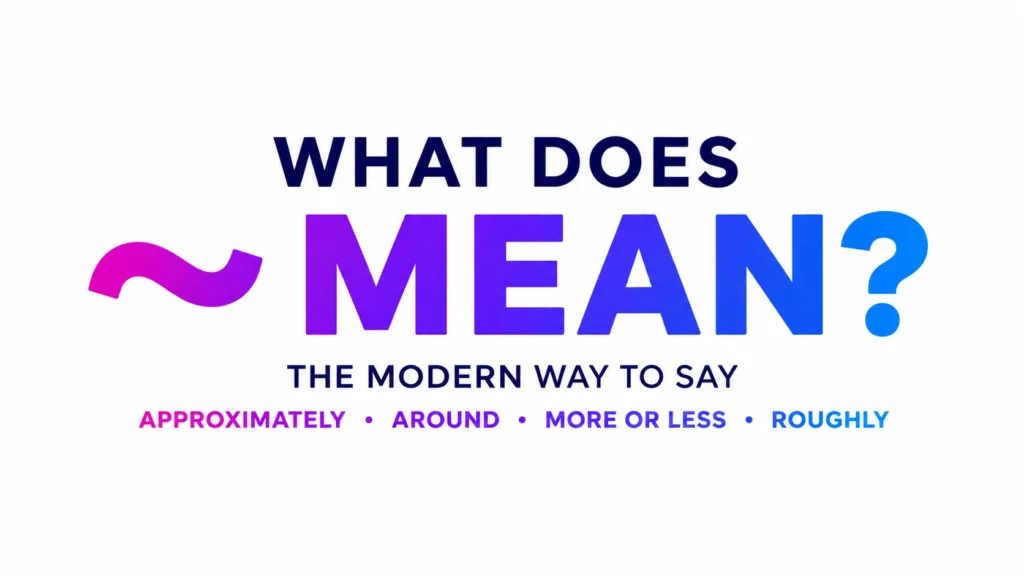
The symbol “~” is small, almost invisible at first glance, but its meaning changes completely depending on where you see it. Some people encounter it in texting, others in math class, and many see it in usernames or social media captions without really knowing what it stands for.
That confusion is exactly why people search for “what does ~ mean.”
In simple terms, this symbol can suggest approximation, softness in tone, playfulness in communication, or even stylistic identity online. It is one of those rare symbols that carries both technical and emotional meanings at the same time.
Understanding “~” helps you read messages more accurately, avoid misunderstandings, and even use it confidently in your own communication.
What Does ~ Mean – Quick Meaning
Core Definition
The symbol “~” is called a tilde. Its meaning depends on context, but generally it represents:
- Approximation or “about”
- Soft or playful tone in text
- Substitution or variation in writing systems
- Style or aesthetic expression online
Common Examples
- “~10 minutes” → about 10 minutes
- “I’m tired~” → soft, relaxed emotional tone
- “love~” → playful or affectionate style
- “100~” → roughly 100, not exact
In Simple Words
- In math: “approximately equal to”
- In texting: “soft emotional ending”
- In usernames: “aesthetic decoration”
Origin & Background
Historical Roots
The tilde originated from Latin handwriting traditions. Scribes used it as a shortcut mark to represent missing letters. For example, abbreviating words by placing a small line above letters.
Later, it evolved into a standardized symbol in mathematics, linguistics, and computing.
Cultural Evolution
Over time, the tilde moved beyond academic use. With the rise of digital communication, especially early internet chatrooms, people started using it creatively.
It became popular because:
- It looked visually soft and friendly
- It added personality to plain text
- It helped express emotion without emojis
Social Media Influence
On platforms like Instagram, TikTok, and messaging apps, “~” became a stylistic tool. Users started placing it at the end of words to make messages feel less strict and more emotional.
Example evolution:
- “okay” → “okay~”
- “bye” → “bye~”
- “love you” → “love you~”
It subtly changes tone without changing meaning.
Real-Life Conversations
WhatsApp Chat Example
Person A: Are you coming in 10 minutes?
Person B: Yeah~ just getting ready
The “~” softens the reply. It feels less strict and more relaxed.
Instagram DM Example
Person A: You look amazing in this pic
Person B: thank you~ you’re too kind
Here, the tilde adds warmth and friendliness.
TikTok Comment Example
User 1: This song hits different
User 2: so true~ I can’t stop replaying it
It expresses shared emotional agreement.
Text Message Example
Friend A: Don’t forget the assignment
Friend B: I won’t~ chill 😭
The tone becomes playful instead of serious.
Emotional & Psychological Meaning
The tilde is not just a symbol; it reflects how people emotionally soften communication.
What Emotion It Expresses
- Calmness
- Playfulness
- Warmth
- Casual friendliness
- Non-aggressive tone
Why People Use It
In modern communication, text can feel blunt. “~” helps reduce that harshness.
Instead of sounding like:
- “Okay.” (neutral or cold)
It becomes:
- “Okay~” (soft and friendly)
What It Reveals About Communication Today
People don’t just send information anymore—they send tone. The tilde is part of a larger digital behavior where users try to make text feel more human.
Real-Life Scenario
Imagine someone replying “fine.” It feels distant. Now compare it with “fine~.” The second version feels lighter, even slightly emotional. That small change can affect how the message is interpreted.
Usage in Different Contexts
Social Media
- Used in captions to add style
- Makes posts feel aesthetic or emotional
- Example: “good night~”
Friends & Relationships
- Expresses affection or softness
- Makes messages feel less formal
- Example: “miss you~”
Work / Professional Settings
- Rarely used
- Can appear unprofessional if overused
- Better avoided in formal emails or reports
Casual vs Serious Tone
- Casual: “see you later~”
- Serious: avoid using it entirely
The tilde is context-sensitive and works best in informal communication.
When NOT to Use It
In Professional Communication
Avoid using “~” in:
- Emails to managers
- Academic writing
- Business proposals
It may appear unprofessional or unclear.
Cultural Sensitivity
In some cultures, punctuation is taken seriously. Adding a tilde might confuse readers who are not familiar with its informal tone usage.
Risk of Misinterpretation
In serious conversations, it can:
- Reduce seriousness of the message
- Make emotional situations feel dismissive
Common Misunderstandings
It Is Not Always “Cute”
Many assume “~” always means cuteness, but that is not true. However, It can simply mean approximation or stylistic tone.
It Is Not an Emoji Replacement
So, It does not replace emojis, even though it adds emotion.
It Is Not Random Decoration
In math and programming, it has precise meanings.
Tone Confusion
Some readers may think:
- It shows sarcasm
- It shows uncertainty
- It shows flirting
Context is everything.
Comparison Table
| Symbol | Meaning | Usage | Tone |
|---|---|---|---|
| ~ | Approximation / soft tone | Text, math, style | Casual, flexible |
| . | Full stop | End of sentence | Neutral or serious |
| – | Separation | Writing, lists | Neutral |
| 🙂 | Smiley emotion | Texting | Friendly |
| ? | Question | Inquiry | Curious |
Key Insight
The tilde stands out because it does not have one fixed meaning. Instead, it adapts to emotional and technical contexts, making it one of the most flexible symbols in digital communication.
Variations / Types of ~ Usage
1. Approximation (~10)
Means “about” or “around.”
2. Emotional Softener
Used to soften tone in messages.
3. Aesthetic Style
Used in usernames or captions.
4. Music Lyrics Style
Adds emotional flow: “stay with me~”
5. Mathematical Symbol
Represents approximation.
6. Programming Operator
Used in coding for bitwise operations.
7. Linguistic Marker
Indicates nasal sound in languages.
8. Decorative Ending
Used to make text visually appealing.
9. Repetition Style
“nooo~” for emotional exaggeration.
10. Romantic Tone Marker
Used in affectionate texting.
How to Respond When Someone Uses It
Casual Replies
- “Okay~ cool”
- “Got it~”
Funny Replies
- “Why the tilde tho~ 😂”
- “You’re in soft mode today~”
Mature Replies
- “Understood, thanks.”
- “Yes, I will handle it.”
Respectful Replies
- “Thanks for letting me know~”
- “Appreciate it~”
Your response should match the tone of the message.
Regional & Cultural Usage
Western Culture
Common in texting and online chats. Often used for tone softening.
Asian Culture
Popular in anime fandoms and aesthetic writing styles. Often linked with cute or emotional expression.
Middle Eastern Culture
Less commonly used in formal communication but appears in youth texting culture.
Global Internet Usage
Universally recognized in digital spaces, especially social media.
Generational Differences
- Gen Z: uses it frequently for style and emotion
- Millennials: use it more cautiously
- Older generations: often unfamiliar with it
Is It Safe for Kids?
Yes, the tilde is completely safe. It is not offensive or harmful. However, children should understand:
- It changes tone in informal writing
- It should not be used in formal school work
- It can be misunderstood if overused
Overall, it is a harmless stylistic symbol.
FAQs
What does ~ mean in texting?
It usually adds a soft, casual, or playful tone to a message.
What does ~ mean in math?
It means “approximately equal to” or “about.”
Is ~ formal or informal?
It is informal and mainly used in casual communication.
Why do people put ~ at the end of words?
To soften tone and make messages feel more emotional or friendly.
Does ~ change meaning?
It does not change the core meaning, only the tone or style.
Is ~ the same as emoji?
No, it is not an emoji but can express similar emotional hints.
Conclusion
The tilde “~” is a small symbol with surprisingly deep meaning. It shifts between technical accuracy in math and emotional softness in everyday texting. That flexibility is what makes it powerful in modern communication.
Once you understand it, you start noticing how often people use it to make messages feel warmer, less strict, and more human.
Used correctly, it becomes a subtle but effective tool for expressing tone without saying too much.