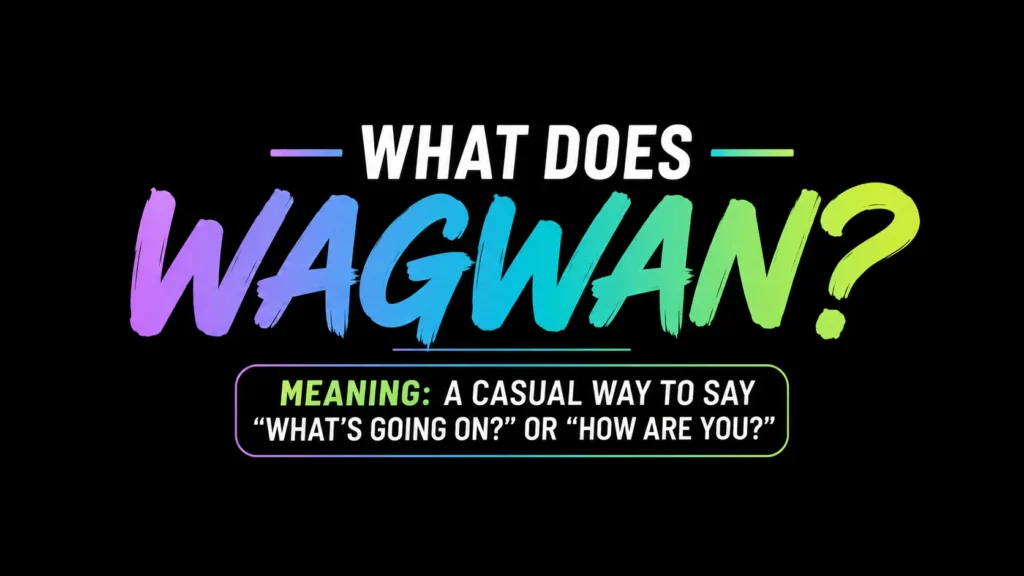
If you spend time on social media, watch British content, follow urban culture, or chat with younger generations online, you’ve probably seen or heard the word “wagwan.”
Many people search for the meaning of wagwan because it appears everywhere—from TikTok videos and Instagram captions to WhatsApp messages and casual conversations among friends.
At first glance, it can seem confusing. Is it a greeting? A question? A slang term? Or does it mean something completely different?
The truth is that wagwan is a friendly expression with deep cultural roots and a fascinating journey into mainstream internet culture. Understanding it helps you communicate naturally and avoid misunderstandings when interacting online.
In this guide, you’ll learn exactly what wagwan means, where it came from, how people use it today, and when you should—or shouldn’t—use it.
Meaning of Wagwan – Quick Meaning
Definition
“Wagwan” is a slang greeting that essentially means:
- What’s going on?
- What’s up?
- How are things?
- What’s happening?
It is commonly used as a casual way to start a conversation.
Simple Meaning
When someone says “wagwan,” they’re usually asking what is happening in your life at that moment.
Quick Examples
“Wagwan bro?”
“Wagwan, haven’t seen you in ages.”
“Yo, wagwan tonight?”
In most situations, it carries a friendly and relaxed tone.
Origin & Background
Jamaican Patois Roots
The phrase comes from Jamaican Patois.
Originally, “wah gwaan” translates roughly to:
“What is going on?”
Over time, the pronunciation and spelling evolved in everyday speech, leading many people to write it as “wagwan.”
Influence of Caribbean Communities
As Jamaican communities grew in countries such as the United Kingdom and Canada, the expression became more widely recognized.
Young people adopted it because it sounded casual, friendly, and culturally expressive.
Rise Through Music
Reggae, dancehall, grime, and hip-hop artists helped spread the phrase internationally.
Fans often repeated slang they heard in songs, making wagwan recognizable even among people with no Jamaican background.
Social Media Expansion
TikTok, Instagram Reels, YouTube Shorts, and meme culture accelerated its popularity.
Today, someone might use wagwan without knowing its original cultural roots.
How the Meaning Evolved
While the original meaning remains “what’s going on,” modern users often employ it simply as:
- Hello
- Hey
- What’s up
- How are you
The greeting has become more flexible than it was originally.
Real-Life Conversations
WhatsApp Conversation
Person A:
Wagwan bro?
Person B:
Not much, just finished work. You?
Person A:
Same here. Thinking about ordering food tonight.
Instagram DM
Person A:
Wagwan, long time no talk.
Person B:
I know! Life’s been crazy lately.
Person A:
We should catch up this weekend.
TikTok Comments
Person A:
Wagwan everyone, who’s watching from London?
Person B:
Wagwan! Watching from Manchester.
Person C:
Big vibes in the comments today.
Text Message
Person A:
Wagwan tonight?
Person B:
Movie and pizza at my place.
Person A:
Count me in.
Emotional & Psychological Meaning
What Emotion Does It Express?
Wagwan usually communicates:
- Friendliness
- Curiosity
- Connection
- Familiarity
- Social warmth
It feels more personal than a formal greeting.
Why People Use It
People enjoy slang because it creates a sense of belonging.
Using wagwan often signals:
- Shared culture
- Friendship
- Informality
- Group identity
What It Reveals About Modern Communication
Modern communication values speed and personality.
Rather than typing “How have you been recently?” many people simply say “wagwan.”
The message is shorter, faster, and feels more natural.
Personal-Style Scenario
Imagine receiving a message after a stressful day.
One friend texts:
“How are you today?”
Another texts:
“Wagwan?”
Both are asking about you.
However, the second message may feel warmer and more relaxed because it sounds like a friend casually checking in.
That’s part of its emotional appeal.
Usage in Different Contexts
Social Media
People commonly use wagwan in:
- Captions
- Comments
- Stories
- Livestream chats
Example:
“Wagwan everyone, hope you’re having a great day.”
Friends & Relationships
Among friends, the phrase feels natural and welcoming.
Example:
“Wagwan mate, where are you?”
Work or Professional Settings
Generally, wagwan is not suitable in formal business communication.
Instead, use:
- Hello
- Good morning
- How are you?
Casual vs Serious Tone
Casual:
“Wagwan bro?”
Serious:
“I’d like to discuss an important matter.”
The phrase works best in relaxed environments.
When NOT to Use It
Formal Emails
Avoid using wagwan when contacting:
- Employers
- Professors
- Clients
- Government officials
Professional Meetings
Business settings usually require more formal language.
Cultural Misunderstandings
Some people may not recognize the term and could become confused.
Sensitive Situations
Avoid using it during:
- Serious discussions
- Medical emergencies
- Legal matters
- Emotional crises
A more thoughtful greeting is usually better.
Common Misunderstandings
People Think It Means Goodbye
It doesn’t.
Wagwan is used at the beginning of conversations.
People Assume It’s British Slang Only
While popular in the UK, its roots come from Jamaican Patois.
People Use It in Formal Settings
This often sounds out of place.
Literal vs Figurative Meaning
Literally:
“What is going on?”
Figuratively:
“Hey, what’s up?”
Most modern users intend the figurative meaning.
Comparison Table
| Expression | Meaning | Tone | Similarity to Wagwan |
|---|---|---|---|
| What’s up? | What’s happening? | Casual | Very Similar |
| How’s it going? | How are things? | Friendly | Similar |
| Yo | Attention greeting | Informal | Related |
| Sup? | What’s up? | Casual | Similar |
| Hello | Standard greeting | Neutral | Less Similar |
| Good Morning | Formal greeting | Professional | Different |
| Goodbye | Farewell | Opposite Context | Opposite |
| Take Care | Closing phrase | Friendly | Opposite Usage |
Key Insight
Wagwan belongs to the same family of casual greetings as “what’s up” and “sup,” but it carries stronger cultural identity and social character.
Variations / Types
Wah Gwaan
Original Jamaican spelling.
Wagwan Bro
Greeting directed toward a friend.
Wagwan Fam
Used among close friends or social groups.
Wagwan G
Popular in urban slang culture.
Wagwan Mate
Common in British casual conversations.
Yo Wagwan
Combines two greetings.
Wagwan Everyone
Used when addressing groups.
Wagwan People
Friendly social media greeting.
Wagwan My Guy
Warm greeting toward a close friend.
Wagwan Today
Asks what’s happening currently.
How to Respond When Someone Uses It
Casual Replies
- Not much, you?
- All good here.
- Just chilling.
Funny Replies
- Surviving one coffee at a time.
- Living the dream… barely.
- Same chaos, different day.
Mature Replies
- Doing well, thanks for asking.
- Busy but productive.
- Everything’s going smoothly.
Respectful Replies
- I’m doing well, hope you are too.
- Thanks for checking in.
- Things are good on my side.
Regional & Cultural Usage
Western Culture
In the UK and Canada, wagwan is widely recognized among younger people and urban communities.
Asian Culture
Many younger users encounter the phrase through social media rather than everyday speech.
Middle Eastern Culture
It appears primarily online through international content and influencer culture.
Global Internet Usage
The internet has transformed wagwan into a globally recognized greeting.
Generational Differences
Gen Z
Frequently uses slang and internet expressions.
Wagwan feels natural and current.
Millennials
Generally understand the phrase but may use it less often.
Older generations may not recognize it at all.
Is It Safe for Kids?
Understanding the Context
Yes, wagwan is generally safe for kids.
It is not offensive, explicit, or harmful.
Parents should simply explain that it is informal slang and may not be appropriate in school assignments, formal emails, or professional situations.
Understanding when to switch between casual and formal language is the most important lesson.
FAQs
What does wagwan mean in texting?
It means “what’s going on?” or “what’s up?” and is used as a friendly greeting.
Is wagwan rude?
No. In most situations, it is friendly and informal.
Is wagwan Jamaican?
Yes. The expression originates from Jamaican Patois.
Can I use wagwan with strangers?
You can, but it works best with people who understand the slang.
Is wagwan the same as what’s up?
Almost. Both ask what is happening, though wagwan has specific cultural roots.
Why is wagwan popular on TikTok?
Social media trends, music, and online culture helped spread the phrase worldwide.
Can wagwan be used professionally?
Generally no. Formal greetings are more appropriate in professional settings.
Conclusion
The meaning of wagwan is simple on the surface but surprisingly rich in cultural significance. What began as a Jamaican Patois expression meaning “what’s going on” has grown into a globally recognized greeting used across social media, music, texting, and everyday conversations.
Its popularity comes from more than convenience. Wagwan feels warm, personal, and connected. It allows people to start conversations in a relaxed and authentic way.
As long as you understand its informal nature and cultural background, you can confidently recognize it, respond to it, and use it appropriately in casual conversations. Language constantly evolves, and wagwan is a perfect example of how local expressions can become part of global communication.