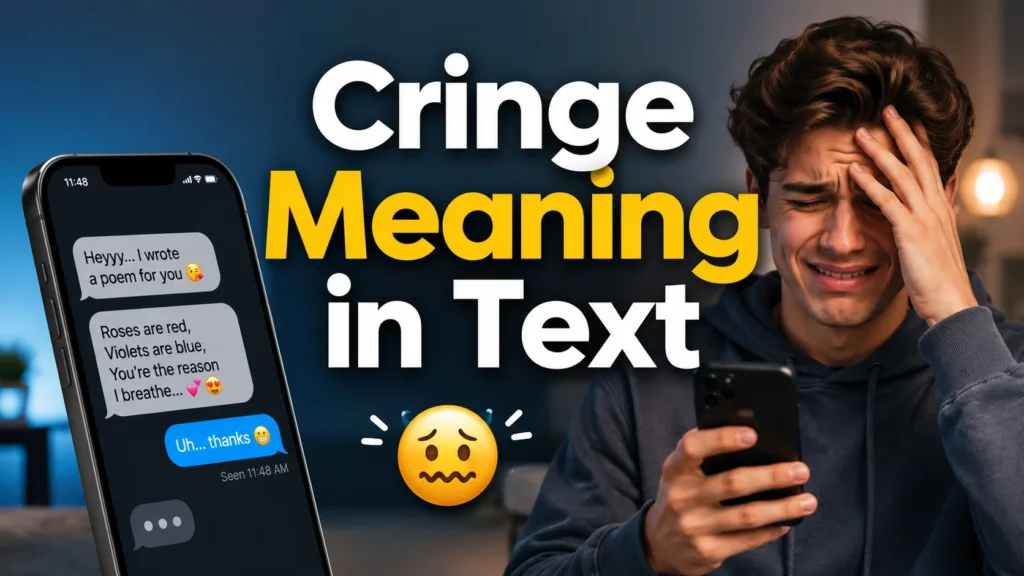
If you’ve ever received a message saying, “That’s so cringe,” or seen someone comment “cringe 😬” on TikTok, Instagram, or Snapchat, you may have wondered what they really meant.
The phrase cringe meaning in text has become one of the internet’s most common slang expressions. While it originally described a physical reaction of embarrassment, today’s digital communication has given it a broader meaning. People use it to describe awkward moments, embarrassing behavior, forced jokes, or anything that makes them feel secondhand embarrassment.
This guide explains exactly what “cringe” means in texting, where it came from, when to use it, when to avoid it, and how to respond naturally.
Cringe Meaning in Text – Quick Meaning
Simple Definition
Cringe in text means:
- Something is embarrassing or awkward.
- A person’s behavior feels forced or uncomfortable.
- You experience secondhand embarrassment for someone else.
People often use it as:
- An adjective: “That was cringe.”
- A verb: “I cringed watching that.”
- A noun (informal): “The cringe is real.”
Quick Examples
“He kept texting her after she ignored him. That’s cringe.”
“That dance challenge was kind of cringe.”
“I looked at my old Facebook posts and cringed.”
Origin & Background
Where Did “Cringe” Come From?
The word cringe has existed in English for centuries. Originally, it meant to shrink back in fear or discomfort.
Over time, its meaning evolved into emotional discomfort rather than physical fear.
Internet Culture
Around the late 2010s, platforms like:
- TikTok
- YouTube
- Twitter (X)
made cringe one of the internet’s favorite words.
People began labeling videos, comments, pickup lines, and awkward interactions as “cringe.”
Social Media Influence
Today, Gen Z especially uses cringe to describe:
- Forced humor
- Fake confidence
- Overacting
- Attention-seeking behavior
- Embarrassing posts
Its popularity continues because online culture changes rapidly, and people constantly evaluate what’s considered “cool” or “cringe.”
Real-Life Conversations
Person A: Did you text your ex five times?
and,
Person B: Yeah…
Person A: Bro… that’s cringe.
Instagram DM
Person A: Did you see his motivational reel?
Person B: Yes 😂
and,
Person A: It felt so fake.
Person B: Totally cringe.
TikTok Comments
User 1: Why is he acting like the main character?
User 2: Peak cringe.
Text Messages
Alex: I accidentally sent “I love you” to my boss.
Emma: OMG 😂😂
Alex: I’m never going back.
Emma: That’s the most cringe thing ever.
Emotional & Psychological Meaning
What Emotion Does It Express?
Cringe usually expresses:
- Embarrassment
- Discomfort
- Awkwardness
- Sympathy
- Secondhand embarrassment
Sometimes it’s playful.
Other times, it’s genuine criticism.
Why People Use It
Calling something cringe often means:
- “This feels unnatural.”
- “This is socially awkward.”
- “I’m uncomfortable watching this.”
Personal-Style Scenario
Imagine watching an old video of yourself from middle school where you’re trying way too hard to impress people.
Most people immediately think:
“I can’t believe I posted that.”
That uncomfortable feeling is exactly what cringe describes.
Usage in Different Contexts
Social Media
Common examples:
- Cringe TikTok videos
- Cringe memes
- Cringe dances
- Cringe captions
Friends & Relationships
Friends often joke:
“Don’t be cringe.”
Meaning:
“Don’t embarrass yourself.”
Work & Professional Settings
Avoid saying:
“Your presentation was cringe.”
Instead say:
- It felt awkward.
- It seemed unprofessional.
- It could be improved.
Casual vs Serious Tone
Casual:
“That’s cringe 😂”
Serious:
“That behavior made people uncomfortable.”
When NOT to Use It
Avoid using “cringe” when:
- Someone is sharing personal struggles.
- Someone is grieving.
- Someone is nervous.
- In formal business communication.
- During professional meetings.
- While giving respectful feedback.
Calling someone “cringe” can sound dismissive or even hurtful.
Common Misunderstandings
It Doesn’t Always Mean Bad
Something can be cringe but harmless.
For example:
Dad jokes.
Many people call them cringe while secretly enjoying them.
Literal vs Figurative
Literal:
“I cringed because the loud noise scared me.”
Modern slang:
“I cringed watching his pickup lines.”
Tone Confusion
Sometimes “cringe” is playful.
Sometimes it’s harsh criticism.
Context always matters.
Comparison Table
| Expression | Meaning | Tone |
|---|---|---|
| Cringe | Embarrassing or awkward | Negative |
| Awkward | Socially uncomfortable | Mild |
| Corny | Cheesy but harmless | Light |
| Embarrassing | Causes shame | Strong |
| Cool | Socially admired | Positive |
| Based | Confident and authentic | Positive |
| Try-hard | Trying too hard | Negative |
Key Insight
Although these expressions overlap, cringe usually focuses on the uncomfortable feeling viewers experience rather than the person’s intentions.
Variations / Types
1. So cringe
Very embarrassing.
2. Cringe worthy
Something that makes you cringe.
3. Cringe moment
An awkward situation.
4. Cringe content
Embarrassing videos or posts.
5. Cringe compilation
A collection of embarrassing clips.
6. Secondhand cringe
Feeling embarrassed for someone else.
7. Cringe post
An awkward social media post.
8. Cringe behavior
Socially uncomfortable actions.
9. Cringe joke
A joke that doesn’t land well.
10. Peak cringe
Extremely embarrassing.
How to Respond When Someone Uses It
Casual Replies
- Fair enough 😂
- I know.
- You’re probably right.
- Haha, I deserve that.
Funny Replies
- Let me embarrass myself in peace.
- Cringe today, legend tomorrow.
- That’s my hidden talent.
Mature Replies
- Thanks for being honest.
- I see what you mean.
- I’ll think about it.
Respectful Replies
- I appreciate your opinion.
- Thanks for the feedback.
- I’ll improve next time.
Regional & Cultural Usage
Western Culture
People casually use cringe for memes, dating, fashion, and entertainment.
Asian Culture
Among younger internet users, cringe is common in gaming, anime communities, and social media.
Middle Eastern Culture
English-speaking youth frequently use cringe in online conversations, especially on Instagram and TikTok.
Global Internet Usage
Cringe has become nearly universal in English-speaking online communities.
Even non-native speakers regularly use it.
Gen Z vs Millennials
Gen Z
Uses cringe almost daily.
Examples:
- “That’s cringe.”
- “So cringe.”
Millennials
Still use cringe but often prefer:
- Awkward
- Embarrassing
- Cheesy
Is It Safe for Kids?
Yes.
Cringe is generally considered safe and family-friendly slang.
However, children should learn not to use it to mock or bully others. Using the word respectfully helps maintain positive online interactions.
FAQs
What does cringe mean in texting?
It means something feels embarrassing, awkward, or uncomfortable.
Is cringe an insult?
Sometimes. It depends on the tone and context. Friends may use it jokingly, while strangers may use it more critically.
What does “you’re cringe” mean?
It means someone thinks your behavior is awkward or embarrassing.
Is cringe positive or negative?
Usually negative, although it can be playful among close friends.
What is secondhand cringe?
It means feeling embarrassed on someone else’s behalf.
Can adults use the word cringe?
Absolutely. While it’s especially popular with Gen Z, people of all ages use it online and in casual conversations.
Why is “cringe” so popular?
Because it quickly describes the uncomfortable feeling of witnessing awkward behavior, making it perfect for fast-paced social media conversations.
Conclusion
The cringe meaning in text is much more than simply calling something embarrassing. It’s a modern internet expression that captures the feeling of secondhand embarrassment, awkwardness, or discomfort when someone’s actions seem forced or socially out of place.
Whether you’re chatting with friends, scrolling through TikTok, or reading Instagram comments, understanding this slang helps you better interpret online conversations. Like many internet expressions, context matters. Used playfully, “cringe” can be funny. Used carelessly, it can come across as hurtful.
Knowing when—and when not—to use it will help you communicate more confidently in today’s digital world.

