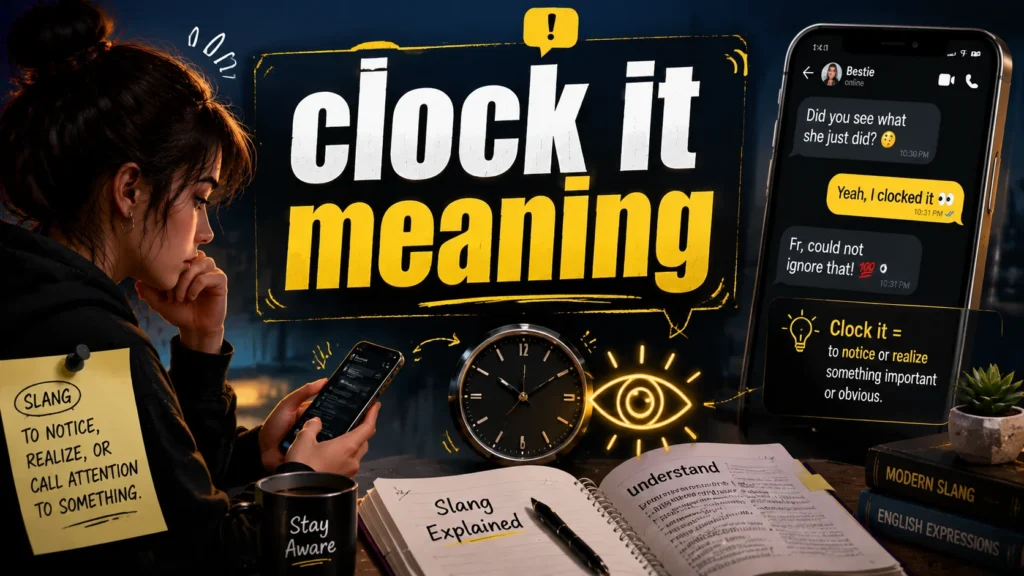
If you’ve seen someone say “I clocked that” or “Did you clock it?” in a message, you’re not alone in wondering what it actually means.
The phrase clock it pops up everywhere—on social media, in group chats, and even in casual conversations. But here’s the thing: it doesn’t mean what it sounds like at first. It’s not about time at all.
People search for “clock it meaning” because the phrase feels slightly mysterious. It sounds simple, but the tone can shift depending on context—sometimes playful, sometimes sharp, and sometimes surprisingly emotional.
This guide clears that confusion. By the end, you’ll not only understand what “clock it” means—you’ll feel when to use it, how to respond, and why it says more than it seems.
Clock It Meaning – Quick Meaning
“Clock it” means to notice, recognize, or pick up on something—often something subtle, hidden, or unspoken.
It usually implies awareness, attention, or catching a detail others might miss.
In simple terms:
- To notice something quickly
- To understand what’s really going on
- To spot behavior, emotions, or hidden meaning
Examples:
- “I clocked that look you gave him.”
- “Did you clock what she said?”
- “He thought no one noticed, but I clocked it.”
Origin & Background
“Clock it” didn’t start in modern texting—it actually has deeper cultural roots.
The phrase comes from African American Vernacular English (AAVE) and was widely shaped by ballroom and drag culture, where “clocking” meant identifying or calling out something about a person—often sharply and directly.
Over time, the meaning softened.
Instead of always calling someone out, it began to mean simply noticing something. Social media platforms like TikTok, Instagram, and Twitter helped spread it globally. Now, it’s part of everyday slang, especially among younger users.
Interestingly, its tone evolved too:
- Earlier: more confrontational (“I see through you”)
- Now: more observational (“I noticed that”)
That shift is why context matters so much today.
Real-Life Conversations
WhatsApp Chat
Person A: Did you see how quiet she got when his name came up?
Person B: Yeah… I clocked that immediately.
Instagram DMs
Person A: Why did he like your old pics suddenly?
Person B: Oh, I clocked that. He’s definitely trying something.
TikTok Comments
User 1: Nobody noticed the background change??
User 2: I CLOCKED IT 😭
Text Messages
Person A: He said he was “busy,” but posted a story.
Person B: I clocked that too. Something’s off.
These examples show how natural and emotional the phrase feels—it’s rarely just about observation. It’s about reading between the lines.
Emotional & Psychological Meaning
“Clock it” carries more emotional weight than it seems.
At its core, it expresses:
- Awareness
- Intuition
- Subtle judgment
- Emotional intelligence
When someone says “I clocked it,” they’re often saying:
“I understand what’s really happening—even if nobody else does.”
It can also create a sense of connection. Two people who “clock” the same thing feel like they’re on the same wavelength.
A real-life style scenario
You’re sitting with friends, and someone makes a slightly passive-aggressive comment. Everyone laughs it off—but you catch the tension.
Later, your friend texts:
“Did you clock what she said earlier?”
That moment? It’s not just observation. It’s shared understanding.
Usage in Different Contexts
Social Media
Used casually to react to posts, comments, or drama.
- “I clocked that detail!”
- “Everyone missed it but I didn’t.”
Friends & Relationships
Often used to point out behavior or emotions.
- “I clocked your mood change.”
- “Don’t think I didn’t clock that.”
Work / Professional Settings
Use carefully. It can sound too informal or slightly confrontational.
- Better alternative: “I noticed that…”
Casual vs Serious Tone
- Casual: playful, observational
- Serious: can feel like calling someone out
Tone depends heavily on delivery.
When NOT to Use It
There are moments where “clock it” can backfire.
- In formal emails or workplace communication
- When addressing sensitive topics directly
- With people unfamiliar with slang
- In cross-cultural conversations where meaning may be unclear
It can come across as sarcastic or accusatory if misused.
Common Misunderstandings
1. Thinking it means time-related
It has nothing to do with clocks or time.
2. Assuming it’s always negative
Not true—it can be neutral or even supportive.
3. Confusing it with “calling out”
While it can imply that, it often just means noticing.
4. Tone confusion
Without context, it may sound passive-aggressive.
Comparison Table
| Expression | Meaning | Tone |
| Clock it | Notice or recognize something | Observational |
| Call it out | Publicly confront something | Direct/Confrontational |
| Spot it | See something quickly | Neutral |
| Pick up on | Understand subtle cues | Thoughtful |
| Miss it | Fail to notice | Opposite |
Key Insight
“Clock it” sits in a unique space—it’s not just noticing, it’s noticing with awareness and intention. That’s what gives it emotional depth.
Variations / Types
- Clocked it – Past tense; already noticed
- Clock that – Emphasis on noticing something now
- I clock you – I understand your behavior or intention
- Don’t think I didn’t clock that – Slightly confrontational
- Clock the vibe – Recognize the mood or atmosphere
- Clock the energy – Sense emotional tone
- Clocked the situation – Understood what’s happening
- Clock it immediately – Noticed instantly
- Clock that real quick – Casual emphasis
- Clock the detail – Notice something small but important
How to Respond When Someone Uses It
Casual Replies
- “Haha yeah, same.”
- “Right? I saw that too.”
Funny Replies
- “My detective skills are elite 😎”
- “Nothing gets past me.”
Mature Replies
- “Yeah, I noticed that as well.”
- “It stood out to me too.”
Respectful Replies
- “Good observation.”
- “I appreciate you pointing that out.”
Regional & Cultural Usage
Western Culture
Common in Gen Z slang and online conversations.
Asian Culture
Less common, but gaining popularity through global media.
Middle Eastern Culture
Used mainly among younger, English-speaking audiences.
Global Internet Usage
Now widely understood due to TikTok and meme culture.
Generational Differences
- Gen Z: uses it naturally and frequently
- Millennials: understand it but use it less often
Is It Safe for Kids?
Yes, “clock it” is generally safe.
It doesn’t carry offensive meaning. However, context matters—if used in a confrontational way, it can still create tension.
FAQs
1. What does “clock it” mean in texting?
It means noticing or recognizing something, especially something subtle.
2. Is “clock it” rude?
Not inherently. Tone and context decide whether it feels neutral or sharp.
3. Does “clock it” mean call out?
Sometimes, but usually it just means noticing—not confronting.
4. Where did “clock it” come from?
It originated from AAVE and ballroom culture before becoming mainstream slang.
5. Can I use it professionally?
It’s better to avoid it in formal communication.
6. Is it popular on TikTok?
Yes, it’s widely used in comments and reactions.
Conclusion
“Clock it” is one of those phrases that quietly says a lot.
It’s about awareness, perception, and reading between the lines. It shows emotional intelligence in a simple, modern way.
Once you understand it, you start noticing how often it appears—and how naturally it fits into conversation.
And maybe the best part?
Now you won’t just understand it—you’ll clock it every time.