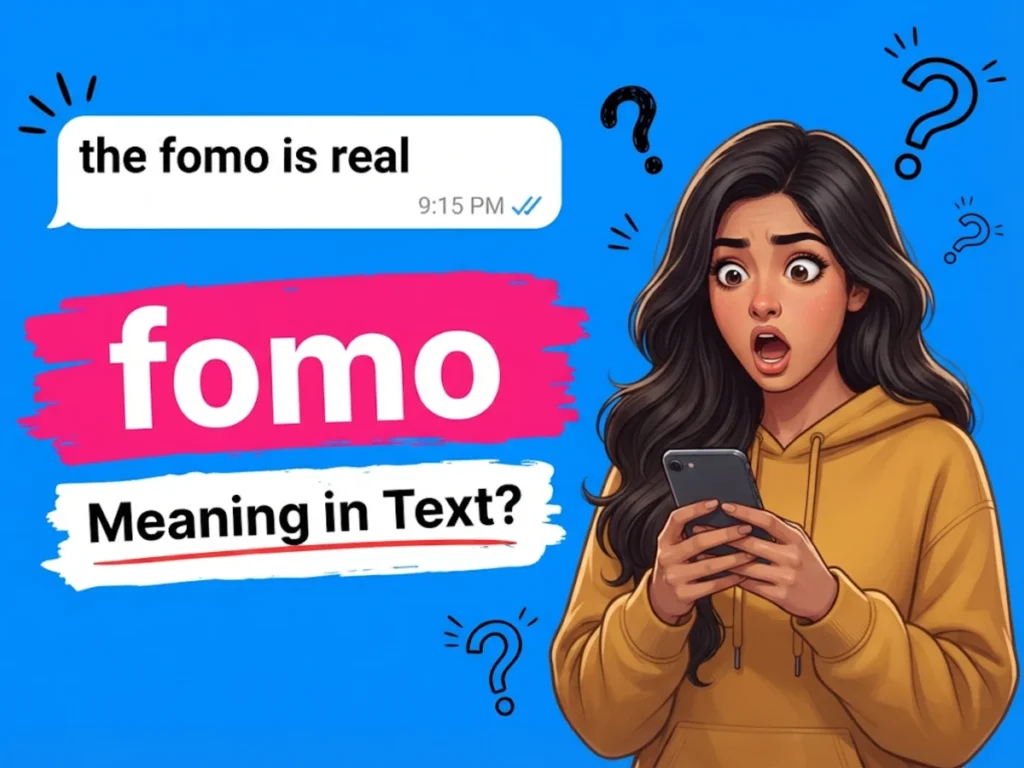
The FOMO meaning in text is “fear of missing out,” the anxious feeling that other people are having fun, making plans or getting something good without you. When someone texts “major fomo rn,” they’re telling you they wish they were there.
It’s one of the few texting acronyms that is also a real dictionary word. Even so, people still search it, usually because a friend dropped it under a party photo or in a group chat, and they want to know if it’s a joke, a complaint or a hint to be invited next time.
READ MORE: WYA Meaning in Chat Explained Simply & Clearly
FOMO Meaning in Text, Explained Simply
FOMO is an acronym that stands for “fear of missing out.” Merriam-Webster defines FOMO as anxiety about being left out of an enjoyable experience that others are having. It labels the word informal and dates its first known use to 2004.
In texts, the meaning shows up in a few flavors, listed here from most to least common:
- Missing a social event: “watching everyone’s stories from the concert, the fomo is unreal.”
- Fear of skipping a deal or drop: “only 3 left?? fomo is making me buy it.”
- A reason to say yes: “I’m tired but fomo says I should come.”
In every case, though, the core idea is the same. Someone feels pulled toward something because they don’t want to be left out.
How people type it
You’ll see “fomo,” “FOMO” and occasionally “Fomo.” Lowercase is the most relaxed. All caps doesn’t change the meaning, though it can look more dramatic, as in “THE FOMO.” People also stretch it for effect, like “fomooo,” and pair it with “rn,” “so bad” or “is real.”
Where it shows up in text form
Above all, it turns up in iMessage, SMS and WhatsApp chats about weekend plans. Beyond that, it’s common in Instagram and Snapchat DMs, especially as a reply to someone’s story. Discord servers use it too, often around game launches or events.
The Real Origin of FOMO
Unlike a lot of slang, this acronym didn’t start on TikTok or in a meme. According to Wikipedia’s article on the fear of missing out, Patrick J. McGinnis popularized the acronym in a 2004 op-ed in The Harbus, the Harvard Business School magazine, while he was a student there.
Before that, marketing strategist Dan Herman used the phrase “fear of missing out” in the late 1990s and in a 2000 journal paper, though not the acronym itself. Herman has said that mobile phones, texting and social media helped the idea spread to everyone else.
That history explains its unusual position, and it also shapes the FOMO meaning in text today. It began as campus and business slang, then became a texting shortcut once group chats and photo feeds made it easy to see exactly what you were missing.
How Tone Changes the FOMO Meaning in Text
The acronym can be a laugh, an eye-roll or a real confession. Here’s how each one looks in a chat.
Funny
A: you’re missing the karaoke night btw
B: I’m in bed eating cereal
A: Jake just did a full Celine Dion
B: the fomo is physically painful
Sarcastic
A: they’re posting pics from the tax seminar
B: wow, huge fomo
A: free pens though
B: ok now I’m actually jealous
Playful
A: the dog park has a puppy party today
B: stop it
A: there are tiny hats
B: fomo. I’m leaving work early
Serious
A: everyone went to the lake without telling me
B: oh no, did they forget?
A: idk, the fomo is making me feel kind of left out
B: want me to ask? or we can do something this weekend
Twelve Real Text Conversations Using FOMO
Each of these shows the FOMO meaning in text inside a different relationship. Notice how much the surrounding words shape the feeling.
Best friends
A: are you coming to the bonfire
B: I have a paper due
A: there’s s’mores
B: ugh fomo. save me one
Dating couple
A: the guys are at the game tonight
B: you can go, babe
A: no, I’ll stay
B: I can feel your fomo from here 😂
Coworkers
A: half the team went to lunch at the new taco place
B: I was in that 1pm call
A: same, mega fomo
B: let’s go tomorrow
Parent and college kid
A: how’s campus?
B: everyone is at the formal and I have the flu
A: sorry sweetie. fomo?
B: so much fomo, mom
Siblings
A: mom took you to the outlet mall without me??
B: you were asleep
A: fomo AND betrayal
B: I got you socks
New neighbors
A: hey, we’re having a small BBQ Saturday if you want to stop by
B: oh nice, I’ll try!
A: no pressure
B: honestly the fomo will get me there
Group chat friends
A: who’s in for the 2am diner run
B: I have work at 8
A: so is that a yes
B: fomo wins. omw
Gamers on Discord
A: the event skin disappears tonight
B: I don’t even play that mode
A: never coming back though
B: fine, the fomo got me
Roommates
A: the building rooftop is open, people are watching the meteor shower
B: I’m in pajamas
A: everyone is
B: ok fomo, coming up
Long-distance friends
A: we’re all at the cabin and it’s snowing
B: send videos
A: you’d love this
B: watching from here with full fomo
Teammates
A: coach is buying pizza after practice
B: I’m stuck in traffic
A: there are like 8 pizzas
B: drive faster fomo is real
Shopping buddies
A: the sale ends at midnight
B: I don’t need anything
A: the jacket you liked is 40% off
B: fomo is a powerful force
Grammar: How FOMO Fits Into a Text
Grammatically, it works as a noun. That’s why it pairs with “have,” “get” or “the”: “I have fomo,” “I got fomo,” “the fomo is real.” Some people treat it like an adjective, as in “I’m so fomo,” although that’s less common and sounds very casual.
In addition, it can stand alone as a reply. For instance, a friend sends a beach photo and you answer “fomo.” That one word does a lot of work, since it says “that looks great and I’m jealous.”
Meanwhile, capitalization is mostly style. Lowercase feels chatty, while all caps adds drama without changing the meaning. Because it’s in major dictionaries, it’s less informal than most texting slang. Even so, it still belongs in casual messages rather than a cover letter.
How to Reply When Someone Says They Have FOMO
Funny replies
- “Don’t worry, it was mostly people standing around.”
- “I’ll send you the blurry videos as compensation.”
- “Fomo is just the universe’s RSVP reminder.”
Serious replies
- “Sorry you couldn’t make it. Want to plan something soon?”
- “We missed you. Next time, let’s pick a day that works for you.”
Flirty replies (with a partner or crush)
- “You’d have been the best part of it.”
- “Next time, you’re my plus-one.”
Neutral or unbothered replies
- “Next time!”
- “Valid lol”
- “There’ll be more.”
FOMO vs Related Texting Terms
Several terms orbit the FOMO meaning in text, and one is its direct opposite.
| Term | Meaning | Usage Context | Tone | Popularity | Confusion Risk |
|---|---|---|---|---|---|
| FOMO | Fear of missing out | Missing events, deals, trends | Playful to anxious | Very high | Low |
| JOMO | Joy of missing out | Happily staying home | Content, smug | Medium | Medium, often mistaken for a typo |
| FOBO | Fear of a better option | Refusing to commit to plans | Indecisive | Low | High |
| YOLO | You only live once | Justifying a risky or fun choice | Hype | High | Low |
| WYA | Where you at | Asking where someone is | Casual | High | Low |
| IRL | In real life | Contrasting online and offline | Neutral | High | Low |
Notably, JOMO is the opposite feeling. Merriam-Webster even links it as a counterpart, describing pleasure in skipping something rather than worry about it.
Who Uses FOMO and Where
Because the acronym dates back to 2004, it crosses age groups more than most texting terms. Since it has been around for two decades, many Millennials have used it for years. Gen Z uses it as well, though often in a lighter, joking way, like “fomo” about a sale or a sold-out drop.
Because it appears in mainstream dictionaries, English speakers broadly recognize it. We haven’t found reliable data on regional differences, so we won’t claim any. On platforms, private chats come first. After that come DM replies to stories, where the “missing out” is visible in the photo itself.
Is It Okay to Text FOMO?
First of all, the acronym is clean, with no profanity and no explicit meaning. It’s also widely known, so it’s one of the safer abbreviations to use with parents, teachers or even a relaxed coworker.
That said, context still matters. Telling a boss “huge fomo” about a team event can sound like a complaint about not being invited. Also, be gentle if someone uses it seriously. When a friend says they felt left out, a joking reply can make them feel worse.
A Close Look at Why FOMO Lands in Texts
What makes this acronym special is timing. Texts and stories show you an event while it’s still happening, so the feeling arrives in real time, not days later. As a result, “fomo” often works as a live reaction rather than a complaint. On top of that, it’s surprisingly useful as a gentle hint. Saying “major fomo” lets someone admit they wish they’d been included, without making it an accusation.
FOMO Meaning in Text: Common Questions
Is it rude to reply with just “fomo” in a text?
Usually, no. A one-word “fomo” reply to a party photo reads as friendly jealousy, which most people take as a compliment. However, if the other person just told you about something stressful, a one-word reply can seem off. Match it to the mood of what they sent.
What’s the difference between texting FOMO and saying it out loud?
People do say “fomo” out loud as a word, rhyming with “promo.” In a text, it’s lighter and faster, and you can stack it with emojis. Out loud, tone of voice shows whether you’re joking or actually disappointed, which a text can’t always do.
Does FOMO mean the same thing in a group chat vs a 1-on-1 text?
The meaning doesn’t change, though the message behind it might. In a group chat, it’s usually a playful reaction to a photo everyone can see. In a private text, it can be a quieter way of saying “I wish you’d invited me.”
Is FOMO a real word?
Yes. Merriam-Webster lists it as an informal noun, and other major dictionaries include it too. So it has moved beyond pure slang, even though it started as an acronym.
Is FOMO a mental health term?
It describes a common feeling rather than a medical diagnosis. Writers often connect it to social media, since feeds show you what others are doing. Still, if you use it in texts, people will read it as everyday language, not a clinical statement.
What’s the opposite of FOMO?
The usual answer is JOMO, “joy of missing out.” It describes feeling happy, not anxious, about skipping something. For example, “staying in with soup, full jomo.”
Can FOMO be about shopping?
Definitely. In fact, many people use it about limited sales, product drops or events with tickets. In those texts, it suggests urgency, such as “fomo made me buy it.”
Wrapping Up the FOMO Meaning in Text
FOMO means “fear of missing out,” and it’s how people admit they wish they were somewhere, or had something, that others are enjoying right now.
Tips for using it:
- Use it as a quick, friendly reaction to photos and plans.
- Add “is real” or “rn” for a more casual feel.
- Use it as a soft hint when you’d like to be included next time.
- Try JOMO when you’re happily staying in.
Mistakes to avoid:
- Joking about it when someone is genuinely hurt about being left out.
- Using it with a boss in a way that sounds like a complaint.
- Confusing it with FOBO, which is about indecision.
- Overusing it until it stops meaning anything.
Text it when you’re reacting to fun you missed or a deal you can’t resist. Meanwhile, skip it in formal messages, or when someone needs comfort instead of a joke.