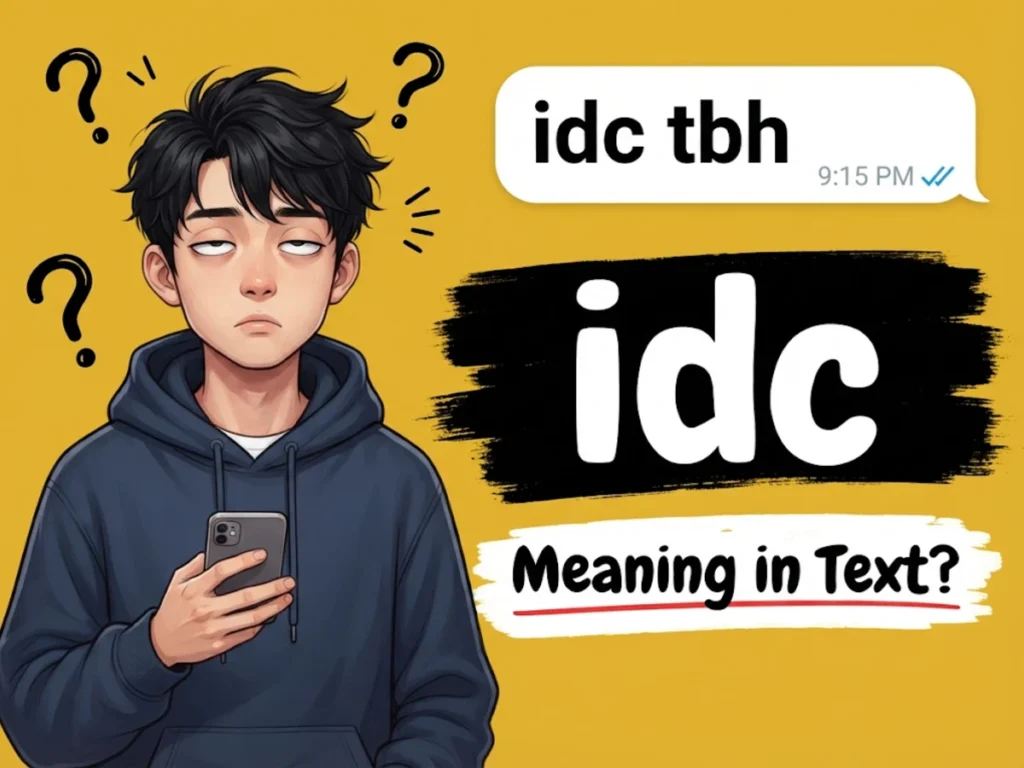
The IDC meaning in text is “I don’t care.” When someone sends you “idc,” they’re telling you the choice, topic, or outcome doesn’t matter much to them, either because they’re easygoing or because they’ve checked out of the conversation.
That second part is why people look it up. After all, “idc, you pick” and “idc.” with a full stop feel completely different on a screen. So this guide explains both readings, shows how to tell them apart, and covers what to send back.
READ MORE: WTV Meaning in Text Explained Simply with Examples
IDC Meaning: The Short Answer
IDC is an abbreviation of a full sentence: I Don’t Care. Dictionary.com lists the “I don’t care” sense as American and says it comes from its use in digital communications. In casual chats, it’s almost always typed in lowercase.
Outside texting, the same letters have other jobs. In British English, IDC can mean an industrial development certificate. Meanwhile, tech news often mentions IDC, the market research firm. None of those show up in a text from your friend, though, so context settles it fast.
Flexible or Fed Up? The Two Faces of IDC
Here’s the detail that makes this abbreviation tricky. “I don’t care” can be generous, as in “anything works for me.” Yet it can also be cold, as in “stop asking me.” The letters stay the same, while the surrounding words do all the work.
The easygoing version
This usually comes attached to a choice. For example, “idc, wherever you want” or “idc which movie” means the person is flexible. In fact, they’re often trying to be nice by letting you decide.
The dismissive version
This one tends to arrive alone, sometimes with a period. For instance, a bare “idc.” after you share news can sting. It suggests boredom, hurt feelings, or a wish to end the topic.
How tone shows up in real chats
Funny:
A: should i get the giant pretzel or the small one
B: idc but you know the answer
A: giant it is
Sarcastic:
A: i reorganized the whole spice rack alphabetically
B: wow. riveting. idc
A: rude, it looks amazing
Playful:
A: guess who’s stealing your hoodie again
B: idc as long as i get it back eventually 😌
A: no promises
Serious:
A: are you upset about tonight?
B: honestly idc anymore. i’m just tired
A: ok, want to talk tomorrow?
Where the Abbreviation Shows Up
Texting is its natural home. On SMS and iMessage, it often answers quick questions about food, plans, or timing. On WhatsApp, it pops up in group chats when everyone is voting on something and one person just wants a decision.
In DMs, it works the same way. On Instagram and Snapchat, it’s a fast reply to “which pic should I post?” On Discord, gamers use it when picking maps or modes. Because it’s so short, it fits any chat app without changing meaning.
Spelling variants
- “idc” in lowercase is the standard, relaxed form.
- “IDC” in caps can read as louder or more annoyed.
- “idrc” adds “really” and softens it slightly.
- “idcccc” with stretched letters feels playful, not angry.
Grammar and Sentence Role
Grammatically, IDC works as a complete clause with a subject and a verb. Therefore it can stand alone as a full reply. It also slides into longer sentences, either at the start (“idc what we eat”) or at the end (“pick any, idc”).
Punctuation shifts the mood. A trailing period makes it flatter and colder, while an emoji or “lol” makes it lighter. In short, it belongs in informal register only, never in formal writing.
The IDC Meaning in Real Chat Examples
Friends choosing dinner:
A: tacos or pizza?
B: idc, both slap
A: tacos then
B: perfect
Partners planning a night in:
A: horror or comedy tonight?
B: idc as long as there’s popcorn
A: comedy, i’m scared enough already
Coworkers on a team chat:
A: should the meeting be 2 or 3?
B: idc, whatever works for the client
A: 3 it is
Siblings arguing:
A: you took the last cookie
B: idc 🍪
A: i’m telling mom
Parent checking in:
A: Do you want chicken or fish for dinner?
B: idc, either is fine
A: Chicken then
A stranger on a marketplace app:
A: can you do $40 instead of $50?
B: idc, just pick it up today
A: deal
Best friends after a breakup:
A: he posted a new pic
B: idc what he does now
A: proud of you fr
Roommates splitting chores:
A: want trash or dishes this week?
B: idc, i’ll take whatever’s left
A: dishes are yours lol
Gaming friends:
A: which map?
B: idc just queue
A: ok loading
A tense text between friends:
A: you didn’t even say happy birthday
B: idc about birthdays, you know that
A: still would’ve been nice
A classmate sorting a group project:
A: do you want the intro or the conclusion?
B: idc, you choose first
A: i’ll take the intro
How to Reply to IDC
Your reply should match which version you got. Here are text responses for every mood.
- Funny: “great, then we’re getting the weirdest option on the menu”
- Serious: “Is everything okay? You seem off today.”
- Flirty: “you say that, but i know you care a little 😏”
- Neutral: “ok, i’ll pick then”
If you’re unsure which version it was, simply make the decision and see how they react. Alternatively, ask a gentle follow-up if the chat felt tense.
IDC Meaning vs Similar Abbreviations
Several shortcuts sit close to IDC, and people often mix them up. This table shows the IDC meaning next to its neighbors.
| Term | Meaning | Usage Context | Tone | Popularity | Confusion Risk |
|---|---|---|---|---|---|
| IDC | I don’t care | Choices, shrugging off topics | Neutral to cold | Very high | Medium (easygoing vs dismissive) |
| IDM | I don’t mind | Polite flexibility | Warm | Medium | Low |
| IDK | I don’t know | Uncertainty | Neutral | Very high | Medium (looks similar) |
| IDRC | I don’t really care | Softer indifference | Mild | Medium | Low |
| WTV | Whatever | Brushing something off | Dismissive | High | Low |
| ILY | I love you | Showing care (opposite feeling) | Warm | High | Low |
Who Sends It Most
Teens and young adults use it constantly because it’s quick and fits fast chats. Gen Z often pairs it with emojis or extra letters to keep it from sounding harsh.
Since it’s plain English shorthand, it travels well across English-speaking countries. However, older relatives may misread it. They may also read it as blunter than you meant.
Where IDC Came From
The phrase “I don’t care” is ordinary English. According to Dictionary.com’s entry for IDC, the abbreviated form comes from its use in digital communications.
It belongs to the same SMS shorthand family as IDK and BRB. Those abbreviations grew out of fast typing on small keyboards rather than a viral meme. So, unlike many slang words, it has no single famous moment behind it. Instead, it just became the quickest way to type a very common feeling.
Is IDC Rude?
It can be, depending on the moment. On its own, the IDC meaning is neutral, and it isn’t profane or explicit. Still, a lone “idc” in response to someone’s excitement can feel like a door slamming.
- At work, use “either option works for me” instead.
- With teachers or professors, avoid it completely.
- With family, add context so it doesn’t sound cold.
With anyone who doesn’t text in slang, spelling out “I don’t mind” is the safer choice, since it carries the flexible meaning without the cold edge.
Why a Shrug Works So Well in Text
What makes this abbreviation durable is that it does two jobs at once. It hands over control of a small decision, which keeps chats moving. At the same time, it lets people show distance without writing a whole message about it. That double use is also why the IDC meaning causes so much second-guessing. Ironically, the people who reply “idc” quickly are often the ones being kind, while a slow, lone “idc” hours later usually means the opposite.
FAQs About the IDC Meaning
Is it rude to reply with just “idc” in a text?
It can come across that way. A single “idc” gives the other person nothing to work with. If you’re simply flexible, add a few words like “idc, you choose.” That small change turns a shrug into a kind gesture.
What’s the difference between texting IDC and saying it out loud?
Out loud, your voice shows whether you’re relaxed or irritated. In a text, however, readers only see three letters and punctuation. That’s why the same words can feel friendly in person but cold on a screen. Adding an emoji helps close that gap.
Does IDC mean the same thing in a group chat vs a 1-on-1 text?
The meaning stays “I don’t care,” but the effect changes. In a group chat, it’s usually a vote of “anything works.” In a private chat, by contrast, it feels more personal, so a bare one can seem dismissive.
What does IDC mean from a girl or a guy?
It means the same thing either way. Context matters far more than who sends it. If it’s attached to a choice, they’re flexible. If it follows a disagreement, they may be upset.
Is IDC the same as IDK?
No. IDK means “I don’t know,” while IDC means “I don’t care.” They look alike, so people mix them up. One expresses uncertainty; the other expresses indifference.
Can IDC mean something else?
Yes, though not usually in texts. Dictionary.com lists “industrial development certificate” as a British meaning. Also, IDC is the name of a tech research firm. In a casual chat, though, it’s almost always “I don’t care.”
How do I respond when someone says idc during an argument?
Pause before replying. Often, “idc” in a fight signals hurt rather than true indifference. A calm “it sounds like you’re frustrated, can we talk later?” usually works better than matching their tone.
Final Thoughts on IDC in Texts
The IDC meaning is simple: “I don’t care.” What changes is the feeling behind it, which can range from easygoing to fed up.
Usage tips:
- Attach it to a choice to sound flexible.
- Add an emoji or “lol” to soften it.
- Use “idm” if you want to sound warmer.
- Keep it for friends and casual chats.
Common mistakes:
- Sending a lone “idc.” after someone shares good news.
- Confusing IDC with IDK.
- Using it with a boss, client, or teacher.
- Assuming every “idc” is an insult.
Overall, use it when you’re truly flexible or want to end a minor debate. Avoid it when someone is excited, upset, or waiting on a real answer.