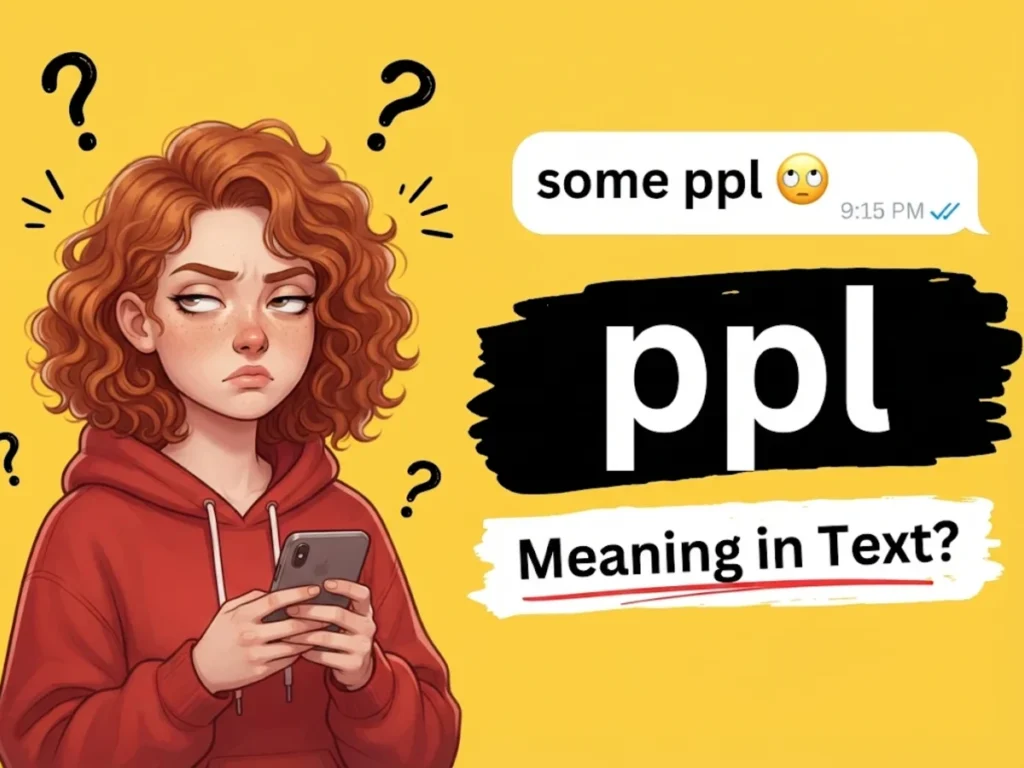
The PPL meaning in text is almost always “people.” Someone who texts “ppl are so loud here” means “people are so loud here.” It’s a shortened spelling that drops the vowels, which makes it quick to type and easy to read once you know it.
Still, the letters can trip you up. In grammar books, ppl. stands for “participle,” and in some technical contexts it means something else entirely. Plus, phrases like “some ppl” can carry a little shade. This guide sorts out every reading and the tone behind each.
READ MORE: SMTH Meaning in Text — What Does SMTH Mean?
PPL Meaning in Text, Explained Simply
PPL is an abbreviation, not an acronym. In other words, it doesn’t stand for three separate words. Instead, it squeezes one word, “people,” down to its main consonants: P, P, and L.
As a result, it’s different from most chat shorthand. LOL, TY, and BRB each pack several words into initials. By contrast, PPL works like “msg” for “message” or “smth” for “something,” keeping just enough letters to stay readable.
Other Meanings of PPL
- Participle (grammar): Merriam-Webster lists “ppl” as an abbreviation for “participle,” and Dictionary.com lists “ppl.” the same way. You’ll see it in dictionaries and grammar notes, not in texts.
- Parts per litre: Wiktionary records this technical use. It appears in science or measurement contexts.
In a text from a friend, however, “people” is the answer nearly every time.
How People Type It
Generally, lowercase “ppl” is the norm. All caps, “PPL,” appears too, especially in angry or excited messages. Sometimes people write “ppls” as a playful plural, though it isn’t standard. Meanwhile, spaced or dotted versions like “p.p.l.” are very rare in chats.
Where It Appears
You’ll find it in SMS, iMessage, and WhatsApp chats, especially in longer messages where people save keystrokes. It’s also common in Instagram, Snapchat, and Discord DMs, along with group chats where people vent or plan.
Common Phrases Built With PPL
Because it replaces a regular noun, PPL slots into everyday phrases. Here are the ones you’ll see most:
- “some ppl” usually points at someone without naming them, often with mild shade.
- “my ppl” means “my people,” as in your friends, family, or crew.
- “ppl say” passes along general opinion, like “ppl say the new café is good.”
- “too many ppl” is a quick complaint about crowds.
Notice that the tone comes from the phrase, not the letters. “My ppl 🫶” is warm, while “some ppl need to learn manners” is pointed.
How Tone Shifts the Meaning of PPL
Funny
A: Why are there 40 ppl in line for a donut
B: because it’s a VERY good donut
A: is it worth an hour
B: it’s worth two
Sarcastic
A: Some ppl just never text back 🙃
B: I was in the shower for 10 minutes
A: a likely story
B: ok I fell asleep
Playful
A: Missed my ppl this week
B: your ppl missed you too
A: dinner Friday?
B: obviously
Serious
A: I don’t like ppl talking about you behind your back
B: thanks for telling me
A: just wanted you to know
B: I appreciate you looking out
Grammar: Where PPL Fits
Grammatically, PPL is a plural noun, just like “people.” Therefore, it takes plural verbs: “ppl are,” not “ppl is.” It can be a subject (“ppl love this”), an object (“I hate crowds of ppl”), or part of a phrase (“my ppl”).
Unlike interjections such as “ty,” it rarely stands alone as a full reply. One exception is a short answer to “Who’s coming?” where “like 10 ppl” works fine. Capital letters change emphasis, not meaning. “PPL ARE SO RUDE” simply reads as shouting.
The register is informal. So, in essays, emails, or anything official, spell out “people.”
Real Chat Examples of PPL
Friends at a concert:
A: where are you
B: by the stage, so many ppl here
A: wave your phone light
B: waving now
Partners planning a dinner:
A: How many ppl should I book for?
B: 6, my sister is coming
A: perfect, booking now
B: you’re the best
A coworker before a meeting:
A: How many ppl confirmed for the training?
B: 12 so far
A: let’s print 15 handouts
B: on it
A parent checking plans:
A: Who’s going to the party?
B: just ppl from my class
A: and an adult will be there?
B: yes mom, her parents
Siblings and holiday plans:
A: Too many ppl at grandma’s this year
B: 23 at last count
A: I’m hiding in the kitchen
B: save me a seat
A stranger in a group chat for a hike:
A: How many ppl are joining Saturday?
B: around 8 so far
A: is parking easy?
B: arrive early, it fills up fast
Gaming friends on Discord:
A: we need 2 more ppl for the squad
B: I’ll ping Jay and Mo
A: tell them 9pm
B: done
A roommate venting:
A: Some ppl leave dishes in the sink for three days
B: I know you mean me
A: I didn’t say names
B: washing them now
Friends after a show:
A: ppl were crying at the ending
B: I was ppl
A: lol same
B: no shame
A classmate asking about a project:
A: How many ppl per group?
B: 4 max
A: want to team up?
B: yes, grab Leah too
How to Reply
Because PPL is just a word, your reply responds to the message, not the abbreviation. Still, some answers fit common situations.
Funny Replies
- “Ppl are the worst. Except us.”
- “Ppl? Never heard of them”
- “Should we move to a quiet island?”
Serious Replies
- “That’s frustrating, I’m sorry”
- “How many ppl are you expecting?”
- “Do you want me to talk to them?”
Flirty Replies
Flirting fits only between partners or people already flirting. For example:
- “Forget other ppl, you’re my favorite person”
- “I’d skip the crowd to hang out with just you”
Neutral or Unbothered Replies
- “ok”
- “fair”
- “lol yeah”
PPL Meaning vs Similar Text Abbreviations
| Term | Meaning | Usage Context | Tone | Popularity | Confusion Risk |
|---|---|---|---|---|---|
| PPL | People | Everyday texts, group chats | Neutral | Very high | Low (participle in grammar) |
| SMTH | Something | Casual texts | Neutral | High | Low |
| MSG | Message | Talking about texts or DMs | Neutral | High | Medium |
| BC | Because | Explaining reasons | Neutral | High | Medium |
| FAM | Family or close friends | Warm group talk | Affectionate | High | Low |
| NO1 | No one (opposite idea of “people”) | Complaining nobody showed up | Dramatic | Low | Medium |
Who Uses PPL
Pretty much anyone who texts uses it, mainly because shortening “people” saves time in long messages. Teens and adults both rely on it, especially when typing quickly. Some careful writers still spell the word out, but that’s a personal style.
There’s no verified evidence of strong regional differences. Since it simply shortens an English word, it’s understood wherever people text in English.
Where the PPL Meaning Comes From
PPL comes from the habit of dropping vowels to save space, which grew with early texting and chat. In those days, character limits and slow keypads rewarded short spellings. As a result, words like “people,” “message,” and “please” got trimmed down.
In fact, no meme or viral moment launched it. Instead, it simply stuck because it’s easy to read. The grammar sense, “participle,” is older and comes from dictionary and textbook abbreviations, which is a completely separate tradition.
Is PPL Rude or Inappropriate?
On its own, the word is neutral and clean. There’s no profanity, so it’s safe in school and family chats. However, the phrase “some ppl” can feel passive-aggressive. If you’re upset with someone, saying it directly is often kinder than hinting.
At work, “ppl” is fine in quick chats among peers. In emails or messages to managers and clients, though, write “people.” Full spelling looks more careful and professional.
What Makes PPL Work in Texts
Here’s what makes the PPL meaning distinctive. Unlike initialisms, it keeps the skeleton of the real word, so readers can decode it even if they’ve never seen it before. That’s why it rarely confuses anyone, even parents. It also pairs naturally with possessives, like “my ppl” and “your ppl,” which turns a dry noun into a quick sign of belonging. As a result, the same three letters can complain about strangers or celebrate your closest friends.
FAQs About the PPL Meaning
What does PPL mean from a guy or a girl?
Basically, it means “people” no matter who sends it. The tone depends on the full phrase, not the sender. “My ppl” sounds affectionate, while “some ppl” can sound annoyed. Read the whole message for the mood.
Is it rude to reply with just “ppl” in a text?
A one-word “ppl” reply would be confusing rather than rude. Since it’s a noun, it usually needs a sentence around it. One exception, however, is a short answer like “10 ppl” to “How many are coming?” In that case, it’s perfectly clear.
What’s the difference between texting it and saying it out loud?
Of course, nobody says “pee-pee-el” out loud; they just say “people.” After all, the abbreviation only exists to save typing time. Spoken, the word carries tone through your voice. Typed, the surrounding words and emojis do that job.
Does it mean the same thing in a group chat vs a 1-on-1 text?
Yes, it means “people” in both. In group chats, however, it’s often used to count heads or plan events. One-on-one, it’s more likely to appear in venting or gossip. The meaning stays identical either way.
What does “some ppl” mean in a text?
“Some ppl” means “some people,” but it often points at someone specific without naming them. Sometimes it’s a joke; other times, it’s a subtle complaint. If it feels aimed at you, it’s fine to ask directly. Clear talk usually clears the air faster.
What does “my ppl” mean?
“My ppl” means “my people,” the friends, family, or community you feel close to. It’s warm and friendly. For example, you’ll often see it with heart emojis. It’s the opposite of the shady “some ppl.”
Does PPL mean participle?
In grammar references, yes. Merriam-Webster and Dictionary.com both list it as an abbreviation for “participle.” In texting, though, nobody uses it that way. If you see it in a chat, it means “people.”
Final Thoughts on PPL Meaning in Text
In summary, the PPL meaning in text is “people,” a vowel-free shortcut that saves time. The grammar meaning, “participle,” belongs to textbooks, not chats. Tone comes from the surrounding phrase, especially “some ppl” versus “my ppl.”
Usage Tips
- Use plural verbs: “ppl are,” not “ppl is.”
- Say “my ppl” to show warmth toward your friends.
- Spell out “people” in professional writing.
- Add context so the sentence reads smoothly.
Common Mistakes
- Using “some ppl” to hint at someone instead of talking to them.
- Writing “ppl” in school essays or work emails.
- Treating it as an acronym with three separate words.
- Confusing it with the grammar abbreviation in a dictionary.
When to Use It and When to Avoid It
Use it in casual chats, group plans, and quick messages with friends. On the other hand, avoid it in formal settings, where spelling out “people” shows care.