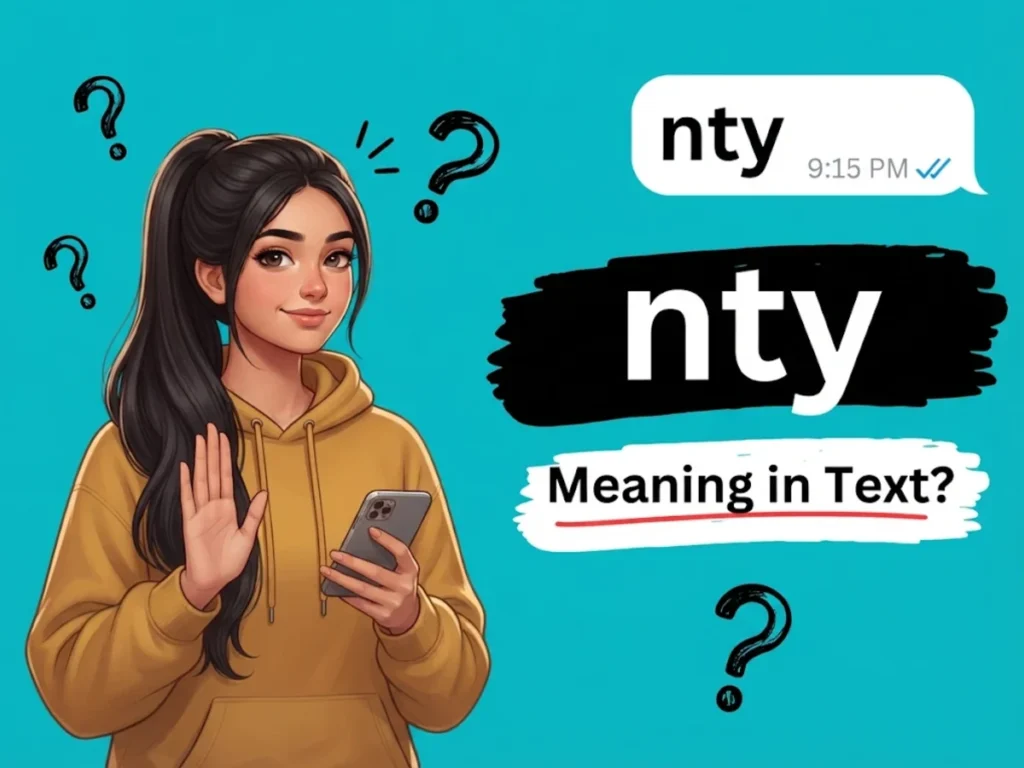
The NTY meaning in text is simply “no thank you.” When someone texts you “nty,” they are turning down whatever you just offered, whether that’s a slice of pizza, a plan, or a link to a video. In short, it’s a quick, mostly polite refusal.
So why look it up? Because three lowercase letters can feel colder than the full phrase. Many people wonder whether “nty” is friendly, annoyed, or a brush-off. Also, uppercase NTY sometimes turns out to be a typo for NYT, which adds to the confusion. This guide clears up both questions.
READ MORE: NP Meaning in Chat: Definition, Examples & Usage Guide
What Does NTY Mean When Someone Texts It to You?
NTY is an abbreviation of “no thank you.” Each letter stands for one word: No, Thank, You. Because it’s built from TY, the familiar shorthand for “thank you,” it carries a small dose of courtesy inside the refusal.
In practice, it almost always answers a question. For example, someone asks “want my fries?” and you reply “nty.” You will rarely see it open a conversation, since there’s nothing to refuse yet.
The Less Common Readings
There are two rarer cases worth knowing. First, a capitalized “NTY” can be a slip for NYT, short for The New York Times. Second, a lowercase “nty” is occasionally a typo for “nyt,” which some people use for “night.” If a message about the news or bedtime doesn’t make sense as a refusal, one of these is probably the answer.
Where You’ll See It
The NTY meaning is the same in every app, and texting is its natural home. It shows up in SMS, iMessage, and WhatsApp, where quick replies matter most. It also appears in Instagram, Snapchat, and Discord DMs. Online game chats use it too, especially when someone declines a trade or a party invite.
How People Type It
Most people type it in lowercase: “nty.” The all-caps version, “NTY,” looks a bit firmer. Some add punctuation, like “nty!” for a cheerful pass or “nty.” for a flat one. Meanwhile, spaced-out versions such as “n t y” are uncommon.
The NTY Meaning Changes With Tone
The letters stay the same, yet the feeling shifts a lot. Here’s how four common tones play out.
Funny
A: I made a new smoothie. Kale, garlic, and mango
B: nty 💀
A: you haven’t even tried it
B: and I’d like to keep it that way
Sarcastic
A: Want to help me move a couch up four floors?
B: wow, tempting. nty
A: I’ll buy pizza
B: …ok maybe
Playful
A: Should I send you 40 cat videos?
B: nty
A: too late, sending
B: fine, but only the orange ones
Serious
A: Can I add you to the work group chat for weekends?
B: nty, I’m keeping weekends offline
A: Totally fair
B: Thanks for asking first though
Real Chat Examples of NTY
These conversations show how the word fits different relationships.
Friends planning a night:
A: Karaoke tonight?
B: nty, my voice is still recovering from last time
A: lol fair
B: next week though
Partners and dessert:
A: Last bite of cheesecake is yours if you want it
B: nty babe, it’s all yours
A: you’re the best
B: I know
A coworker offering a task:
A: Do you want to take over the Friday report?
B: Nty, I’m already covering Monday’s
A: No worries, I’ll ask Sam
B: Thanks!
A parent checking in:
A: Want me to save you some leftovers?
B: nty mom, already ate
A: ok, but there’s lasagna
B: …save me a little
Siblings and borrowed clothes:
A: Can I borrow your black jacket?
B: nty
A: please, it’s one night
B: fine, but return it clean
A stranger in a marketplace chat:
A: Would you take $20 for the lamp?
B: Nty, firm at $35
A: $30?
B: Deal
Gaming friends on Discord:
A: trade my sword for your shield?
B: nty, I need the shield for the boss
A: worth a shot
B: ask me after the raid
A friend offering a spoiler:
A: Want to know how the finale ends?
B: NTY. Do not.
A: lol I won’t
B: I’m muting you just in case
A roommate and chores:
A: I’ll swap dishes for trash this week?
B: nty, I like trash duty
A: weird but ok
B: no smells on my hands
A gym partner:
A: 6am leg day tomorrow?
B: nty, 7 is my limit
A: 7 it is
B: see you there
A friend recommending a show:
A: You need to watch this 9-season drama
B: nty, I don’t have that kind of time
A: just one episode
B: ok, ONE
Grammar Behind the NTY Meaning
Grammatically, NTY works like an interjection. It replaces a full sentence of refusal, so it can stand alone as a complete reply. That’s actually its most common form.
When it appears mid-sentence, it usually leads, as in “nty, I’m good.” Putting it at the end also works: “I’ll pass, nty.” However, splitting it inside a longer sentence feels clumsy.
Capitalization matters a little. Lowercase reads as casual and relaxed. In contrast, all caps can read as firm or even emphatic, like “NTY, stop sending me that meme.” The register is informal throughout, so it doesn’t belong in formal writing.
How to Reply When Someone Sends NTY
A refusal doesn’t need a long answer. Still, your reply sets the mood for what comes next.
Funny Replies
- “Your loss, more for me”
- “Rejected again, I’ll recover”
- “Noted. Offer withdrawn forever”
Serious Replies
- “No problem, thanks for letting me know”
- “All good, maybe another time”
- “Got it. Want me to check back next week?”
Flirty Replies
Flirting only fits if the offer was romantic or playful between partners. For instance:
- “Even if I bring snacks? 😏”
- “Fine, but you’re missing out on great company”
Neutral or Unbothered Replies
- “ok”
- “👍”
- “cool”
NTY Meaning Compared With Similar Terms
People often search these terms alongside it, so here’s how they stack up.
| Term | Meaning | Usage Context | Tone | Popularity | Confusion Risk |
|---|---|---|---|---|---|
| NTY | No thank you | Declining offers in texts and DMs | Polite to blunt | Moderate | Medium (NYT typo) |
| TY | Thank you | Showing thanks | Warm | Very high | Low |
| NP | No problem | Replying to thanks | Easygoing | High | Low |
| IDC | I don’t care | Showing indifference | Neutral to dismissive | High | Medium |
| NVM | Never mind | Taking back a request | Casual | High | Low |
| YW | You’re welcome (opposite energy: accepting thanks) | Replying to TY | Friendly | High | Low |
Who Uses NTY
It isn’t tied to one generation, because the idea behind it is universal. In fact, anyone comfortable with texting shorthand can read it at a glance. Some people still prefer typing the full “no thanks,” but that’s a style choice, not a different meaning.
As for platforms, private messages are where it lives. Group chats and game chats see it often, because offers fly around fast there. On the other hand, it rarely appears in public posts, since there’s usually nothing to decline.
Where the NTY Meaning Came From
This abbreviation comes from early internet chat, not from a meme. According to How-To Geek, it spread through message boards and IRC chat rooms, and Urban Dictionary’s earliest entry dates to 2005. It likely grew out of TY, which was already common shorthand.
Instant messaging then pushed it into everyday use. As phones took over, it settled into texting as a fast way to say no without sounding rude.
Is NTY Rude?
Usually, no. Still, short refusals can sting. The Cambridge Dictionary blog notes that a bare “no, thank you” can sound unfriendly, and it suggests adding a reason or a thank-you for the offer. The same logic applies to nty, which is even shorter.
There’s no profanity here, so it’s safe for school or family chats. With a boss or teacher, though, write it out in full. “No, thank you, I’m all set” reads as more respectful in a professional message.
What Makes NTY Stick in Texts
Here’s what makes the NTY meaning unusual. Most refusal slang, like “nah” or “pass,” drops politeness completely. NTY keeps “thank you” inside the word, so the sender gets to say no and be courteous in three keystrokes. As a result, it survives because it solves a real texting problem: refusing fast without seeming cold. Adding one short reason, as in “nty, already ate,” turns it from curt to considerate.
FAQs About the NTY Meaning
What does NTY mean in text from a guy or a girl?
The meaning doesn’t change with the sender. Whoever texts it is saying “no thank you” to something you offered. The tone depends on context and punctuation, not on gender. If it follows a flirty offer, read the surrounding messages for clues.
Is it rude to reply with just “nty” in a text?
It can feel a little abrupt, but it’s rarely meant as rude. With close friends, a plain “nty” is normal. With someone you don’t know well, add a short reason or a “thanks for asking.” That small extra makes the refusal feel warm instead of curt.
What’s the difference between texting it and saying it out loud?
Nobody says “en-tee-why” out loud. In speech, people just say “no thanks,” and tone of voice softens it. Texting removes that voice, so the letters can seem colder. As a result, emojis or punctuation often do the job your tone of voice would do.
Does it mean the same thing in a group chat vs a 1-on-1 text?
The meaning stays the same in both. However, in a group chat it’s often a quick vote, like declining a plan everyone else is joining. In a 1-on-1 text it feels more personal, so a reason helps more there. Either way, it’s still a polite pass.
Is NTY the same as NYT?
No, but they’re easy to mix up. NYT stands for The New York Times, and people sometimes type NTY by accident. If the message mentions an article or a puzzle, the sender probably meant NYT. Otherwise, assume it’s a refusal.
Can NTY mean “not that you”?
That reading isn’t a recognized meaning. Some people guess at it, but no dictionary or common usage supports it. If a message seems odd, simply ask what they meant. In almost every case, the answer is “no thank you.”
Should I use NTY at work?
In a casual team chat with peers, it’s usually fine. With managers, clients, or teachers, though, spell out “no, thank you.” Full words show care, and they avoid any chance the abbreviation seems dismissive. When in doubt, choose the longer version.
Final Thoughts on NTY Meaning in Text
To sum up, the NTY meaning in text is “no thank you,” a quick way to turn down an offer. It’s polite at heart, yet it can read as blunt without context. Watch for the rare NYT typo too.
Usage Tips
- Add a short reason to soften it, like “nty, I’m full.”
- Keep it lowercase for a relaxed tone.
- Use it mainly with friends, family, and casual chats.
- Pair it with an emoji when the offer was a joke.
Common Mistakes
- Sending it to a boss or client instead of the full phrase.
- Using it to open a chat, when it only works as a reply.
- Typing NTY when you meant NYT.
- Repeating it coldly after someone already took the hint.
When to Use It and When to Avoid It
Use it for small, low-stakes offers between people who know you. On the other hand, avoid it when someone has put real effort into an invitation or when the relationship is formal. In those moments, a full sentence shows more respect.