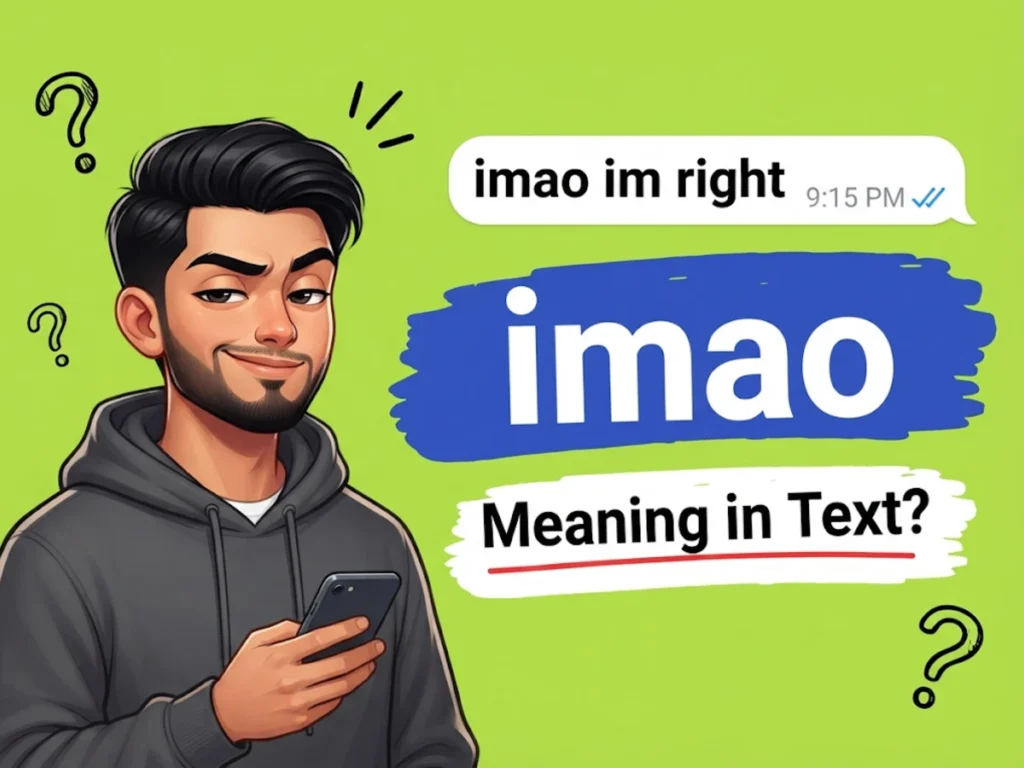
The IMAO meaning splits two ways, and both are real. Officially, IMAO stands for “in my arrogant opinion,” a cheeky twist on IMHO (“in my humble opinion”). In many texts, however, “imao” is simply “lmao” (laughing my ass off) with the first letter read as a capital I.
So if someone texts “imao pineapple on pizza is elite,” they’re stating a bold opinion with a wink. But if they reply “Imao” right after your joke, they’re probably just laughing. That mix-up is exactly why people search for it.
READ MORE: What Does IMO Mean? Full Breakdown of the Texting Abbreviation
IMAO Meaning: The Two Readings
1. In my arrogant opinion
This is the original acronym. According to Dictionary.com, it’s a play on IMHO and is usually used ironically or self-deprecatingly. In other words, the person is admitting they’re being a bit smug, often as a joke.
For example: “imao, the first movie is better than the sequel.” The speaker knows it’s just an opinion. Still, they’re stating it with mock confidence.
2. A misread “lmao”
Here’s the twist. In many fonts, a lowercase “l” looks almost identical to a capital “I.” As a result, “lmao” and “Imao” can look the same on screen. Dictionary.com notes that “imao” is often a misspelling of LMAO for exactly this reason. So some people type “imao” because they’ve read “lmao” that way for years.
Is “imao” an acronym, an abbreviation, or slang? It’s an acronym in its original sense. Read as a typo, though, it’s really just LMAO in disguise.
How to Tell Which IMAO You’re Reading
This is the most useful skill for this term, because the two meanings feel totally different. Luckily, the position in the message usually gives it away.
- Before an opinion: “imao, cats are better than dogs” → in my arrogant opinion.
- After something funny, by itself: “Imao” → laughing (LMAO).
- With laughing emojis: “imao 😂😂” → laughing.
- In a debate or hot take: “imao that ending was terrible” → arrogant opinion.
If it’s still unclear, check how the person usually types. Someone who always writes “imao” after jokes is almost certainly laughing.
Where IMAO Appears in Messages
In SMS, iMessage, and WhatsApp, you can run into both versions. The laughing typo tends to land right after a funny message. Meanwhile, the opinion meaning appears when friends argue about movies, food, or sports.
In Instagram, Snapchat, and Discord DMs, the pattern is the same. For example, in a Discord debate about a game, “imao the old map was better” reads as a confident hot take.
Typing variations
You’ll see “imao,” “IMAO,” and “Imao.” Capitalized “Imao” is the form most likely to be a disguised “Lmao,” since the capital I and the lowercase l look alike in many fonts. All caps “IMAO” usually signals the opinion meaning.
Grammar and Position of IMAO
As “in my arrogant opinion,” IMAO works like a sentence adverb. It often comes at the start: “imao, this is the best pizza in town.” Alternatively, it can come at the end: “this is the best pizza, imao.”
As a laughing reaction, it’s an interjection. It can stand alone as a complete reply. In fact, that’s how most “lmao”-style uses appear.
Capitals change the feel. “IMAO” in all caps tends to be the opinion meaning, while “Imao” alone is likely laughter. Either way, the register is informal. Don’t use it in emails, essays, or professional messages.
Four Tones of IMAO in Texts
Funny
A: imao, cereal is a soup
B: absolutely not
A: it’s food floating in liquid
B: I’m blocking you
Sarcastic
A: imao I’m the best driver in this family
B: you hit the mailbox last week
A: the mailbox moved
B: sure it did
Playful
A: imao my playlist is better than yours
B: prove it
A: sending it now, prepare to cry
B: okay this slaps, I’ll admit it
Serious
A: imao you should take the job offer
B: really? you think so?
A: yes, but I know I’m biased
B: thanks, I’ll sleep on it
Real Chat Examples of IMAO
Here’s how IMAO shows up across different relationships, with both meanings.
Friends after a joke
A: my cat just knocked my coffee onto my laptop
B: Imao
A: it’s not funny
B: it’s a little funny
Coworkers debating lunch
A: imao the taco place is better than the burger place
B: that’s a bold stance
A: I stand by it
B: fine, tacos Friday
Partners
A: imao I’m the better cook
B: you burned toast yesterday
A: toast is not cooking
B: ok chef
Siblings
A: imao mom likes me more
B: she literally said I’m her favorite
A: she says that to everyone
B: Imao true
Parent and teen
A: What does “imao” mean? Is it a typo?
B: sometimes it’s lmao, sometimes it means in my arrogant opinion
A: Which one did you mean?
B: lmao, mom
Group chat about movies
A: imao the book was better
B: it always is
A: but this time it’s not close
B: agree, the movie skipped the best part
Classmates
A: imao the professor’s slides are useless
B: they’re just walls of text
A: reading the textbook instead
B: same
Stranger in a game chat
A: imao this map favors attackers
B: nah defenders win more
A: we’ll see after this round
B: Imao we lost
Best friends
A: I tripped in front of my crush
B: Imao
A: you’re supposed to comfort me
B: there there, Imao
Roommates
A: imao we don’t need a second fridge
B: we have 12 hot sauces
A: we need a second fridge
B: told you
Old friend online debate
A: imao the 2000s had the best music
B: you just miss being young
A: that too
B: Imao fair
How to Reply to IMAO
First, figure out which meaning you got. Then reply to match.
- Funny (to an opinion): “Your arrogance has been noted.”
- Serious (to an opinion): “Fair point, but I see it differently.”
- Flirty: “You’re cute when you’re wrong.”
- Neutral (to laughter): “Glad that made you laugh.”
If you honestly can’t tell, just ask, “lmao or arrogant opinion?” Most people will find that funny.
IMAO Compared With Similar Terms
Because the IMAO meaning overlaps with opinion acronyms and laughing slang, here’s a clear comparison.
| Term | Meaning | Usage Context | Tone | Popularity | Confusion Risk |
|---|---|---|---|---|---|
| IMAO | In my arrogant opinion / misread LMAO | Hot takes or laughing | Ironic or amused | Low to medium | High |
| IMHO | In my humble opinion | Polite opinions | Modest | High | Low |
| IMO | In my opinion | Everyday opinions | Neutral | Very high | Low |
| LMAO | Laughing my ass off | Reacting to jokes | Amused | Very high | Medium (looks like Imao) |
| LOL | Laughing out loud | Light laughter | Casual | Very high | Low |
| TBH | To be honest | Candid statements | Sincere | Very high | Low |
Who Uses IMAO?
The opinion meaning is older and tied to early internet culture, so longtime forum users and people who enjoy ironic debate are likely to recognize it. In contrast, people who never used forums may only know “imao” as the lmao look-alike.
That said, both groups overlap a lot. Anyone who texts can run into either version. Because it’s English-language internet slang, it’s understood wherever English-speaking communities chat online. However, it remains far less common than IMO or LMAO.
Origin of IMAO
IMAO didn’t come from TikTok or a modern meme. Instead, it comes from Usenet, an early internet discussion system. According to Dictionary.com’s IMAO entry, one early use appeared in May 1989 in a Usenet discussion about the Grateful Dead. The poster even explained the acronym to avoid confusion.
During 1989, it appeared only a handful of times, mostly in arguments. By 1993, it had become widespread on Usenet, again mainly in heated debates.
Later, in the 1990s and 2000s, it softened into a playful, self-aware phrase. Still, it never caught on like IMHO. Dictionary.com suggests one reason: “in my arrogant opinion” isn’t a natural English phrase, and few people want to admit arrogance.
The typo meaning came much later, from font design rather than slang. Because “l” and “I” look alike in many sans-serif fonts, “lmao” gets read and retyped as “imao.”
Is IMAO Rude or Offensive?
The opinion meaning isn’t offensive. It’s playful and self-aware. That said, it can sound smug if the other person isn’t in a joking mood.
The laughing meaning is a different story. Because it stands in for LMAO, it hides a mild swear word (“ass”). So avoid it with teachers, bosses, or anyone who’d mind mild profanity.
At work, write “In my opinion” instead. Also, be careful laughing with “Imao” when someone shares something painful, since it can seem dismissive.
Why IMAO Is Such an Odd Case
What makes IMAO unusual is that its most common modern use comes from a reading error, not from the original acronym. Most slang spreads because people like the meaning. IMAO, on the other hand, partly spreads because a capital I and a lowercase l look almost identical in many fonts. As a result, one string of letters carries a 1989 Usenet acronym and a modern laughing typo at the same time. That double life keeps it alive, even though the original phrase never became popular.
IMAO Meaning FAQ
Is it rude to reply with just “imao” in a text?
Not really, but it depends on the moment. As a laughing reaction, a standalone “Imao” is like “lmao,” which is fine after a joke. However, it can seem rude if someone shares something serious. In that case, reply with real words instead.
What’s the difference between texting IMAO and saying it out loud?
People rarely say IMAO out loud. When they do, they say the full phrase, “in my arrogant opinion,” usually with a grin. The typo meaning only exists in writing, because it depends on how letters look on a screen.
Does IMAO mean the same thing in a group chat vs a 1-on-1 text?
The meanings stay the same in both. In group chats, though, “imao” often kicks off a debate, since several people can disagree with a hot take. In a 1-on-1 text, it’s more likely to be a laughing reply.
Is IMAO a typo for LMAO?
Often, yes. Dictionary.com notes that “imao” is frequently a misspelling of LMAO. A lowercase “l” and a capital “I” look nearly the same in many fonts, so people misread and retype it.
What does IMAO mean from a girl or a guy?
It means the same thing from anyone. Either they’re stating a bold opinion with a wink, or they’re laughing. Look at where it appears in the message to tell which.
What’s the difference between IMAO and IMHO?
IMHO means “in my humble opinion” and sounds modest. IMAO means “in my arrogant opinion” and sounds playfully smug. In fact, IMAO was created as a twist on IMHO.
Is IMAO still used in 2026?
Yes, in both forms. The lmao look-alike keeps appearing because of the font confusion, and the “arrogant opinion” meaning still turns up in debates. However, it’s much less common than IMO or IMHO.
Final Thoughts on the IMAO Meaning
IMAO means “in my arrogant opinion,” but in many texts it’s actually “lmao” with a capital I. Its position in the message tells you which.
Usage tips
- Put it before a bold opinion for the original meaning.
- Use it with a wink, not to sound truly superior.
- Write “lmao” clearly if you mean laughter.
- Switch to “in my opinion” for anything formal.
Common mistakes
- Assuming every “imao” is an opinion.
- Using it seriously, which can sound arrogant.
- Laughing with “Imao” at someone’s bad news.
- Forgetting the laughing version hides a mild swear.
Use IMAO for playful hot takes among friends. Avoid it in serious or professional chats, where it can sound smug or mildly crude.