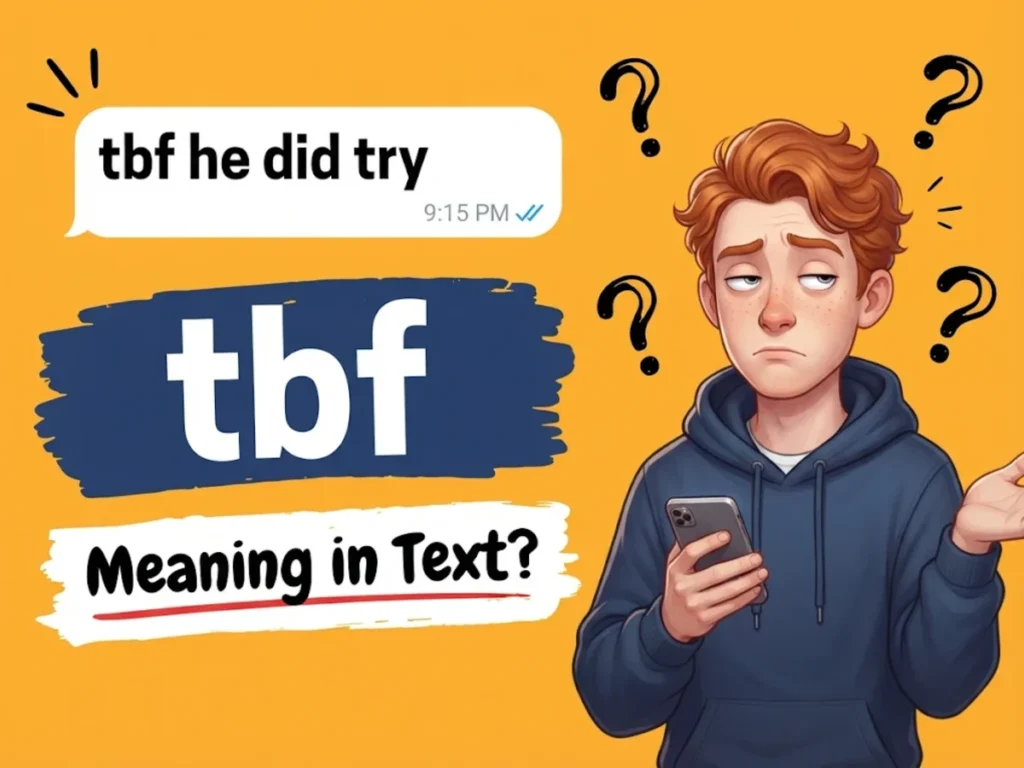
The TBF meaning in text is “to be fair.” People add it when they want to admit a fair point, give someone credit, or soften a criticism they just made.
For example, “the movie was long, but tbf the ending was great” concedes something positive. Likewise, “tbf, you did warn me” admits the other person was right. People search the term because it often appears mid-argument, and it’s easy to misread as sarcasm or confuse with TBH.
READ MORE: What Does IMO Mean? Full Breakdown of the Texting Abbreviation
TBF Meaning in Plain English
TBF is an abbreviation of the phrase “to be fair.” Dictionary.com lists it as an abbreviation that comes from digital communications, and it can be written in capitals or as lowercase “tbf.”
Its job is balance. Someone uses it to step back from their own opinion and acknowledge another side. As a result, it often follows a complaint, as if the sender is catching themselves before they get too harsh.
The Rare Second Meaning
Outside texting, TBF can also be the name of the Grumman TBF Avenger, a World War II torpedo bomber that turns up in history writing. You’ll almost never meet that sense in a chat, though. So if a friend sends it, read it as “to be fair.”
Where TBF Shows Up in Messages
Texts and WhatsApp chats are where it does most of its work. It fits naturally into the back-and-forth of a disagreement, such as friends debating a match, a date or a group decision.
It also appears in DMs on Instagram, Snapchat and Discord, mostly in the same debating role. Meanwhile, Dictionary.com’s own examples come from football coverage in the BBC and the Guardian, which shows how naturally it fits sports arguments.
How TBF Fits Into a Sentence
Grammatically, TBF works like a sentence adverb or a discourse marker. In other words, it comments on the whole statement rather than on one word. It can sit at the start (“tbf, he tried”), in the middle (“it was cold, tbf, but fun”), or at the end (“you deserve the win tbf”).
It can stand alone as a reply, too. A one-word “tbf” after someone makes a good point means “fair enough, you’re right.” All caps doesn’t change the meaning; however, a capitalized “TBF” at the start of a message can feel slightly more emphatic. Overall, it is informal, but it’s mild enough for a relaxed work chat.
TBF Across Four Tones
Because it softens or concedes, TBF can sound sincere, cheeky or dry depending on what surrounds it.
Funny
A: you ate my leftovers again
B: tbf they were calling my name
A: they were labeled with MY name
B: and yet they called
Sarcastic
A: sorry I’m 40 minutes late
B: tbf you did say “on my way” an hour ago
A: ok that’s fair
B: I was being fair, yes
Playful
A: you’re the worst at mini golf
B: tbf the windmill hated me personally
A: the windmill hates no one
B: it hates me
Serious
A: I’m still upset about how she spoke to me
B: that’s valid. tbf she was stressed about her mom
A: I didn’t know that
B: maybe talk to her tomorrow
TBF Meaning in Everyday Chats
Below are realistic text and DM exchanges. Each one starts with a quick note on who is talking, so you can see how the relationship shapes the tone.
Two friends arguing about a match:
A: ref robbed us
B: tbf we didn’t take a single shot on target
A: whose side are you on
B: the side of facts
A couple deciding on dinner:
A: you always pick the restaurant
B: tbf you always say “anywhere is fine”
A: …ok you got me
B: tacos then
Coworkers after a long meeting:
A: that meeting could’ve been an email
B: tbf we did fix the budget issue
A: true, that part was useful
B: the other 50 minutes though
The TBF Meaning in Family Chats
A parent and a teenager:
A: your room is a disaster
B: tbf I cleaned it last week
A: last week isn’t this week
B: fair, doing it tonight
Siblings splitting a gift:
A: you paid less for mom’s present
B: tbf I booked the restaurant
A: ok that evens out
B: thank you
Online, Team and Group Chats
A stranger in a Discord DM:
A: your build guide was wrong about the boss
B: tbf that was before the patch
A: oh, didn’t realize
B: I’ll update it today
Roommates and the dishes:
A: the sink is full again
B: tbf half of those are yours
A: …
B: I’ll wash mine if you wash yours
Friends rating a new album:
A: the album is mid
B: tbf track 4 goes hard
A: ok track 4 is decent
B: that’s all I’m saying
Teammates after a loss:
A: I missed every free throw
B: tbf you also had 12 rebounds
A: thanks, needed that
B: we go again Saturday
An old friend reconnecting:
A: you never text back
B: tbf neither do you
A: lol we’re both terrible
B: let’s fix it, coffee Friday?
A group chat planning a trip:
A: the cabin was so far from everything
B: tbf that was kind of the point
A: fair, it was peaceful
B: booking it again next year
How to Answer a TBF Text
When someone uses TBF, they’re usually conceding a point or nudging you to see another side. Therefore, your reply can accept it, push back, or just keep things light.
- Funny: “tbf is doing a lot of heavy lifting in that sentence”
- Serious: “That’s fair, I hadn’t thought about it that way.”
- Flirty (with someone you like): “tbf you’re cute when you’re right”
- Neutral or unbothered: “fair enough”
TBF Compared With Similar Abbreviations
A handful of short phrases do similar jobs, and they’re easy to mix up. Here’s a quick comparison, including one that pushes the other way.
| Term | Meaning | Usage Context | Tone | Popularity | Confusion Risk |
|---|---|---|---|---|---|
| TBF | To be fair | Conceding a point, softening criticism | Balanced | Moderate | Medium (vs TBH) |
| TBH | To be honest | Sharing a frank opinion | Candid | Very high | Medium (vs TBF) |
| IMO | In my opinion | Flagging a personal view | Neutral | High | Low |
| NGL | Not gonna lie | Admitting something | Casual | High | Low |
| Fair | I accept your point | Short replies | Agreeable | High | Low |
| No offense | Warning before criticism, the opposite of conceding | Blunt opinions | Edgy | Moderate | Low |
Who Uses TBF?
TBF is common among people who argue for fun: sports fans, group chats that debate everything, and friends who like to be precise. It works for any age, because “to be fair” is an ordinary English phrase that adults already say out loud.
Regionally, Dictionary.com tags it as American; even so, its quoted examples come from the BBC and the Guardian, so it clearly has a home in British sports writing as well. Beyond that, it’s best to treat it as general English internet shorthand rather than a regional marker.
Where TBF Came From
The phrase “to be fair” is much older than texting. The abbreviation, however, grew out of digital communication, where people shorten common phrases to save time. In that sense, it belongs with early chat shorthand like TBH and IMO, not with TikTok trends or memes.
Dictionary.com’s examples include a 2010 Guardian article and a 2013 BBC sports piece. Football discussions are a natural fit, since fans constantly concede that the other side “deserved it, tbf.” From there, it moved into everyday texts about anything that needs a fair-minded aside.
Is TBF Rude?
Not on its own. In fact, it usually makes a message softer, since the sender is admitting the other side has a point. That said, it can feel dismissive if someone uses it to defend a person who hurt you, as in “tbf he was tired.” In that case, the problem is the message, not the abbreviation. With a teacher or manager, write out “to be fair” for clarity, although TBF is clean and contains no profanity.
The Self-Correction Signal
What makes TBF stick is that it lets someone change their mind mid-message without losing face. A sender can complain in the first half of a text and then add “tbf” to pull back, all in one line. Consequently, it often reveals the moment someone realizes they were being a bit unfair. Watch for it in arguments: when a friend starts using TBF, they’re usually halfway to agreeing with you.
TBF Meaning: FAQ
Is it rude to reply with just “tbf” in a text?
No, a lone “tbf” usually reads as “fair point.” It tells the other person you accept what they said. However, in a heated argument it can seem like a reluctant concession. If you truly agree, adding “you’re right” makes it warmer.
What’s the difference between texting TBF and saying it out loud?
Out loud, people say the full phrase “to be fair,” and their tone shows whether they mean it. Hardly anyone says “T-B-F” aloud. In text, by contrast, the abbreviation is quicker, but tone is harder to read. So a texted “tbf” can occasionally come across as sarcastic when it wasn’t meant that way.
Does TBF mean the same thing in a group chat vs a 1-on-1 text?
Yes, the meaning doesn’t change. In a group chat, though, it often signals someone stepping into a debate to balance it out. In a private chat, it’s more personal, typically admitting the other person has a point.
What is the difference between TBF and TBH?
TBF means “to be fair” and concedes another side. TBH means “to be honest” and introduces your frank opinion. For example, “tbh I didn’t like it” shares a view, while “tbf it was their first try” defends someone. They look alike, yet they point in different directions.
Where do you put TBF in a sentence?
Anywhere it reads naturally. It works at the start, middle or end, as in “tbf, it rained” or “it rained, tbf.” Most people place it right before or after the point they’re conceding.
Can TBF be sarcastic?
Yes. “Tbf you did say you’d be on time” can be a playful dig. In those cases, the sender is pointing out a fair fact to make a joke. Context and emojis usually reveal the tone.
Final Thoughts on the TBF Meaning
To wrap up, TBF stands for “to be fair.” It’s a small, polite tool for admitting another side, softening criticism, or giving credit where it’s due.
Usage Tips
- Place it next to the point you’re conceding.
- Use it to soften criticism among friends.
- Write out “to be fair” in formal messages.
- Add “you’re right” when you fully agree.
Common Mistakes
- Confusing it with TBH.
- Using it to excuse someone who hurt the person you’re texting.
- Overusing it until every message sounds hedged.
- Assuming it’s always sarcastic.
Use TBF in casual debates, group chats and friendly disagreements. On the other hand, avoid it when someone needs support rather than balance, or when a formal tone is expected.