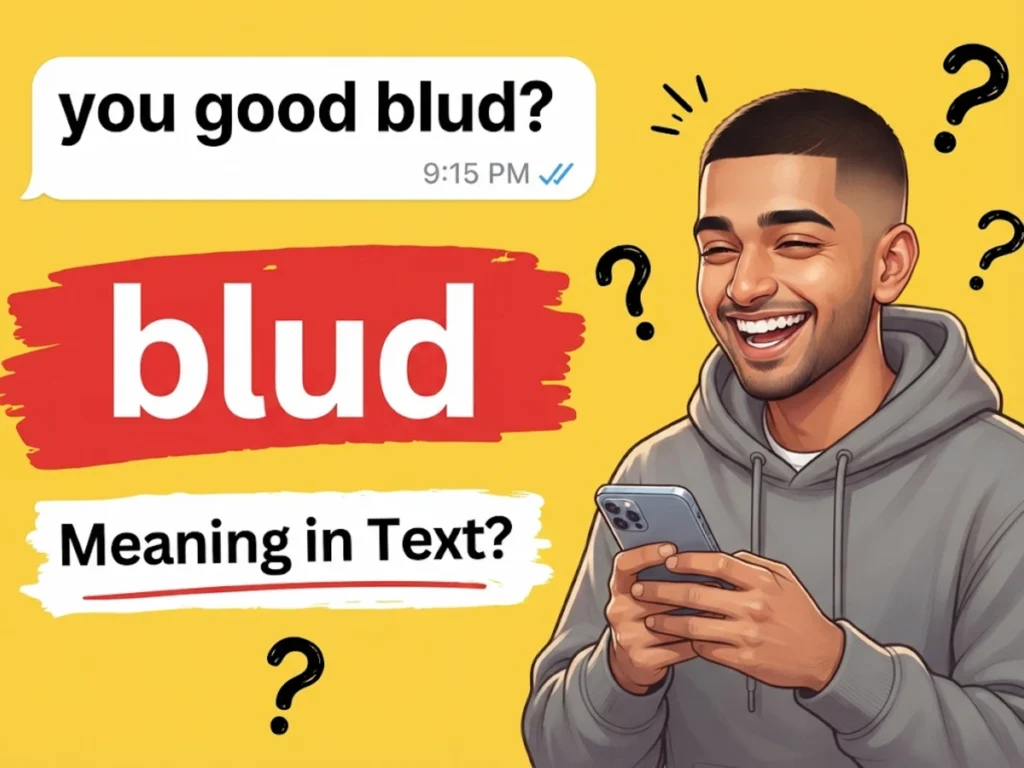
The blud meaning in text is “bro,” “mate” or “my guy”: it’s a friendly way to address someone, mostly another man, and it comes from Jamaican and British slang. So if someone texts “you good blud?”, they are simply checking on you the way a close friend would.
There is a second, newer use too. In memes and group chats, people call a third person “blud” to tease them, as in “blud thinks he’s on the team.” That shift from warm to mocking is exactly why so many people search the blud meaning in text. Same four letters, very different energy, and the context decides which one you got.
READ MORE: Wagwan Meaning: What It Really Means and How to Use It Naturally
What Blud Means When Someone Texts It to You
Blud is a slang word, not an acronym or abbreviation. It is a respelling of “blood,” as in family. Here are its real meanings, starting with the one you will see most.
1. A friendly name for a mate
This is the original and still the most common meaning. Know Your Meme describes it as a term of endearment used mostly in the UK, an alternative to “mate” or “bro.” For example, “wagwan blud” is a casual greeting between friends.
2. A teasing label for someone else
Online, blud also works in the third person. A caption like “who invited my man blud” points at someone who seems out of place. In a group chat, “blud really said that” pokes fun at whoever just made a bold claim. In other words, the word can be affectionate or sarcastic, depending on who it is aimed at.
How it looks on different apps
In WhatsApp, iMessage and SMS, it usually appears lowercase at the start or end of a message. On Snapchat, Instagram DMs and Discord, it often sits in quick replies like “nah blud.” You may also see “blood” or “bludd,” since it sounds the same as “blood.” Capitalized “BLUD” mostly appears when someone is shouting a joke.
Where Blud Comes From
The word grew from Jamaican speech and travelled into British youth slang. According to Know Your Meme, it was already defined on Urban Dictionary in April 2003, simply as “mate.” A later 2006 definition described its use in the UK as an endearment, similar to “bredren.”
It also belongs to Multicultural London English, a way of speaking that developed in diverse parts of London in the late 20th century. Wikipedia’s article on Multicultural London English lists blud as a word for a close friend, from “blood,” implying family. The same article notes that this dialect draws heavily on Caribbean English, particularly Jamaican Patois.
So blud is not a TikTok invention. It came from real communities first, and memes only spread it further. Since roughly 2021, image macros such as “who invited my man blud” have carried the word far beyond the UK.
A Note on Cultural Roots
Because the word comes from Jamaican and Black British speech, it is worth using with some awareness. Plenty of people from many backgrounds use it naturally, especially in London. Still, forcing it into every sentence to sound “street” can come across as a caricature. In short, if it fits how you and your friends already talk, it’s fine. If it doesn’t, nobody will miss it.
Blud Meaning in Text Message Examples
The chats below show both sides of the blud meaning in text, across different relationships.
Talking to blud (the friendly use)
Best mates, football plans
A: you coming to five-a-side tonight
B: yeah blud, 7?
A: bring your boots this time
B: one time, I forgot ONCE
Cousins on WhatsApp
A: blud I’m outside
B: two mins
A: you said that ten mins ago
B: I’m literally putting my shoes on
Coworker, casual DM
A: covered your shift Saturday, no stress
B: you’re a legend blud, I owe you
A: coffee tomorrow and we’re even
B: deal
Older brother checking in
A: you good blud? haven’t heard from you
B: yeah just busy with exams
A: shout if you need anything
B: will do, thanks
Flatmates
A: blud who finished the milk
B: not me
A: there’s a milk moustache on your face
B: ok it was me
Gaming friends, Discord
A: blud get on the objective
B: I’m literally on it
A: you’re in the spawn
B: lag, I swear
Talking about blud (the teasing use)
Group chat, someone overconfident
A: Tom said he’s gonna run a marathon next month
B: blud has never run for a bus
A: 😭
B: I’ll be at the finish line with snacks
Friends, after a bad haircut photo
A: [photo]
B: who did this to you blud
A: my mate said he could do fades
B: your mate lied
Partner, watching a reality show
A: he really thinks she likes him
B: blud is delusional
A: production loves him though
B: villain edit incoming
Classmates, group project
A: Sam put his name on the slides
B: blud did one slide
A: and it was the title page
B: incredible work
Mum, catching the slang
A: what does “blud” mean, your brother keeps saying it
B: it’s like “mate,” nothing bad
A: ok blud
B: Mum please never say that again
The last chat shows something real: once a parent uses it, the word instantly sounds funnier.
Blud in Four Different Tones
The word changes flavor depending on delivery.
Funny
A: I’ve been awake since 5 for no reason
B: blud is a farmer now
A: I’m being serious
B: so is the rooster
Sarcastic
A: I’ll definitely be on time today
B: sure blud
A: watch me
B: I’m watching. you’re 10 minutes late
Playful
A: rate my new trainers
B: clean, blud. very clean
A: knew it
B: still not as clean as mine
Serious
A: blud I need to talk, you free?
B: always. what’s up
A: things at home are rough
B: call me now, I’m here
How Blud Works in a Sentence
Grammatically, blud is a noun used as a term of address, the same job “mate” or “bro” does. Most often it sits at the end (“you alright, blud?”) or the start (“blud, listen”). In the third person, it acts as a subject: “blud thinks he’s funny.”
It can stand alone as a reply, usually with a tone: “blud…” means “mate, really?” Lowercase is the norm. All caps adds volume or disbelief, so “BLUD” often means “are you serious?” As slang, it is strictly informal.
How to Reply When Someone Calls You Blud
A good reply matches the tone. Here are some text-ready options.
- Funny: “who are you calling blud, I’m a respectable citizen”
- Serious: “yeah I’m good, thanks for checking”
- Flirty (only if you are already close): “blud? that’s the best you’ve got for me?”
- Neutral: “wagwan, what’s up?”
If someone uses it to tease you, it’s usually banter. Laughing along tends to land better than getting defensive.
Blud vs Similar Words
People who look up the blud meaning in text often compare it with these.
| Term | Meaning | Usage Context | Tone | Popularity | Confusion Risk |
|---|---|---|---|---|---|
| blud | Mate, bro; or a teasing “this guy” | UK and online chats | Friendly or mocking | High | Medium: two uses |
| bruv | Brother, mate | UK casual speech | Friendly | High | Low |
| fam | Close friend, family | Greetings, replies | Warm | High | Low |
| bro | Brother, friend | Global casual chats | Friendly | Very high | Low |
| my man | Friend, or pointed callout | Praise or teasing | Mixed | Medium | Medium |
| stranger | Someone you don’t know (the opposite) | Formal or distant | Neutral | High | Low |
Who Uses Blud
You will hear it most among younger people in the UK, particularly in and around London, where it is part of Multicultural London English. Wikipedia notes that variants of that dialect also developed in cities such as Birmingham and Manchester.
Outside the UK, many younger people picked it up through memes, so they often use the teasing third-person version. Meanwhile, the original “mate” sense stays strongest in British chats. Either way, these are tendencies, not hard rules.
Is Blud Rude or Offensive?
On its own, blud is not a swear word, and in British usage it is friendly. That said, a 2006 Urban Dictionary entry cited by Know Your Meme links its earliest roots to Jamaican swearing, which is worth knowing if you are texting someone older from a Caribbean background. Also, the teasing third-person use can sting if the person being mocked sees it.
At work or school, keep it for peers you already joke with. With a boss, a teacher or a client, it would read as too casual. And because it’s tied to Black British and Jamaican speech, using it to mock an accent is never a good look.
What Makes Blud Last
What gives blud its staying power is that it carries family inside it. Calling someone “blud” quietly says “you’re like blood to me,” even when the message is about milk or football. Yet the same closeness makes the mocking version funnier, because you are pretending to be fond of someone you are roasting. Few nicknames can flip like that without changing a letter, and that flexibility keeps it alive in group chats.
FAQ: Blud Meaning in Text
Is it rude to reply with just “blud” in a text?
A lone “blud” usually reads as “mate, really?” It shows mild disbelief or amusement. Between friends, it’s completely normal. However, it may confuse someone who doesn’t use UK slang, so add a word or two if you are unsure.
What’s the difference between texting blud and saying it out loud?
Out loud, tone and accent make the meaning obvious, whether it is warm or teasing. In a text, those cues disappear, so “blud” can look harsher than intended. That’s why people add emojis like 😂 or 💀 when they’re joking. Spoken, it also flows more naturally inside a London accent.
Does blud mean the same thing in a group chat vs a 1-on-1 text?
One-on-one, blud is usually friendly and direct, like calling someone “mate.” In a group chat, it is more often third-person teasing, such as “blud really thought.” So the word gets more playful, and sometimes more savage, in groups. Context tells you which.
Is blud only for boys?
Mostly, people use it toward men, because it works like “bro.” Still, friends of any gender sometimes use it with each other in casual chats. It’s less about gender and more about closeness. If you are unsure, see how your friends use it.
Is blud British or American slang?
It is British slang with Jamaican roots. It became especially linked with London’s multicultural speech. Americans mainly know it from memes. As a result, the third-person joke version is more common online than the original greeting.
What does “who invited my man blud” mean?
It is a meme caption used to point at someone who looks out of place in a photo or group. Know Your Meme traces viral versions to around 2021. In chats, people use it when someone joins a conversation uninvited. It’s playful, but it is still a mild roast.
Can I say blud if I’m not from the UK?
You can, especially in the meme sense, which has gone global. Still, using it constantly with a fake accent can feel try-hard. It works best when it fits how your friends already talk. Respecting where the word comes from goes a long way.
Wrapping Up the Blud Meaning in Text
In short, the blud meaning in text is “mate” or “bro,” a friendly UK term with Jamaican roots. Online, it also works as a teasing label for someone else. Who it is aimed at decides whether it is affection or a roast.
Usage tips
- Use it with friends who already talk this way.
- Add an emoji when you are teasing.
- Remember the roots, and avoid mimicking accents.
- Keep it out of formal messages.
Common mistakes
- Using blud with a boss or teacher.
- Roasting someone as “blud” in a chat they can see.
- Assuming it’s American slang.
- Forcing it into every sentence.
When to use it: greetings and banter with close friends. When to avoid it: formal chats, people you have just met and anyone you’d hate to offend.