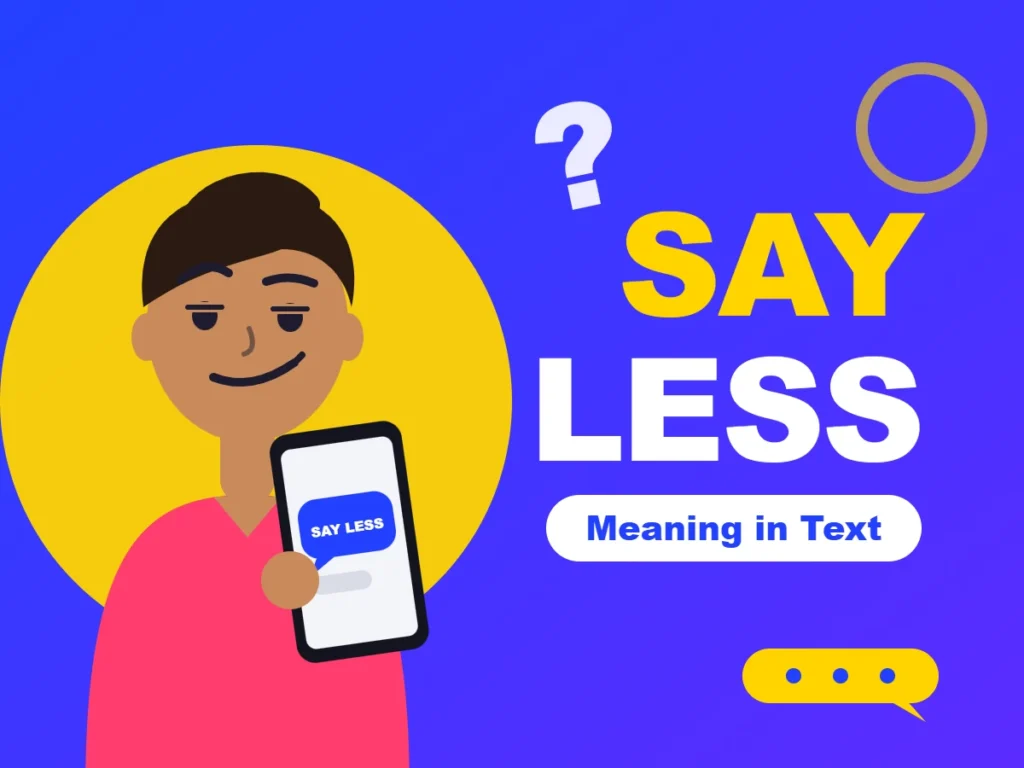
Say less meaning in text: “I’m in, you don’t need to convince me.” When someone texts you “say less,” they are agreeing so fast that you can stop explaining. It sounds like an order to be quiet, but in most chats it is an excited yes.
That gap between the words and the intent is exactly why people look up the say less meaning in text. Read literally, “say less” looks cold, maybe even like the other person is fed up with you. However, most of the time it is the opposite: you offered food, a plan, a favour or some gossip, and they are so on board that more detail would be wasted. There is also a rarer, literal use where someone really does want you to stop talking, and a third, advice-style use (“move quiet, say less”). Context tells you which one you got.
READ MORE: What Does FR Mean in a Text? Full Meaning Explained
Say Less Meaning in Text: Three Ways It Gets Used
1. “Done, I’m in” (by far the most common)
This is the reading behind almost every search. Someone makes an offer and “say less” means the deal is closed. Dictionary.com’s Gen Z slang guide describes it as an abrupt, often funny way of saying “I understand” or “I’ve got the point.” In practice it usually carries enthusiasm too, not just understanding.
2. “Okay, I get it, please stop”
Occasionally, though, it is meant literally. If someone is oversharing, over-explaining or repeating the same complaint, “say less” can be a dry way of cutting them off. This version tends to come without emojis and after a long message, which is the giveaway.
3. “Talk less” as advice
You will also see it as a life motto: keep plans private, don’t announce things before they happen. In a text this looks like “new job starts monday, say less till it’s official.” Here it is an instruction about secrecy, not a reply to anyone.
Is it an acronym? No. “Say less” is a two-word slang phrase, not an abbreviation, so there is nothing to expand. People do not shorten it to “SL” in any widespread way, and if you see “SL” in a text it almost certainly means something else.
Why “Say Less” Can Look Rude (and Usually Isn’t)
Dictionary.com points out that the phrase may come off as rude to some people because it is basically a request to stop talking. That is the whole tension of the phrase. A parent, manager or anyone who has not met the slang version can read it as dismissive.
The trick is to look at what came right before it:
- An offer, invite or good news → it is enthusiasm.
- A long rant, a lecture or TMI → it may be a real “that’s enough.”
- A secret or a plan → it might mean “keep this quiet.”
Punctuation also helps. “say less!!” or “say lesss 😤” is hyped. A flat “Say less.” with a full stop after a long paragraph from you is worth a second look.
Where you will actually see it
Most of the time it lives in casual one-on-one texts, SMS and iMessage, plus WhatsApp chats between friends. Beyond that, it turns up just as naturally in Instagram and Snapchat DMs and in Discord servers when someone proposes a match, a call or a plan. Because it is a reply phrase, it belongs in conversations rather than in posts.
For example, typing is usually lowercase (“say less”). Stretching the last letter (“say lesssss”) adds excitement, and all caps (“SAY LESS”) reads as shouting-level hype, not anger, when it follows an offer.
How the Phrase Works Grammatically
“Say less” is an imperative, the same shape as “come here” or “hold on.” Grammatically it is a command. Functionally it behaves like an interjection or a one-line reply, in the same family as “bet” or “deal.”
- It stands alone. “say less” is a complete answer; nothing else is required.
- It usually opens or ends a reply. “say less, what time?” or “pizza on me? say less.”
- It almost never sits mid-sentence. You would not write “I think say less is fine.”
- Register: strictly informal. It does not belong in an email, a cover letter or a message to a client.
Finally, one quirk worth knowing: because it is a command, it can only really respond to something. Sending “say less” as an opening message makes no sense, which is part of why it reads as agreement. It always points back at the previous text.
Real Conversations Using “Say Less”
Friends, last-minute plans
A: tickets fell through for my brother, you want his
B: wait for tonight??
A: yeah free, just get here by 8
B: say less 🏃
Partner, food
A: im picking up tacos on the way home
B: say less
A: usual order?
B: you know it
Coworkers (friendly)
A: if you cover my 2pm call ill take your friday close
B: say less
A: lifesaver
B: put it in the calendar before i forget lol
Sibling, a secret
A: dont tell mom i dented the car
B: say less 🤐
A: im serious
B: i said say less. its handled
Parent who doesn’t know the slang
A: Your dad and I are booking the cabin for July
B: say less!!
A: Why are you telling me to be quiet?
B: no mom it means im in 😂 book it
Gaming on Discord
A: need one more for ranked
B: say less, hopping on
A: bring your mic this time
B: it was ONE time
Roommate, cleaning bargain
A: you do dishes this week, i do bathroom
B: say less, deal
A: no backing out on wednesday
B: i would never (i would)
Group chat organiser
A: who’s down for brunch sunday
B: say less
A: say less as in yes or as in shut up
B: as in YES what time
The literal version
A: and another thing about my landlord, so basically the lease said
B: say less, I’ve read all nine messages
A: rude
B: lovingly rude. call him tomorrow
Stranger on Marketplace
A: Would you take $40 for the desk?
B: say less, can you pick up today?
A: 5pm works
B: perfect, sending the address
Gossip
A: you will not believe what happened at the party
B: say less, im listening
A: you literally just told me to say less
B: say MORE actually
Four Tones, Four Mini Chats
Hyped
A: concert tickets, front row, i have two
B: SAY LESS
A: thought so
B: what do i wear
Sarcastic
A: i made a 14-slide presentation on why we should get a dog
B: say less, truly, stop
A: slide 9 has puppy photos
B: ok fine slide 9 only
Playful
A: want me to bring dessert or should i bring wine
B: say less on both
A: that’s two things
B: and i said less, keep up
Serious
A: i know things are tense, ill fix it with dad tonight
B: say less. thank you
A: you okay?
B: yeah. just tired of the back and forth
“Say Less” Next to Similar Replies
| Term | Meaning | Usage Context | Tone | Popularity | Confusion Risk |
|---|---|---|---|---|---|
| say less | I’m in, no need to explain | Replying to offers, plans, invites | Enthusiastic, sometimes curt | High | Medium (can look rude) |
| bet | OK, deal, sounds good | Confirming plans | Casual, upbeat | High | Low with younger texters |
| say no more | Same idea, older phrasing | Agreeing to a request | Friendly | Medium | Low |
| fr | For real, agreeing strongly | Backing up a point | Casual | High | Low |
| ight | Alright, OK | Quick acknowledgement | Neutral, laid-back | Medium | Low |
| tell me more | Keep going, I want details | Opposite energy to say less | Curious | Medium | Low |
Replying When Someone Texts “Say Less”
Since the other person has already agreed, your reply usually just locks in the details.
Funny
- “say less? i barely said anything”
- “great, saying zero from now on”
Serious / practical
- “Perfect. I’ll grab you at 7.”
- “Great, I’ll send the address now.”
Flirty (only if you’re already flirting)
- “you’re easy to convince 😏”
- “good, because I wasn’t taking no”
Neutral / unbothered
- “cool”
- “bet, see you there”
If you’re not sure whether they meant the literal “stop talking,” just ask: “wait, say less as in yes?” Nobody minds the clarification.
Who Sends It
You will see it most among Gen Z and younger millennials, who use it as an everyday yes in casual texting. Older millennials are more likely to have the longer “say no more” in their vocabulary and may read “say less” correctly anyway because of that. Parents and older relatives are the group most likely to take it literally, as the parent conversation above shows.
On geography, the one specific documented note we found is that Wikipedia’s Toronto slang entry lists “say less,” alongside “say no more” and “don’t say a word,” as a way to enthusiastically or supportively agree to a demand, request or suggestion. That said, it is used well beyond Toronto, including in the US, but we did not find reliable data ranking countries, so we won’t guess.
Where “Say Less” Came From
There isn’t a single famous “first use.” According to Dictionary.com, the phrase appeared online as early as 2011. It is also the title of a 2019 song by R&B artist Ashanti and the name of a 2017 album by Canadian musician Roy Woods. Dictionary.com adds that its current popularity may owe something to a 2021 Saturday Night Live sketch.
In other words, it is a compressed version of the much older “say no more,” which English speakers have used to mean “understood, I’m on it” for a long time. Dropping it to two words fits texting perfectly: it is short, it lands fast, and its slight bluntness is part of the charm. The same Dictionary.com guide notes that many Gen Z slang terms have roots in Black culture and other communities before going mainstream; it does not trace “say less” to one specific community, so we won’t either.
Is It Okay to Text “Say Less”?
It is not offensive, has no profanity and no hidden explicit meaning. The only risk is tone.
- Friends, siblings, partners: completely fine.
- Boss or teacher: risky. Even a friendly manager may read it as “stop talking.” Use “Sounds good, I’ll do it” instead.
- Customers or clients: avoid it.
- Someone upset or venting: don’t use it. Mid-vent, it will almost always read as dismissive, whatever you meant.
What Makes It Stick in Texting
The reason “say less” survives in texting comes down to timing. Most texts that need a reply are offers or asks, and the fastest polite answer usually still needs a word of thanks or a follow-up question. “Say less” skips both by flattering the asker: it implies they made such a good offer that no persuasion was needed. On top of that, it closes the negotiation. Once someone sends it, backing out feels worse than after a plain “ok,” because they’ve just announced how little convincing they needed. That small social commitment is something “bet” or “sure” doesn’t quite carry, and it is why people keep reaching for it when a plan really matters to them.
Say Less in Texts: FAQ
Is it rude to reply with just “say less” in a text?
Usually not, as long as it follows an offer, invite or good news, where it reads as instant agreement. It can come across as rude after someone has shared feelings, a complaint or a long explanation, because then it sounds like “stop talking.” If the other person is older or doesn’t use much slang, add a word or two, like “say less, I’m in!”, so they don’t take it literally. When in doubt, a quick emoji softens it.
What’s the difference between texting “say less” and saying it out loud?
Out loud, your voice does the work: an excited “say less!” can’t be mistaken for annoyance. In a text, the words arrive without that tone, so the literal “stop talking” meaning becomes easier to misread. That’s why people stretch it (“say lesss”), use caps or add emojis when texting. Spoken, it’s also often paired with a grin or a nod, which text just can’t carry.
Does “say less” mean the same thing in a group chat vs a 1-on-1 text?
Mostly yes, it still means “I’m in.” In a group chat, though, it works like a vote: it tells the organiser to count you in without adding to the noise. In a one-on-one text it can feel more personal and committed, like you’re promising to show up. The literal “stop talking” meaning is also rarer in groups, since cutting someone off publicly feels harsher.
Is “say less” the same as “say no more”?
They mean nearly the same thing. “Say no more” is the older, more widely understood version and sounds a bit friendlier to people who don’t follow slang. “Say less” is shorter and feels more current and casual. If you’re texting someone older, “say no more” is the safer choice.
Can “say less” mean “keep it a secret”?
Yes, sometimes. When someone shares something private, a reply of “say less 🤐” can mean “I won’t tell anyone.” It can also be advice to keep plans quiet until they’re finished. The surrounding messages, and emojis like a zipped mouth, are your clue.
Is “say less” flirty?
Not by itself. It’s a general agreement phrase, and most of the time it’s about food, plans or favours. In a flirty conversation it can carry flirty energy, for example accepting a date fast, but the flirting comes from the context, not the phrase. Don’t read romance into it from a coworker or friend.
Should I use “say less” with my boss?
It’s better not to, unless your workplace is very casual and you already text that way. Some managers will understand it as enthusiasm, but others will hear “don’t tell me more,” which isn’t a great look. “Sounds good, I’m on it” gives the same energy without the risk.
How do I know if someone meant it sarcastically?
Look at what you sent before it and how they typed it. A full stop, no emojis and a long message from you before it point to “please stop.” An offer from you followed by “say less!!” or an emoji is almost always genuine. If it’s still unclear, a light “lol is that a yes or a stop” clears it up.
Bottom Line
In short, the say less meaning in text is almost always “yes, I’m in, you’ve convinced me.” It can occasionally mean “that’s enough” or “keep it quiet,” and context and punctuation tell you which.
Tips for using it
- Send it right after an offer or invite so it reads as a yes.
- Add an emoji or stretch it (“say lesss”) if the other person might take it literally.
- Follow up with a detail (“say less, what time?”) to keep the plan moving.
Common mistakes
- Using it while someone is venting or upset.
- Sending it to a boss, teacher or client.
- Assuming an older relative knows the slang meaning.
- Confusing it with “tell me more,” which is the opposite.
When to use it: casual chats with friends, family your age, partners and group plans. When to avoid it: professional messages, serious conversations and anyone who might hear it as “be quiet.”