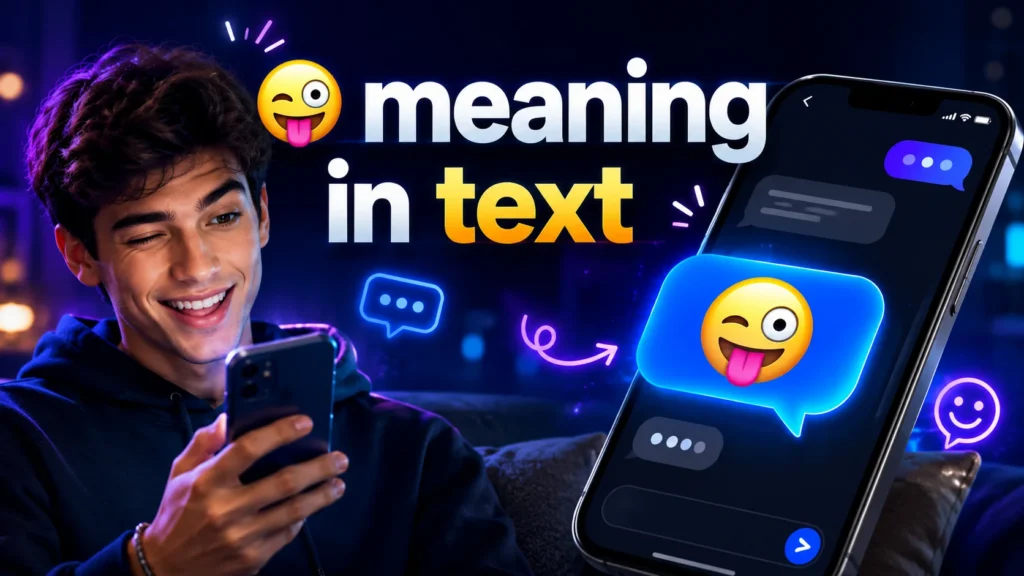
The 😜 meaning in text is usually playful teasing, silliness, cheeky humor, or lighthearted flirtation. Because the face combines a wink with a tongue sticking out, it often tells the reader, “I’m joking, so don’t take this too seriously.”
However, the emoji does not have one fixed emotional meaning. In a friendly conversation, 😜 may soften a joke. Meanwhile, in a romantic chat, it can add a mischievous or flirty tone.
For example, “You know you missed me 😜” sounds playful and confident. In contrast, “Nice driving 😜” may be gentle sarcasm after someone makes a mistake.
People often search for the 😜 meaning in text because a wink can suggest flirting, while a tongue-out expression can suggest joking or childish fun. Therefore, the relationship, previous message, and surrounding words all matter.
This guide explains what 😜 means from a friend, girl, guy, or romantic partner. Additionally, it covers emotional context, social media use, possible misunderstandings, cultural differences, suitable replies, and situations where the emoji should be avoided.
😜 Meaning in Text – Quick Meaning
The 😜 emoji is officially known as the Winking Face with Tongue. Its Unicode code point is U+1F61C, and its original Unicode name described a face with a stuck-out tongue and winking eye.
In everyday texting, it commonly means:
- I am joking
- I am teasing you
- Do not take me seriously
- I am being silly
- I am feeling playful
- I am flirting lightly
- I know I am being cheeky
- That comment was sarcastic
- I am trying to lighten the mood
Consider these examples:
“I ate the last slice of pizza 😜”
Here, the sender knows they did something slightly annoying. However, the emoji makes the confession feel playful.
“You looked cute today 😜”
In this example, the message may be flirtatious because the sender combines a compliment with a cheeky expression.
“Of course I studied all night 😜”
By contrast, this message may be sarcastic. The person probably did not study all night and is joking about it.
Therefore, the exact 😜 meaning in text depends on what appears before the emoji.
Origin and Background of the 😜 Emoji
Where the emoji came from
The 😜 emoji represents a digital version of a familiar human expression: winking while sticking out the tongue.
Before modern emojis became common, people often used text-based emoticons such as ;P, ;-P, or :P. The semicolon represented a wink, while the letter P represented a tongue sticking out.
As smartphones and social platforms became more visual, the illustrated 😜 emoji largely replaced those older combinations. Consequently, users could express playfulness with one recognizable symbol instead of several punctuation marks.
Unicode identifies the character as U+1F61C. Meanwhile, modern emoji references describe it as more playful or goofy than a standard tongue-out face because the wink adds a mischievous quality.
Cultural influence
Winking has long suggested secrecy, shared understanding, teasing, or flirtation in many cultures. Similarly, sticking out the tongue can communicate silliness, mockery, rebellion, or childlike humor.
When these two expressions are combined, the result feels intentionally unserious. Therefore, 😜 often functions as an emotional safety signal after a bold statement.
For instance, a friend may write, “I’m obviously the smartest person here 😜.” Without the emoji, the sentence might sound arrogant. With it, the reader is more likely to recognize the joke.
Social media impact
WhatsApp, Instagram, Snapchat, TikTok, Facebook, and messaging apps helped turn 😜 into a familiar reaction.
On social media, users often place it after captions that are exaggerated, playful, or slightly provocative. Furthermore, the emoji may appear with phrases such as “just kidding,” “you wish,” “caught you,” or “don’t be jealous.”
However, emoji designs can look slightly different across devices and platforms. Research has shown that visual differences between platforms can sometimes affect how people interpret an emoji’s emotional tone.
How its meaning evolved
Originally, 😜 mainly communicated silliness and joking. Nevertheless, texting culture gradually added a flirtatious interpretation because the wink can suggest attraction or private understanding.
Today, the emoji often sits between humor and flirtation. As a result, it may deliberately leave the sender’s intention slightly unclear.
That ambiguity can be useful. A person may test a romantic tone without making an extremely direct statement. However, it can also cause confusion when the receiver does not know whether the sender is being friendly or interested.
Real-Life Conversations Using 😜
WhatsApp conversation
Person A: Did you eat the chocolate I saved?
Person B: Maybe 😜
Person A: I knew it was you!
Person B: I’ll buy you another one.
Here, 😜 shows playful guilt. Although Person B admits nothing directly, the emoji strongly suggests that they ate the chocolate.
Instagram DM
Person A: That new profile picture looks really good.
Person B: Only “really good”? 😜
Person A: Fine. You look amazing.
In this conversation, the emoji invites more praise. Therefore, it feels confident, teasing, and mildly flirtatious.
TikTok comments
Commenter A: I could easily do this dance.
Commenter B: Then post your version 😜
Commenter A: Suddenly, I’m busy.
Here, 😜 playfully challenges the first commenter. It does not create a serious confrontation because the tone remains humorous.
Text-message conversation
Person A: Are you still angry with me?
Person B: Maybe a little 😜
Person A: Can I make it up to you?
Person B: Bring coffee, and we’ll talk.
In this example, the emoji softens the tension. Person B may still be annoyed; however, they are willing to reconnect.
Emotional and Psychological Meaning
The 😜 emoji often expresses emotional playfulness. More importantly, it helps the sender communicate that a statement should not be interpreted literally.
People use it because text messages do not include vocal tone, facial expressions, or body language. Therefore, a sentence that sounds funny in person may look harsh on a screen.
For example, “You are terrible at this” could appear insulting. However, “You are terrible at this 😜” sounds more like friendly teasing, especially between close friends.
The emoji can also protect the sender emotionally. Someone may write a flirtatious message and add 😜 so they can later treat it as a joke if the other person does not respond positively.
Consequently, it sometimes acts as a low-risk way to test attraction.
Imagine that a coworker-turned-friend texts, “You only came to the event because you knew I’d be there 😜.”
You may read the message as flirtation because it suggests personal interest. Nevertheless, the playful emoji gives the sender room to claim they were simply joking.
This emotional flexibility explains why 😜 can be charming but confusing. It communicates interest without demanding a serious response.
Usage in Different Contexts
Social media
On social media, 😜 commonly appears in humorous captions, playful comments, challenges, and reactions.
For example, someone might post a vacation picture with the caption, “Working very hard today 😜.” Since the photograph shows a beach, the emoji highlights the joke.
Similarly, a creator may reply “You wish 😜” to a teasing comment. In that case, the emoji shows playful confidence rather than genuine anger.
Friends and relationships
Among friends, 😜 usually communicates harmless teasing.
A friend might write, “You finally replied after three business days 😜.” Although the comment points out slow communication, the emoji keeps it friendly.
In romantic relationships, the expression can feel more intimate. For example, “Come over and find out 😜” has a clearly suggestive tone, depending on the conversation.
Therefore, the same emoji can shift from friendly to flirty based on the relationship.
Work and professional settings
The 😜 emoji is usually too informal for serious professional communication.
Although it may be acceptable in a relaxed team chat, it can appear unprofessional in customer emails, job applications, formal announcements, or communication with senior management.
Additionally, teasing can be misunderstood at work. Therefore, a simple smiling emoji such as 🙂 may be safer when warmth is needed.
Casual versus serious tone
The emoji works best in casual conversations.
However, it should be avoided when someone shares painful news, discusses a serious problem, or requests clear information. A playful expression may seem dismissive in those situations.
For example, replying “I understand 😜” to someone discussing an illness, financial problem, or family conflict would feel inappropriate.
When Not to Use 😜
Avoid using 😜 when the conversation requires sincerity, emotional sensitivity, or professional clarity.
It may be inappropriate when:
- Offering condolences
- Apologizing for serious harm
- Discussing an emergency
- Responding to emotional distress
- Communicating with a customer
- Confirming legal or financial information
- Giving formal workplace instructions
- Speaking with someone who dislikes teasing
- Making a joke about a sensitive subject
- Flirting with someone who has shown no interest
Moreover, do not use the emoji to hide a genuinely hurtful statement.
For instance, “Nobody likes you 😜” may still feel cruel, even if the sender claims it was a joke. Adding a playful face does not automatically remove the emotional impact of insulting words.
Therefore, consider whether the message would still be respectful without the emoji. If it would sound harmful, rewrite the sentence instead of relying on 😜 to soften it.
Common Misunderstandings
😜 does not always mean flirting
Because the emoji includes a wink, many people assume it always communicates attraction.
However, friends, siblings, classmates, and family members also use it for ordinary jokes. Therefore, one 😜 emoji is not enough evidence that someone likes you romantically.
It is not always sarcastic
The emoji can support sarcasm, but it also expresses genuine silliness.
For example, “Yes, I’m a professional chef 😜” is probably sarcastic after someone burns dinner. Meanwhile, “Look at my silly costume 😜” is simply playful.
It does not excuse an offensive message
A sender may add 😜 after a rude comment and later say, “I was only joking.”
Nevertheless, the receiver’s discomfort still matters. A joking intention does not erase embarrassment, disrespect, or hurt.
Platform designs may look different
The emoji may appear slightly different on Apple, Samsung, Google, Microsoft, and other platforms.
Although the central expression remains recognizable, small visual differences can make it look more goofy, flirtatious, exaggerated, or mischievous. Because emoji interpretation is already context-sensitive, design variation may increase uncertainty.
It is different from simply sticking out the tongue
The wink adds secrecy, confidence, or teasing.
Therefore, 😜 often feels more mischievous than 😛, which typically communicates general silliness without the same flirtatious undertone.
😜 Emoji Comparison Table
| Emoji | Common Meaning | Typical Tone | Main Difference |
|---|---|---|---|
| 😜 | Teasing, silliness, or light flirting | Playful and mischievous | Combines a wink with tongue-out humor |
| 😛 | Simple silliness or joking | Goofy and friendly | Usually less flirty |
| 😝 | Wild laughter or extreme silliness | Energetic and exaggerated | Feels more intense |
| 😉 | A joke, secret, or flirtation | Subtle and suggestive | Does not include childish humor |
| 🤪 | Wild, crazy, or chaotic fun | Very goofy | More chaotic than flirty |
| 😏 | Confidence or suggestive interest | Flirty or smug | More serious and seductive |
| 😂 | Strong laughter | Openly amused | Focuses on humor rather than teasing |
| 🙃 | Awkwardness, irony, or hidden frustration | Dry or ironic | May hide negative feelings |
| 😇 | Innocence, sometimes pretend innocence | Sweet or ironic | Suggests “I did nothing wrong” |
| 🤭 | Shyness, surprise, or secret laughter | Cute and restrained | Less bold than 😜 |
Key Insight
The 😜 emoji is especially flexible because it combines humor with a wink. Therefore, it can feel sillier than 😉, more flirtatious than 😛, and less intense than 😝 or 🤪.
Variations and Types of 😜
1. 😜 Alone
When sent by itself, 😜 usually means “I’m joking,” “I’m teasing,” or “I’m being silly.”
However, without words, the receiver must rely entirely on the previous message.
2. 😜😜
Using the emoji twice increases the playful energy.
For example, “You know I’m right 😜😜” sounds more obviously teasing than the same sentence with one emoji.
3. 😜😂
This combination signals that the sender is joking and laughing.
Therefore, it usually feels friendly rather than romantic.
4. 😜😉
Together, these emojis may create a more flirtatious tone.
The tongue suggests playfulness, while the second wink adds secrecy or personal interest.
5. 😜❤️
This combination often communicates affectionate teasing.
For example, a partner may write, “You are so annoying 😜❤️.” The heart makes it clear that the comment is loving.
6. 😜🔥
This pairing can indicate playful attraction or excitement.
However, when used under someone’s picture, it may feel more suggestive than friendly.
7. 😜🙈
This combination suggests cheekiness followed by pretend embarrassment.
It may mean, “I cannot believe I said that,” even though the sender probably meant to say it.
8. 😜👍
Here, the emoji keeps an agreement lighthearted.
For example, “Fine, you win this time 😜👍” shows playful acceptance.
9. Just kidding 😜
This is one of the clearest uses.
The words and emoji work together to show that the previous statement was not meant seriously.
10. You wish 😜
This phrase usually expresses confident teasing.
Depending on the relationship, it may be friendly competition or light flirtation.
How to Respond When Someone Uses 😜
Casual replies
- “Very funny.”
- “I know you’re joking.”
- “You’re impossible.”
- “Okay, I’ll let that slide.”
- “Sure you did.”
These replies maintain the playful mood without making the conversation more romantic.
Funny replies
- “That emoji will not save you.”
- “Caught being cheeky again.”
- “I’m keeping screenshots.”
- “You have chosen chaos today.”
- “Try that excuse again.”
Humorous responses work particularly well between close friends.
Flirty replies
- “Is that supposed to charm me? 😉”
- “Careful, I might believe you.”
- “You’re getting confident.”
- “Maybe you should prove it.”
- “Keep teasing and find out.”
Before using a flirty reply, make sure the other person has shown genuine interest and respects your boundaries.
Mature replies
- “Are you joking or being serious?”
- “I’m not sure how to read that.”
- “Could you explain what you mean?”
- “I prefer direct communication.”
- “That joke made me uncomfortable.”
These responses are useful when the emoji creates confusion or hides an insensitive comment.
Respectful replies
- “I understand that you’re teasing.”
- “Let’s keep the conversation friendly.”
- “I know you meant it lightly, but please avoid that joke.”
- “Thanks for clarifying.”
- “I would rather not joke about that subject.”
A calm reply allows you to maintain boundaries without unnecessarily escalating the conversation.
Regional and Cultural Usage
Western culture
In North America, the United Kingdom, Australia, and much of Europe, 😜 commonly represents joking, cheekiness, or flirtation.
However, the strength of the flirtatious meaning varies. Younger users may interpret it as playful and slightly old-fashioned, while others continue using it regularly.
Asian culture
Across Asian messaging cultures, 😜 is often understood as playful teasing or friendly silliness.
Nevertheless, social rules around flirtation differ. Therefore, a message that seems casual in one culture may feel unusually direct in another.
Middle Eastern culture
In Middle Eastern online communication, 😜 is commonly used among friends and relatives to soften teasing.
However, when sent between people who are not close, the wink may be interpreted as flirtatious. Consequently, relationship boundaries and cultural expectations become especially important.
Global internet usage
Globally, the emoji remains widely recognizable because its facial expression is visually expressive.
Even so, emojis do not carry completely universal meanings. Research on emoji ambiguity shows that people can interpret the same symbol differently when it appears without enough surrounding context.
Gen Z versus Millennials
Millennials often use 😜 as a straightforward “just kidding” emoji.
Gen Z users may still understand it, although some prefer alternatives such as 😭, 💀, 🤪, or ironic combinations. Therefore, 😜 can occasionally feel more nostalgic or deliberately cheesy in younger conversations.
Still, meaning depends more on personal texting style than age alone.
Is 😜 Safe for Kids?
Yes, 😜 is generally safe for children.
It usually communicates joking, silliness, and playful teasing. Furthermore, it does not have an automatically adult or offensive meaning.
However, children should understand that emojis cannot make every statement harmless. A hurtful insult may still cause emotional pain even when 😜 appears afterward.
Parents and teachers can explain a simple rule: use the emoji to share fun, not to hide bullying.
Additionally, children should avoid sending flirtatious or confusing messages to strangers online. Context awareness remains important, even with an innocent-looking emoji.
Frequently Asked Questions
What is the 😜 meaning in text?
The 😜 meaning in text is usually playfulness, teasing, silliness, sarcasm, or light flirtation. It often tells the reader not to take the message too seriously.
What does 😜 mean from a girl?
From a girl, 😜 may indicate friendly teasing, confidence, joking, or romantic interest. However, the surrounding words and her usual texting style determine the meaning.
What does 😜 mean from a guy?
From a guy, 😜 can mean that he is joking, being cheeky, or flirting lightly. Nevertheless, one emoji alone does not prove romantic attraction.
Is 😜 a flirting emoji?
Yes, 😜 can be flirty because the wink adds a mischievous tone. However, it is also widely used between friends and family members without romantic meaning.
What is the difference between 😜 and 😛?
😜 combines a wink with a tongue-out face, so it often feels teasing or flirtatious. In contrast, 😛 usually communicates straightforward silliness.
Is 😜 rude or sarcastic?
It can support sarcasm, although it is not automatically rude. The words before the emoji determine whether the message feels playful, dismissive, or insulting.
How should I reply to 😜?
You can respond playfully with “Very funny,” “You’re impossible,” or another light emoji. However, when the meaning is unclear, ask whether the sender is joking or serious.
Conclusion
The 😜 meaning in text is usually playful teasing, silliness, cheeky humor, or light flirtation.
Because the emoji combines a wink with a tongue-out expression, it often acts as a signal that the sender is joking. Therefore, it can soften a bold comment, playful challenge, sarcastic statement, or affectionate insult.
However, context remains essential. A close friend may use 😜 innocently, while a romantic interest may use it to test a flirty tone. Likewise, an insensitive person may add it after a rude comment and claim they were only joking.
For that reason, consider the relationship, previous message, punctuation, and surrounding emojis before deciding what it means.
When the tone feels comfortable, respond with similar playfulness. Meanwhile, when the message feels confusing or disrespectful, ask directly or establish a calm boundary.
Ultimately, 😜 works best when both people understand the joke. Used thoughtfully, it adds warmth and personality to digital conversations without requiring a long explanation.