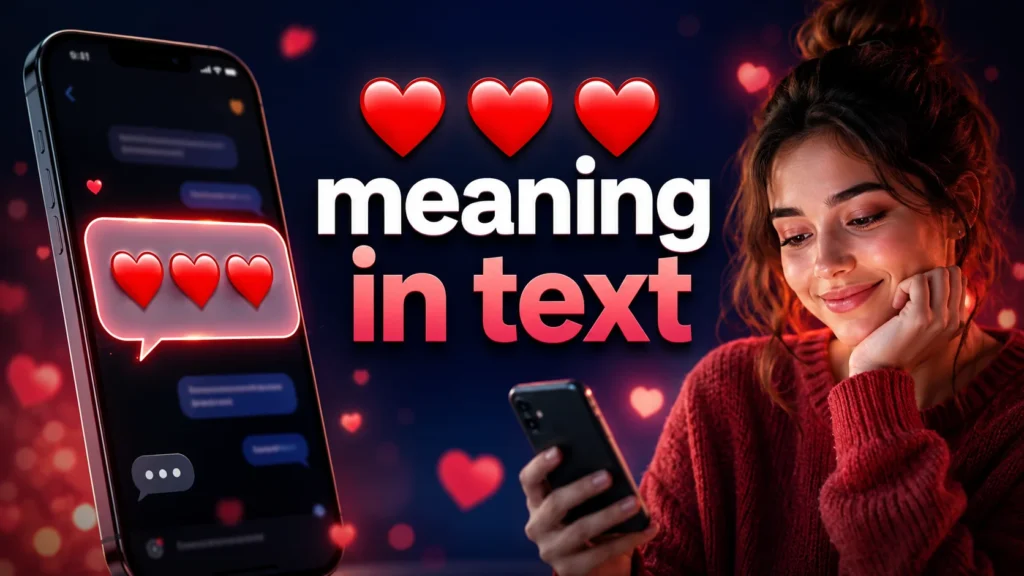
The ❤❤❤ meaning in text is usually strong affection, deep care, emotional support, or enthusiastic love. Because three hearts feel more intense than one, the sender is often emphasizing warmth, closeness, or appreciation.
However, three hearts do not always mean romantic love. A friend may send ❤❤❤ after good news, while a family member may use them to show support. Meanwhile, a romantic partner may send the same symbols to express attraction or emotional intimacy.
For example, “I’m so proud of you ❤❤❤” feels supportive and loving. In contrast, “Goodnight ❤❤❤” may sound more romantic, especially when it comes from someone who already shows interest.
Therefore, the relationship, message topic, timing, and normal texting style all matter. This guide explains the possible ❤❤❤ meaning in text, including friendly, romantic, supportive, sarcastic, and cultural interpretations.
❤❤❤ Meaning in Text – Quick Meaning
The ❤❤❤ meaning in text is usually an intensified version of one heart.
It can mean:
- I love you very much
- I care deeply about you
- I am proud of you
- I support you
- I appreciate you
- I am emotionally close to you
- I am excited for you
- I am sending comfort
- I feel romantic attraction
- I want my message to feel extra warm
The symbol ❤ is widely used as a heart of love, affection, and emotional connection. When it appears three times, repetition adds intensity.
Consider these examples:
“Thank you for always being there ❤❤❤”
Here, the sender expresses strong appreciation and emotional closeness.
“You looked beautiful today ❤❤❤”
In this case, the hearts may be romantic or flirtatious.
“Good luck with your exam ❤❤❤”
Here, the hearts communicate encouragement and support rather than romance.
Therefore, three hearts usually strengthen the emotional tone, although the exact feeling depends on the conversation.
Origin and Background of ❤❤❤
The heart as a symbol
The heart shape has represented love, affection, and emotional connection for centuries.
Although the human heart does not look exactly like the familiar symbol, the shape gradually became associated with romance, devotion, and emotional life. As a result, people began using it in letters, artwork, cards, jewelry, and eventually digital communication.
Before emojis became common, people often typed symbols such as <3 to represent a heart. Later, smartphones and messaging platforms made visual heart symbols much easier to send.
Why people repeat the heart
Repetition has always been a simple way to increase emotional intensity.
For example, “thank you” feels polite, while “thank you so much” feels warmer. Similarly, one heart may show affection, whereas three hearts usually communicate stronger emotion.
Therefore:
- ❤ may feel simple and caring
- ❤❤ may feel warmer and more personal
- ❤❤❤ may feel deeply affectionate or enthusiastic
Still, repetition does not create a fixed mathematical scale. Some people naturally send several hearts to everyone, while others use even one heart only in special relationships.
Cultural influence
Love letters, greeting cards, romantic films, and popular music helped make the heart a universal symbol of affection.
Meanwhile, family and friendship culture expanded its meaning beyond romance. Today, people use hearts to congratulate friends, comfort relatives, thank teachers, support creators, and react to emotional stories.
As a result, three hearts can communicate many forms of love, including romantic love, friendship, family affection, gratitude, and kindness.
Social media impact
Instagram, WhatsApp, Facebook, TikTok, Snapchat, and other platforms made repeated hearts extremely common.
For instance, someone may comment ❤❤❤ under a friend’s photograph without writing any words. In that situation, the hearts may mean, “You look amazing,” “I love this,” or “I support you.”
Likewise, creators often receive rows of hearts from followers. Therefore, repeated hearts can function as emotional applause.
Real-Life Conversations Using ❤❤❤
WhatsApp conversation
Person A: I finally passed my driving test!
Person B: I knew you could do it! I’m so proud of you ❤❤❤
Person A: Thank you for helping me practice.
Here, the three hearts express pride, support, and genuine friendship. There is no obvious romantic meaning.
Instagram DM
Person A: Your new picture is beautiful.
Person B: Thank you ❤❤❤
Person A: You always look amazing.
In this conversation, the hearts could be friendly or lightly flirtatious. However, the second compliment makes the exchange feel more personal.
TikTok comments
Commenter A: I’ve been feeling better after a really difficult year.
Commenter B: So happy for you ❤❤❤
Commenter A: Thank you. That means a lot.
Here, the hearts show emotional support and encouragement.
Text-message conversation
Person A: Goodnight. Sleep well.
Person B: Goodnight ❤❤❤
Person A: Those hearts are making me smile.
In this example, three hearts may suggest romantic affection. The meaning becomes stronger because the exchange is private and emotionally warm.
Emotional and Psychological Meaning
Three hearts often communicate emotional intensity without requiring a long explanation.
Sometimes, people struggle to put affection into words. Therefore, they use repeated hearts to make a short message feel warmer and more sincere.
For example, “I’m here for you” already sounds supportive. However, “I’m here for you ❤❤❤” feels softer and more emotionally present.
The hearts can also create reassurance. During difficult moments, a friend may send them to say, “You are not alone,” even when they do not know what else to write.
In romantic conversations, three hearts may indicate comfort, trust, attachment, or attraction. Nevertheless, they do not automatically prove that someone wants a relationship.
Imagine that you tell a close friend about a personal problem. They reply, “Please take care of yourself ❤❤❤.”
The message may feel deeply loving, although the love is probably supportive rather than romantic. By contrast, if someone regularly compliments you, sends goodnight messages, and adds ❤❤❤, the romantic possibility becomes stronger.
Therefore, emotional patterns matter more than one isolated message.
Usage in Different Contexts
Social media
On social media, three hearts commonly express approval, beauty, support, or excitement.
Someone may comment ❤❤❤ under:
- A friend’s selfie
- A wedding photograph
- A graduation post
- A family picture
- A new outfit
- A personal achievement
- An emotional story
- A creative project
In these cases, the hearts often replace a sentence such as “I love this” or “You look wonderful.”
However, a public heart comment is usually less intimate than the same message sent privately. Therefore, platform and visibility influence interpretation.
Friends and relationships
Among friends, ❤❤❤ can express strong platonic love.
For example, “Miss you so much ❤❤❤” may simply show that the friendship is emotionally close.
In romantic relationships, the same hearts often communicate deeper intimacy. Partners may use them after “I love you,” “goodnight,” “I miss you,” or affectionate compliments.
Still, many people have naturally warm texting styles. Consequently, repeated hearts should be interpreted alongside their behavior, not treated as proof of romance.
Family communication
Family members frequently use three hearts to express unconditional love.
Parents may send them after encouraging a child. Siblings may use them after a meaningful conversation. Meanwhile, grandparents may include several hearts in nearly every affectionate message.
Therefore, family context usually points toward care, pride, and emotional closeness rather than flirtation.
Work and professional settings
Three hearts are generally too personal for formal business communication.
However, they may appear in casual team chats after a celebration, farewell, or supportive message. For example, coworkers might send hearts when someone announces a new baby or recovers from illness.
Even so, a single neutral heart or a simple congratulatory message may be safer when professional boundaries are important.
Casual versus serious tone
Repeated hearts work in both casual and serious emotional conversations.
In a playful message, they may show excitement. In a serious message, they may offer comfort or reassurance.
For example:
- “You got the tickets! ❤❤❤” feels excited.
- “I’m thinking of you ❤❤❤” feels caring and serious.
Therefore, the surrounding words reveal the emotional direction.
When Not to Use ❤❤❤
Avoid using three hearts when the message could create false romantic expectations.
For example, if someone has openly expressed romantic interest and you only see them as a friend, repeated hearts may unintentionally encourage them.
The hearts may also be inappropriate when:
- Writing a formal business email
- Communicating with a customer
- Replying to a serious complaint
- Speaking with someone who dislikes emotional symbols
- Trying to establish professional boundaries
- Responding sarcastically to painful news
- Contacting someone after they requested distance
- The message could seem emotionally manipulative
Additionally, do not use hearts to avoid taking responsibility.
For instance, “Sorry I lied ❤❤❤” may appear dismissive because the emotional symbols do not replace a sincere apology.
In serious situations, use clear words first. Then, add hearts only when they support the message rather than weaken it.
Common Misunderstandings
Three hearts do not always mean “I love you romantically”
Many people assume that repeated hearts automatically signal romantic attraction.
However, friends and family members regularly use them to express care. Therefore, romance should not be assumed without additional signs.
More hearts do not always mean more love
Repetition often increases warmth, but texting habits differ.
One person may send five hearts casually, while another may use one heart only with a romantic partner. Consequently, the sender’s usual style is important.
The plain heart may display differently
The symbol ❤ may appear red, black, or in another visual style depending on the platform, font, and device.
However, the intended meaning usually remains love or affection. The design difference rarely changes the emotional message completely.
Hearts can be supportive rather than flirtatious
A message such as “Stay strong ❤❤❤” is usually supportive.
By contrast, “You looked so good tonight ❤❤❤” has a stronger chance of being flirtatious.
Therefore, the sentence matters more than the symbol alone.
They can occasionally be sarcastic
Although uncommon, some people use hearts sarcastically after a fake compliment or passive-aggressive statement.
For example, “Thanks for ignoring me again ❤❤❤” does not express genuine love. Instead, the contrast creates frustration or sarcasm.
❤❤❤ Comparison Table
| Symbol or Emoji | Common Meaning | Typical Tone | Main Difference |
|---|---|---|---|
| ❤ | Love, care, or appreciation | Warm and simple | Less intense |
| ❤❤ | Strong affection | Personal and warm | More emphasis than one heart |
| ❤❤❤ | Deep affection or enthusiastic support | Loving and expressive | Strong emotional emphasis |
| ❤️ | Love and romance | Warm or romantic | Most familiar red-heart form |
| 💕 | Affection and closeness | Cute and gentle | Often feels playful |
| 💖 | Excited or sparkling love | Enthusiastic | More celebratory |
| 💗 | Growing affection | Sweet and emotional | Often suggests increasing love |
| 💙 | Trust, loyalty, or calm care | Supportive | Less traditionally romantic |
| 🤍 | Pure, gentle, or peaceful love | Soft and sincere | Often used for sympathy |
| 🖤 | Dark style, grief, or deep affection | Stylish or serious | Meaning depends strongly on context |
Key Insight
Three hearts usually intensify affection, but the heart style changes the emotional flavor. Therefore, ❤❤❤ often feels classic and direct, while colorful hearts may communicate more specific moods.
Variations and Types of ❤❤❤
1. ❤
Meaning: Basic love, care, or appreciation.
One heart is simple, warm, and widely used in both friendly and romantic conversations.
2. ❤❤
Meaning: Stronger affection.
Two hearts add emphasis without feeling as intense as three or more.
3. ❤❤❤
Meaning: Deep affection, strong support, or enthusiastic love.
This variation feels emotionally generous and personal.
4. ❤️❤️❤️
Meaning: Strong love with a clearly red, romantic appearance.
This version is often used between partners, close friends, and family members.
5. ❤❤❤❤❤
Meaning: Very enthusiastic affection.
Several hearts may communicate excitement, celebration, or an especially emotional response.
6. ❤❤❤🥰
Meaning: Loving affection with warmth and tenderness.
The smiling face with hearts makes the message feel sweeter and more personal.
7. ❤❤❤😘
Meaning: Affection combined with a kiss.
This pairing is more likely to sound romantic or flirtatious.
8. ❤❤❤😭
Meaning: Overwhelming love, gratitude, or emotional appreciation.
The crying emoji may represent happy tears rather than sadness.
9. ❤❤❤✨
Meaning: Admiration, celebration, or magical excitement.
This version often appears under beautiful pictures or good news.
10. ❤❤❤🤗
Meaning: Love, comfort, and emotional support.
The hugging face makes the hearts feel reassuring rather than flirtatious.
How to Respond When Someone Uses ❤❤❤
Casual replies
- “Thank you so much!”
- “You’re the sweetest.”
- “That means a lot.”
- “Sending love back.”
- “Aww, thank you.”
These replies work when the hearts feel friendly or supportive.
Funny replies
- “That’s a lot of love.”
- “Three hearts? I must be special.”
- “I’m collecting all of these.”
- “Heart delivery received.”
- “You’re making me emotional now.”
Humor can keep the exchange warm without making it overly serious.
Romantic replies
- “I love you too ❤❤❤”
- “You have my whole heart.”
- “Missing you even more now.”
- “Those hearts belong to me, right?”
- “Sending you twice as many.”
Use a romantic reply only when the relationship and tone clearly support it.
Mature replies
- “I appreciate your kindness.”
- “Your support means a lot to me.”
- “I care about you too.”
- “Thank you for being there.”
- “I’m glad we can speak honestly.”
These responses acknowledge the emotion without assuming romance.
Respectful replies
- “Thank you for the support.”
- “That was very thoughtful.”
- “I appreciate the warm message.”
- “Sending good wishes back.”
- “Thank you for thinking of me.”
A respectful reply works well when you want to remain kind while maintaining emotional boundaries.
Regional and Cultural Usage
Western culture
In Western texting culture, repeated hearts are common between partners, relatives, close friends, and social media users.
However, romantic interpretations become stronger in private conversations, especially when combined with compliments, goodnight messages, or expressions of missing someone.
Asian culture
Across many Asian digital communities, repeated hearts are widely used to express friendship, admiration, gratitude, and support.
People may send several hearts without romantic intention. Therefore, the symbol may feel more socially flexible in group chats and fan communities.
Middle Eastern culture
In Middle Eastern messaging culture, hearts are commonly exchanged among close friends and family members.
Women friends may send several hearts to each other as a normal expression of affection. Meanwhile, hearts between unrelated men and women may be interpreted more romantically depending on personal and cultural expectations.
Therefore, relationship context is especially important.
Global internet usage
Globally, the heart is one of the most recognizable emotional symbols.
Nevertheless, digital habits vary. Some users send repeated hearts casually, while others reserve them for people they deeply love.
As a result, personal behavior often matters more than nationality.
Gen Z versus Millennials
Gen Z users often combine hearts with expressive emojis such as 😭, 🥹, ✨, and 🫶.
For example, “I love this so much ❤❤❤😭” communicates intense emotional enthusiasm.
Millennials also use repeated hearts frequently, although they may pair them with more traditional phrases such as “Love you” or “So proud of you.”
Both generations understand the core meaning, even though their emoji combinations may differ.
Is ❤❤❤ Safe for Kids?
Yes, three hearts are generally safe for children.
They usually communicate love, friendship, gratitude, support, or kindness. Therefore, children may use them in messages to family members, classmates, and trusted friends.
However, adults should teach children that hearts can sometimes be interpreted romantically.
Children should also avoid sending emotionally personal messages to strangers online. In addition, they should understand that an unknown person sending hearts repeatedly may be trying to create uncomfortable closeness.
The symbol itself is harmless. Nevertheless, online safety still depends on who is sending the message and what else they are saying.
Frequently Asked Questions
What is the ❤❤❤ meaning in text?
The ❤❤❤ meaning in text is usually strong love, affection, appreciation, emotional support, or excitement. Three hearts intensify the warmth of the message.
What does ❤❤❤ mean from a girl?
From a girl, three hearts may express friendship, care, gratitude, support, or romantic attraction. The surrounding conversation and her usual texting style reveal the most likely meaning.
What does ❤❤❤ mean from a guy?
From a guy, three hearts can indicate deep care, affection, flirting, or romantic interest. However, they may also be supportive if the conversation involves friendship or encouragement.
Do three hearts mean “I love you”?
They can mean “I love you,” especially in a close or romantic relationship. Nevertheless, they may also mean “I care about you” or “I’m proud of you.”
Is ❤❤❤ romantic?
Three hearts can be romantic, particularly after compliments, goodnight messages, or “I miss you.” However, they are not automatically romantic in family or friendship conversations.
What is the difference between ❤ and ❤❤❤?
One heart expresses basic warmth or affection. Meanwhile, three hearts add stronger emotional emphasis and may feel more personal or enthusiastic.
How should I reply to ❤❤❤?
You can respond with “Thank you,” “Sending love back,” or matching hearts. However, choose a reply that fits your relationship and comfort level.
Conclusion
The ❤❤❤ meaning in text is usually strong affection, deep appreciation, emotional support, or enthusiastic love.
Because the heart appears three times, the message often feels warmer and more expressive than a single heart. However, repeated hearts do not always indicate romantic attraction.
A close friend may send them to celebrate your success. A family member may use them to offer comfort. Meanwhile, a romantic partner may send them to express love, longing, or intimacy.
Therefore, consider the sender’s normal style, your relationship, the surrounding words, and the timing of the message.
When the meaning feels friendly, respond with gratitude or affection. When it feels romantic and you share that interest, you can match the warmth. However, when you prefer clear boundaries, a polite “Thank you for the support” is enough.
Ultimately, three hearts are a simple but emotionally powerful part of digital communication. They may not explain every feeling, yet they often say, “You matter to me,” more warmly than words alone.