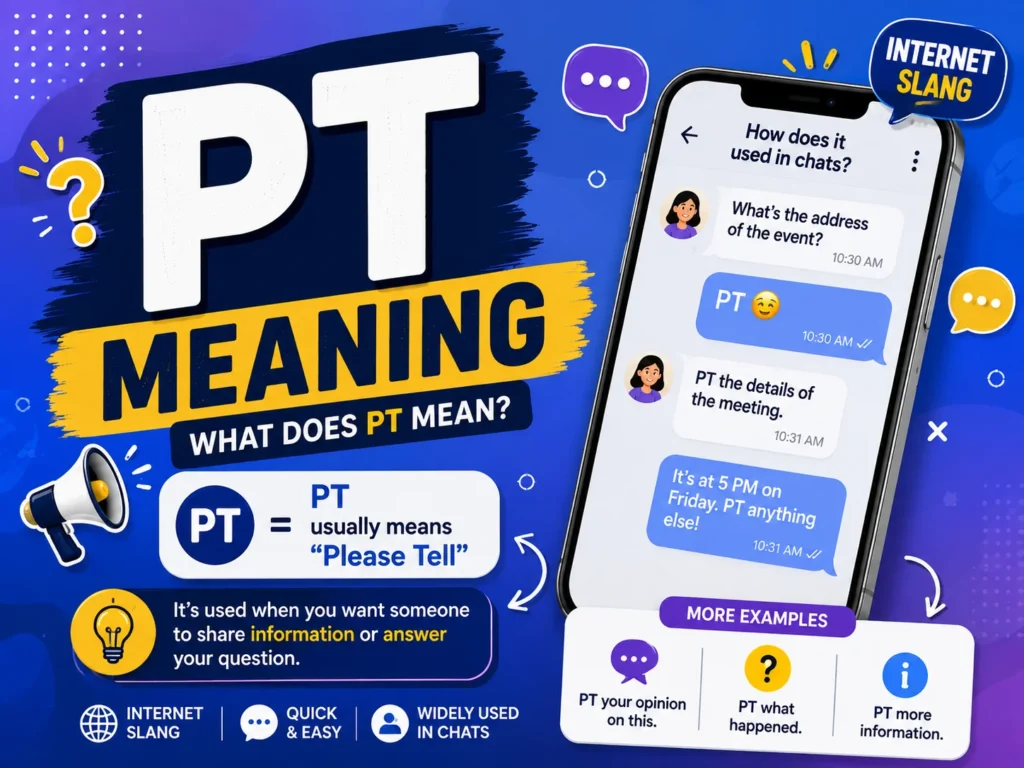
PT can mean several things in text, but the meaning depends on context. Most commonly, PT means part, part-time, physical training, personal trainer, physical therapy, or Pacific Time. So, what does this mean when someone texts it to you? You need to look at the surrounding message before choosing the meaning.
What Does PT Mean in Text?
“PT” is an abbreviation, not one fixed slang word. Unlike terms such as “LOL” or “BRB,” it doesn’t have a single universal definition in texting.
The most likely meaning depends on what you’re talking about:
- Part — especially “pt 2,” “pt 3,” or a continuation of something.
- Part-time — usually in conversations about jobs or schedules.
- Physical training — common in fitness, sports, and military contexts.
- Personal trainer — common when discussing gyms and workouts.
- Physical therapy — common in healthcare and injury-related conversations.
- Pacific Time — common when arranging an online meeting, event, or livestream.
- Point — sometimes used as a written abbreviation, especially in notes or informal writing.
Cambridge Dictionary confirms that pt is a standard written abbreviation for part, point, and pint, while PT can also be used for part-time in workplace English.
This explains why searching “PT meaning in text” can be confusing. Two people can type exactly the same two letters and mean completely different things.
Is PT an Acronym, Abbreviation, or Slang Word?
The safest description is abbreviation or initialism, depending on the phrase being shortened.
It isn’t necessarily slang. In fact, many uses of PT are established abbreviations used in professional settings.
For example:
- “I work PT now.” = I work part-time.
- “PT starts at 6.” = physical training starts at 6.
- “My PT says I need more exercises.” = personal trainer or physical therapist, depending on the conversation.
- “See pt 3.” = See part 3.
- “The meeting is at 4 PM PT.” = Pacific Time.
That distinction matters because calling every abbreviation “slang” can create unnecessary confusion.
The Most Common Meanings of PT
1. PT Meaning “Part”
One of the clearest general meanings of pt is part.
You may see it when someone divides a story, explanation, document, or online series into sections:
“Did you watch pt 1?”
That means:
“Did you watch part 1?”
You may also see “pt 2,” “pt 3,” and similar forms. Cambridge specifically lists pt as a written abbreviation for “part.”
This meaning is especially easy to identify when a number follows it.
2. PT Meaning “Part-Time”
In work-related texts, PT commonly means part-time.
For example:
“I got a PT job at the cafe.”
The person means:
“I got a part-time job at the cafe.”
This usage isn’t new internet slang. Cambridge’s Business English Dictionary lists PT/P/T as a written abbreviation for “part-time.” (Cambridge Dictionary)
If the conversation involves jobs, shifts, employment, or working hours, “part-time” should be one of your first interpretations.
3. PT Meaning “Physical Training”
In fitness, sports, military, or school-related conversations, PT can mean physical training.
For example:
“We have PT at 6 tomorrow.”
That could mean a scheduled physical-training session.
This is also a long-established abbreviation rather than a TikTok-created slang term. Some texting references identify physical training as a common interpretation of PT in messages.
4. PT Meaning “Personal Trainer”
In gym conversations, PT can also mean personal trainer.
For example:
“My PT changed my workout.”
Here, the person is probably talking about their trainer, not a physical-training session.
The difference comes from grammar and context:
- “I have PT at 6.” → probably a training session.
- “My PT gave me a new workout.” → probably personal trainer.
5. PT Meaning “Physical Therapy”
In healthcare conversations, PT frequently refers to physical therapy.
For example:
“The doctor said I need PT twice a week.”
Here, PT means physical therapy, a form of rehabilitation.
You shouldn’t assume that every health-related “PT” means personal trainer. If the conversation involves surgery, an injury, rehabilitation, pain, movement, or recovery, physical therapy is a much more likely interpretation.
6. PT Meaning “Pacific Time”
When someone is arranging a time, PT can mean Pacific Time, a North American time zone.
For example:
“The meeting starts at 5 PM PT.”
This isn’t describing a person’s job or workout. It tells you which time zone the schedule uses.
This meaning is particularly common in online events, remote work, gaming, livestreams, and international communication.
7. PT Meaning “Point”
In some written contexts, pt can mean point.
For example:
“You missed my main pt.”
That could mean:
“You missed my main point.”
This is less reliable as casual texting slang than the meanings above, so context matters.
PT on Different Texting Platforms
SMS, iMessage, and WhatsApp
In ordinary texting, PT doesn’t have one universal meaning.
You might see:
“I found a PT job.”
Here, it means part-time.
Or:
“PT tomorrow morning 😭.”
If the conversation is about school, exercise, sports, or military training, it may mean physical training.
WhatsApp and iMessage don’t assign a special meaning to PT. The sender’s context determines what they mean.
Instagram, Snapchat, and Discord DMs
In DMs, pt can appear as shorthand for “part,” particularly when people discuss a series or continuation.
For example:
“Wait for pt 2.”
Here, the meaning is almost certainly “part 2.”
Fitness-related DMs may also use PT for personal trainer or physical training.
TikTok and X
PT can also appear in captions, comments, or posts as “part,” such as “pt 2.” However, if you’re specifically trying to understand a text message, don’t automatically assume the social-media meaning.
The same abbreviation can travel between platforms while keeping different meanings.
Why Do People Search “PT Meaning in Text”?
People usually search this phrase because PT is highly context-dependent.
Imagine receiving:
“I have PT tomorrow.”
Without any previous conversation, you can’t know whether the person means:
- physical training,
- physical therapy,
- a personal trainer,
- or something else.
That uncertainty is exactly what the search solves.
The good news is that you usually don’t need a dictionary. Read the messages immediately before and after “PT.”
If they’re discussing a job, think part-time.
If they’re discussing an injury, think physical therapy.
and,
If they’re discussing a gym, think personal trainer or physical training.
If there’s a number after it, such as “pt 2,” think part.
More,
If there’s a time such as “8 PM PT,” think Pacific Time.
PT Tone and Context Variations
Funny PT Conversation
A funny use often happens when friends talk about exercise.
A: PT at 6 tomorrow.
B: Why are you telling me this like it’s good news?
A: Because we’re suffering together 😂
B: I’m suddenly unavailable.
Here, PT means physical training.
Sarcastic PT Conversation
A: I signed up for PT three times a week.
B: Amazing.
A: Why did you say that like I made a terrible decision?
B: Because you did. 😂
Here, PT could mean personal training or physical training depending on the gym’s terminology.
Playful PT Conversation
A: My PT gave me homework again.
B: Your trainer gives homework?
A: Apparently my muscles have assignments now.
B: Tell them your homework is canceled.
Here, PT most naturally means personal trainer.
Serious PT Conversation
A: The doctor wants me to start PT next week.
B: Physical therapy?
A: Yeah, for my knee.
B: I hope it helps with the recovery.
Here, the medical context makes physical therapy clear.
Real Chat Examples of PT
1. Friend — Part
A: Did you finish the story?
B: Not yet. I’m waiting for pt 2.
A: Same 😂
B: I need to know what happened.
Here, pt = part.
2. Coworker — Part-Time
A: Are you working tomorrow?
B: Yeah, PT shift from 4 to 9.
A: Got it.
B: I have classes during the day.
Here, PT = part-time.
3. Gym Friend — Personal Trainer
A: Who’s that training you?
B: My PT.
A: Is he good?
B: Really good. My workouts finally make sense.
Here, PT = personal trainer.
4. Medical Conversation — Physical Therapy
A: How’s your recovery going?
B: Better. I started PT this week.
A: Is it helping?
B: Yeah, slowly.
Here, PT = physical therapy.
5. School Friend — Physical Training
A: Do we have PT tomorrow?
B: I think so.
A: Great, I forgot my sports shoes today.
B: Bring them tomorrow 😂
Here, PT = physical training.
6. International Friend — Pacific Time
A: What time is the meeting?
B: 7 PM PT.
A: Pacific Time?
B: Yep.
Here, PT = Pacific Time.
7. Sibling — Part
A: Send me the rest of the video.
B: It’s in pt 2.
A: Where?
B: I sent it yesterday.
Here, pt = part.
8. Parent — Part-Time
A: What time will you be home?
B: Around 8. I’m PT at the store tonight.
A: Okay, be careful coming home.
B: I will.
Here, PT = part-time.
9. Stranger — Clarifying the Meaning
A: I have PT tomorrow.
B: Sorry, what does PT mean here?
A: Physical therapy.
B: Oh, got it. Hope it goes well.
This is a good example of why asking for context is better than guessing.
10. Friend — Point
A: You’re missing my main pt.
B: Wait, what point?
A: That we should leave earlier.
B: Ohhh, now I get you.
Here, pt = point.
Grammar and Language Role
Part of Speech
PT isn’t really a traditional part of speech by itself. It’s an abbreviation that takes the grammatical role of the phrase it replaces.
For example:
“I work PT.”
Here, PT functions within the sentence as an abbreviation for “part-time.”
In:
“My PT is great.”
PT functions as a noun phrase meaning “personal trainer” or “physical therapist.”
Can PT Stand Alone?
Yes, but only when the context is already clear.
For example:
A: Are you working full-time?
B: PT.
The answer means “part-time.”
But if someone suddenly sends:
“PT”
with no context, you may reasonably ask what they mean.
Can PT Appear Mid-Sentence?
Yes.
Examples include:
“I’m working PT this summer.”
“My PT gave me exercises.”
“We have PT tomorrow.”
“The event starts at 6 PM PT.”
Capitalization
Capitalization can help, but it doesn’t always determine the meaning.
- PT often appears in established abbreviations.
- pt may be used informally for “part.”
- Pt may appear simply because someone uses inconsistent capitalization.
In casual texting, people don’t always follow strict capitalization rules, so don’t rely on capitalization alone.
Formal or Informal?
It depends on the meaning.
“PT” is perfectly established in professional contexts, but in a casual message, the reader may need context.
For formal writing, spelling out the phrase is often clearer when your audience might not know the abbreviation.
How to Reply to PT in a Text
Funny Reply
If someone says:
“PT at 6 AM.”
You could answer:
“Absolutely not. My bed has already rejected this plan 😂”
Serious Reply
If someone says:
“I start PT next week.”
You could say:
“I hope the treatment goes well. Keep me updated.”
Flirty Reply
If the person means personal trainer:
“Your PT has you working that hard? I might need to come check your progress 😉”
Only use a flirty response when your relationship makes that tone appropriate.
Neutral or Unbothered Reply
If you’re unsure:
“PT as in part-time?”
That’s short, natural, and prevents a misunderstanding.
PT vs Related Abbreviations
| Term | Meaning | Usage Context | Tone | Popularity | Confusion Risk |
|---|---|---|---|---|---|
| PT | Part / part-time / physical training and more | Texting, work, fitness | Casual to professional | High | High |
| FT | Full-time | Work and employment | Neutral | High | Medium |
| PTA | Physical therapist assistant / other meanings | Healthcare, education | Professional | Medium | High |
| P/T | Part-time | Workplace writing | Professional | Medium | Low |
| PT 2 | Part 2 | Online series and messages | Casual | High | Low |
| PT time | Pacific Time, depending on phrasing | Scheduling | Neutral | High | Medium |
The key difference is that PT has unusually broad meanings, while terms such as FT tend to be more predictable.
Who Uses PT?
Teenagers and Younger Users
Younger people may encounter PT through school, fitness, DMs, online series, or conversations with friends. However, PT isn’t exclusively Gen Z slang.
Gen Z vs. Millennials
Both Gen Z and Millennials use abbreviations, but the exact style varies by person and platform.
A younger user may write:
“pt 2??”
while another person might write:
“part 2?”
Neither is inherently more correct.
The important point is that PT isn’t a uniquely Gen Z expression. Its meanings existed in professional and everyday language before current social-media culture.
Regional Usage
PT has English-language uses across different regions, but individual meanings depend heavily on local context.
However, In US-based scheduling, PT commonly refers to Pacific Time. In international conversations, that meaning can become especially important because people often coordinate across time zones.
In UK workplace English, PT or P/T can represent part-time employment.
Fitness and healthcare meanings can also appear internationally.
Origin and Internet Culture
PT doesn’t have one single internet origin.
That’s important because not every abbreviation came from TikTok, memes, or Gen Z culture.
The abbreviation pt for “part” is an established written abbreviation, and Cambridge lists it as such. (Cambridge Dictionary)
Likewise, part-time, physical training, physical therapy, and Pacific Time are established abbreviations used in specific fields.
Texting culture made abbreviations more visible because short messages are convenient and fast. But PT itself should not be presented as a modern meme word with one dramatic origin.
There is also no strong reason to assign PT a specific AAVE origin. Its major meanings come from ordinary English abbreviation practices and specialized terminology.
Is PT Rude or Offensive?
Generally, no.
PT isn’t profanity and isn’t inherently insulting.
The problem is not offensiveness. The problem is ambiguity.
If you text someone:
“PT tomorrow.”
they may not know whether you mean physical training, physical therapy, or something else.
Is PT Appropriate at School?
It depends on the audience.
For a casual message to a classmate:
“Do we have PT tomorrow?”
is fine if everyone understands the abbreviation.
For a teacher or formal school communication, writing physical training may be clearer.
Is PT Appropriate at Work?
If your workplace commonly uses PT for part-time, it can be perfectly normal.
For a formal email to someone unfamiliar with your terminology, however, “part-time” is safer.
Real-World Observation
What makes PT interesting is that it doesn’t behave like a typical slang word. It works more like a context switch: the same two letters change meaning depending on the conversation around them. A person discussing employment can mean part-time, a gym-goer can mean personal trainer, someone recovering from an injury can mean physical therapy, and someone arranging a US-based meeting can mean Pacific Time. In real texting, people usually don’t stop to define PT because their conversation already provides the clue. That’s why the abbreviation has remained useful: it’s short, flexible, and familiar enough to many readers without belonging exclusively to one age group or social platform.
Frequently Asked Questions
What does PT mean in texting?
PT can mean several things in texting. Common meanings include part, part-time, physical training, personal trainer, physical therapy, and Pacific Time. The surrounding conversation usually tells you which one applies. If the message doesn’t provide enough context, asking the sender is better than guessing.
Is PT slang or an abbreviation?
PT is better described as an abbreviation than as a specific slang word. Some people use it casually in texts and DMs, but many PT meanings are also standard in workplaces, healthcare, fitness, and scheduling. Cambridge lists several established meanings for “pt,” including part and point. (Cambridge Dictionary)
Is it rude to reply with just PT in a text?
No, PT itself isn’t rude. However, replying only with “PT” can confuse someone if they don’t know which meaning you’re using. If clarity matters, spell out the phrase or add enough context. For example, “PT at 6” is much easier to understand when you’ve already been discussing physical training.
What’s the difference between texting PT and saying it out loud?
In texting, PT is usually read as an abbreviation, while spoken conversation normally uses the full phrase. Someone would usually say “part-time,” “physical therapy,” or “personal trainer” rather than simply pronouncing the letters. However, people familiar with workplace or fitness terminology may occasionally say “P-T” aloud.
Does PT mean the same thing in a group chat and a 1-on-1 text?
Not necessarily. In a group chat, PT may be understood from the topic everyone is discussing. In a private text, you may have less context, so the abbreviation can be more ambiguous. For example, “PT tomorrow” means little without knowing whether you’re talking about work, exercise, or medical treatment.
What does PT mean in a job-related text?
In a job-related message, PT commonly means part-time. For example, “I’m looking for PT work” means “I’m looking for part-time work.” Workplace English also uses PT/P/T as an abbreviation for part-time. (Cambridge Dictionary)
What does PT mean in a medical text?
In a medical conversation, PT can mean physical therapy, although healthcare professionals may also use PT for patient or other specialized terms. The surrounding medical information determines the meaning. If someone says, “I start PT after surgery,” physical therapy is the most natural interpretation.
What does PT mean after a number?
If you see pt 2, pt 3, or pt 4, it usually means part 2, part 3, or part 4. This is especially common when someone divides a story, explanation, or series into multiple sections. The number makes this interpretation much easier to recognize.
PAA-Optimized Questions
What does PT stand for in text messages?
PT can stand for several phrases, including part, part-time, physical training, personal trainer, physical therapy, and Pacific Time. The correct meaning depends on the subject of the conversation.
What does PT mean from a girl or guy?
There isn’t a special romantic meaning of PT simply because a girl or guy sends it. The abbreviation still depends on context. If the person is discussing a gym, PT may mean personal trainer; if they’re discussing work, it may mean part-time.
What does PT mean on WhatsApp?
On WhatsApp, PT can have the same meanings it has in ordinary texting. “PT 2” usually means part 2, while a work message may use PT for part-time. WhatsApp itself doesn’t give PT a special definition.
What does PT mean on Instagram?
On Instagram, PT may mean “part,” especially when someone refers to part 1, part 2, or another installment. In DMs, however, it can also mean part-time, personal trainer, physical training, or another context-specific abbreviation.
What does PT mean in fitness?
In fitness, PT commonly means personal trainer or physical training. The wording helps distinguish them. “My PT gave me a workout” likely means personal trainer, while “PT starts at 6” may refer to physical training.
Conclusion
So, what does PT mean in text?
There isn’t one universal answer. PT is a context-dependent abbreviation, and the most useful meanings include:
- Part
- Part-time
- Physical training
- Personal trainer
- Physical therapy
- Pacific Time
- Point in some written contexts
The easiest way to decode it is to look at the conversation around the abbreviation.
Usage Tips
- Look at the topic before choosing a meaning.
- Treat “pt 2” or “pt 3” as part 2 or part 3.
- In work conversations, consider part-time first.
- In health or fitness conversations, consider physical therapy, personal trainer, or physical training.
Common Mistakes
- Assuming PT always means physical therapy.
- Assuming every PT use is internet slang.
- Guessing the meaning without reading previous messages.
- Using PT with someone who may not understand the abbreviation.
When to Use PT
Use it naturally in casual conversations when the meaning is obvious. It’s especially convenient when discussing familiar topics such as part-time work, fitness, or online series.
When to Avoid PT
Avoid unexplained PT in formal, important, or potentially confusing messages. If you’re writing to a teacher, client, doctor, employer, or someone unfamiliar with the topic, spelling out the phrase can prevent misunderstandings.
Ultimately, PT isn’t difficult to understand once you know the context. The two letters simply carry different meanings in different conversations—and that’s exactly why the phrase “PT meaning in text” gets searched so often.

