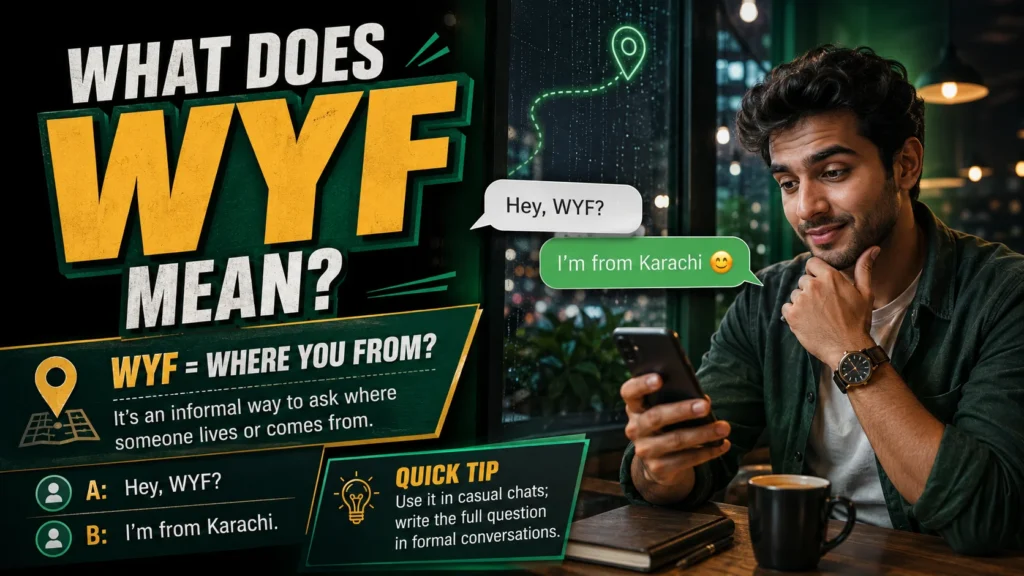
WYF usually means “Where You From?” When someone texts it to you, they are normally asking about your hometown, country, background, or current area. In some conversations, WYF can instead mean “What You Feeling?”
People search “what does WYF mean” because the abbreviation is highly dependent on context. A stranger who sends “Hey, WYF?” probably wants to know where you come from. A friend asking “Pizza or burgers—WYF?” wants to know what you feel like eating.
What Does WYF Mean?
WYF is an informal texting abbreviation that most commonly stands for:
W = Where
Y = You
F = From
The fully grammatical question would be “Where are you from?” In informal conversation, people frequently omit “are,” producing “Where you from?” Texting shortens that question further to WYF.
The sender may want to know:
- Your hometown
- Your country or region
- Where you currently live
- Where you grew up
- Whether you are local
- Your cultural or family background
When WYF arrives without any explanatory context, “Where You From?” is the safest and most likely interpretation.
WYF Means “Where You From?”
“Where you from?” is the primary meaning of WYF in text messages and DMs. It commonly appears near the beginning of a conversation when two people are getting to know each other.
A: Hey, I don’t think we’ve spoken before.
B: No, but we’re in the same gaming group.
A: Nice. WYF?
B: I’m from Toronto. You?
The question may concern someone’s original hometown or present location. If necessary, you can distinguish between the two by replying, “I’m originally from Toronto, but I live in Vancouver now.”
WYF does not necessarily ask for an exact address. A broad answer such as “Northern England,” “Punjab,” or “the East Coast” is acceptable, especially when speaking to someone you do not know well.
WYF Can Mean “What You Feeling?”
The second genuine meaning of WYF is “What You Feeling?” It represents either “What are you feeling?” or “What do you feel like?”
Friends may use this meaning when choosing:
- Food
- Music
- A film or television show
- Clothes
- Weekend plans
- A social activity
- How to respond to a situation
For example:
A: Should we order something or cook?
B: I don’t mind. WYF?
A: I’m feeling Thai food tonight.
B: Perfect. I’ll find a place.
“Where you from?” would make no sense during a discussion about dinner, so WYF clearly asks about preference.
When the conversation involves emotions, it can also mean “What are you feeling?”
A: You’ve been quiet since the meeting.
B: I’m still processing everything.
A: WYF right now?
B: Mostly disappointed.
This version is less universally recognized than “Where you from?” Writing the complete question is better when discussing serious emotions.
Does WYF Have an Explicit Meaning?
In certain adult conversations, WYF can mean “Who you f—ing?” This is a blunt, profane question about someone’s sexual partner.
This interpretation is:
- Less common than “Where you from?”
- Restricted to explicit or relationship-related contexts
- Potentially confrontational or disrespectful
- Inappropriate in school or professional settings
- Not suitable for communication with minors
Do not assume an ordinary WYF message has this meaning. Consider it only when the surrounding discussion clearly concerns sexual relationships, dating accusations, jealousy, or adult humour.
If the message is ambiguous, respond with: “Do you mean where I’m from?”
Can WYF Mean “Why You Flirting?”
“Why you flirting?” has occasionally been recorded as an alternative expansion of WYF. It might appear during a teasing or jealous conversation, but it is not a widely reliable definition.
For example, “You keep liking all their pictures—WYF?” could theoretically mean “Why are you flirting?” However, most readers would need more explanation.
Because this meaning is uncommon, do not use WYF to communicate a serious accusation. Write the complete question instead.
Does WYF Mean “What’s Your Favorite?”
Some online explanations list “What’s Your Favorite?” as another possible meaning. It normally requires an additional subject:
- “WYF movie?”
- “WYF song?”
- “WYF food?”
Even in these examples, the abbreviation may confuse readers. “What’s your favorite?” is possible within a specific friend group, but it is not the default meaning of a standalone WYF message.
The most practical order of interpretation is:
- Where You From?
- What You Feeling?
- Explicit adult meaning
- Rare, group-specific interpretations
What Does WYF Mean on Different Platforms?
WYF in SMS and iMessage
In traditional text messages and iMessage conversations, WYF usually means “Where you from?” Someone may use it after receiving your number, meeting you briefly, or being introduced through a mutual friend.
If established friends are discussing food, emotions, or plans, it can mean “What you feeling?” The message immediately before WYF normally provides the clue.
WYF on WhatsApp
On WhatsApp, WYF retains the same meanings. In a one-to-one conversation with a new contact, it normally asks about location or background.
In a family or friendship group, it might ask for a preference:
“Movie night at eight. WYF—comedy or horror?”
Adding options after WYF makes “What you feeling?” much easier to identify.
WYF on Snapchat
On Snapchat, WYF frequently appears as a brief getting-to-know-you question. Someone who has recently added you may send “Hey, WYF?” to ask where you live or come from.
A Snapchat message can feel flirtatious when it comes from a new romantic interest, but WYF itself is neutral. It does not prove that the sender likes you romantically.
WYF on Instagram
In Instagram DMs, WYF normally means “Where you from?” It may follow a Story reply, introduction, or compliment.
For example:
A: That beach in your Story looks amazing.
B: It was beautiful.
A: Is that near you? WYF?
B: I’m from California.
WYF can appear in comments, but its meaning is harder to determine without a private conversational context.
WYF on Discord
On Discord, a new gaming friend may ask WYF to learn your country, region, or time zone. Within an established server, it can also mean “What you feeling?” when members are choosing a game, voice channel, or activity.
You do not need to disclose personal location information in a public server. Naming a time zone or broad region is usually enough.
WYF on TikTok and X
WYF occasionally appears in TikTok comments, captions, direct messages, and short posts on X. “Where you from?” remains the likely meaning when it is directed at a person.
In a post about choices or mood, “What you feeling?” may fit. Because public content provides less context, writers should use the full phrase if clarity matters.
Capitalization and Texting Variations
Common versions include:
- WYF
- wyf
- Wyf
- wyf?
- WYF??
- where u from?
- whr u frm?
- wyf rn?
Capitalization does not create an official change in meaning. Lowercase “wyf” looks relaxed, while uppercase “WYF” can appear more direct.
Punctuation may affect tone:
- “wyf?” — casual question
- “WYF?” — direct or emphatic
- “wyf 😂” — playful
- “WYF??” — impatient, surprised, or demanding
- “wyf rn?” — could ask where you are from, but often means “What are you feeling right now?” when discussing emotions
The surrounding topic remains more reliable than capitalization.
Tone Variations of WYF
Funny Tone
A: WYF?
B: Emotionally or geographically?
A: Geographically 😭
B: Liverpool. Emotionally, somewhere with unlimited coffee.
The receiver pretends to misunderstand the location question to create humour.
Sarcastic Tone
A: I think putting pineapple and mayonnaise on pizza sounds good.
B: WYF, another galaxy?
A: Don’t judge it until you try it.
B: I’m judging it from a safe distance.
WYF rhetorically asks where someone could come from to have such an unusual opinion.
Playful Tone
A: I’m choosing our movie tonight.
B: That sounds dangerous.
A: WYF—comedy or horror?
B: Comedy, unless you’re volunteering to protect me.
WYF means “What are you feeling?” or “What do you feel like watching?”
Serious Tone
A: You didn’t seem okay after class.
B: I had some bad news.
A: WYF right now—do you want to talk?
B: I’m upset, but talking might help.
The emotional context makes “What are you feeling?” the intended meaning.
Real WYF Text Conversation Examples
Between New Friends
A: It was nice meeting you at the workshop.
B: You too! I’m glad we exchanged numbers.
A: WYF originally?
B: I’m from Birmingham, but I study in London.
Meaning: Where are you originally from?
Between Dating-App Matches
A: Your profile says you’re new to the city.
B: Yeah, I moved here last month.
A: Nice. WYF?
B: Manchester. What about you?
Meaning: Where are you from? The context may be mildly flirty, but the abbreviation itself remains neutral.
Between Coworkers
A: We need to order lunch before the next meeting.
B: I can use the delivery app.
A: Great. WYF—pizza, wraps, or salad?
B: Wraps sound good.
Meaning: What do you feel like eating?
Between a Parent and Child
A: You said your new roommate is an international student.
B: Yes, we met yesterday.
A: WYF?
B: Do you mean me or my roommate? She’s from Malaysia.
Meaning: Where is the person from? This example also shows why a complete question can be clearer.
Between Siblings
A: We have a free evening for once.
B: Finally.
A: WYF—cinema or staying home?
B: Staying home with snacks.
Meaning: What do you feel like doing?
From a Stranger Online
A: Hey, I saw your comment in the travel group.
B: Hi.
A: WYF?
B: I’m from South Asia, but I don’t share my exact location online.
Meaning: Where are you from? The reply protects personal information.
Together with the four tone examples, these provide ten realistic text-message and DM conversations.
Grammar and Language Role of WYF
WYF is an initialism functioning as an interrogative expression. People often describe it as an acronym, but an acronym is normally pronounced like a word. WYF is generally read letter by letter or mentally expanded into the complete question.
It can replace an entire sentence:
A: Nice to meet you.
B: WYF?
It can also appear within a longer question:
- “Hey, WYF originally?”
- “WYF about the new schedule?”
- “WYF for dinner?”
- “WYF—staying in or going out?”
- “Before we choose a time zone, WYF?”
As “Where you from?”, WYF normally stands alone or appears near an introduction. As “What you feeling?”, it is often followed by a subject, choices, or a time reference.
WYF belongs to informal language. It is suitable for relaxed texts and DMs but not for academic papers, business emails, applications, or official correspondence.
How to Reply When Someone Texts WYF
Funny Reply
“Planet Earth, although some people have doubts 😂”
This works when WYF means “Where you from?” and the conversation already feels friendly.
Serious Reply
“I’m originally from Pakistan, but I currently live in the UK.”
This provides a clear answer without revealing an exact location.
Flirty Reply
“Close enough to meet for coffee—where are you from? 😉”
Use this response only when the conversation is already mutual and flirtatious.
Neutral or Unbothered Reply
“I’m from Leeds. You?”
This is simple, natural, and returns the question.
Privacy-Conscious Reply
“I’m from the north, but I prefer not to share my exact city online.”
A stranger is not entitled to your address, workplace, school, neighbourhood, or live location.
Clarifying Reply
“Do you mean where I’m from or what I’m feeling?”
This is the best response when both meanings are possible.
Compared With Similar Texting Terms
| Term | Meaning | Usage Context | Tone | Popularity | Confusion Risk |
|---|---|---|---|---|---|
| WYF | Where you from?; sometimes what you feeling? | Introductions, location, mood, or preferences | Casual and curious | Moderate | High |
| WYA | Where you at? | Asking someone’s current location | Direct | High | Low |
| WYD | What are you doing? | Asking about a current activity | Casual; sometimes flirty | Very high | Low |
| WYM | What you mean? | Requesting clarification | Neutral or challenging | High | Low |
| WBU | What about you? | Returning a question | Friendly | High | Low |
| ASL | Age, sex, location | Online introductions | Direct and dated | Lower today | Medium |
| NVM | Never mind | Ending or withdrawing a question—the functional opposite of seeking information | Neutral or dismissive | High | Low |
WYF and WYA are commonly confused. WYF asks about someone’s origin or home area, while WYA asks where the person is at that moment.
Who Uses WYF?
Teenagers and Young Adults
Teenagers and young adults are most likely to encounter WYF in texts, dating apps, gaming communities, and social-media DMs. Short questions fit rapid conversations where both people expect informal language.
WYF is not universally understood, even among younger users. Many people prefer “Where u from?” because its meaning is more obvious.
Gen Z Versus Millennials
Gen Z users may write lowercase “wyf” without punctuation and expect the conversation to establish its meaning. They are also likely to encounter it in Snapchat, Instagram, Discord, and dating-app conversations.
Millennials grew up with SMS abbreviations and instant messaging, so shortening language is not unique to Gen Z. However, many millennials may recognize WYA, WYD, or WBU more readily than the ambiguous WYF.
These are general observations rather than rules. Friend group, region, and individual habits often matter more than age.
Regional Usage
“Where you from?” is widely understandable across the US, UK, Canada, Australia, and international English-speaking communities. WYF does not belong exclusively to one country.
Actual familiarity varies. People who speak English as an additional language may understand the complete phrase but not immediately recognize its initials.
Origin and Internet Culture
WYF has no reliably documented inventor or exact creation date. It developed from the broader practice of compressing informal questions for rapid digital communication.
Early SMS culture encouraged brevity because messages had character limits and numeric phone keypads made typing slower. Instant messaging and chat rooms further popularized shortened forms such as “u,” “r,” “wya,” and “wyd.”
WYF therefore fits the tradition of texting shorthand that predates TikTok. It should not be inaccurately described as a TikTok-created expression.
A user-submitted Urban Dictionary entry recorded WYF as “where you from” in 2014. That record confirms online usage by that point but does not establish who invented it. A more recent Hushed guide to WYF in texting likewise identifies “Where You From?” as its usual meaning.
Its continued use reflects a basic feature of online slang: context allows people to remove grammar while preserving the intended message.
Is WYF Rude, Offensive, or Inappropriate?
WYF meaning “Where you from?” is not inherently rude or offensive. However, it can sound abrupt when sent without a greeting.
The question may also feel intrusive if it appears to request someone’s exact location, ethnicity, or family background. If a person gives a broad answer or declines to answer, do not pressure them.
“What you feeling?” is normally harmless. The rare explicit expansion contains implied profanity and sexual content, making it inappropriate in professional, educational, or unwanted conversations.
WYF at School
Students may use WYF in private conversations with friends. It should not appear in assignments, messages to teachers, or formal school communication.
Write “Where are you from?” or “Which option would you prefer?” instead.
WYF at Work
WYF may be understood in a private chat between close coworkers, particularly when choosing lunch. It is unsuitable for formal emails, client messages, or conversations requiring clear information.
Instead of “WYF?”, write:
- “Where are you based?”
- “Which option would you prefer?”
- “How do you feel about the proposal?”
Online Safety
If an unknown person sends WYF, you may answer generally or not at all. Never feel pressured to share:
- Your home address
- Your live location
- Your school
- Your workplace
- Your daily routine
- Other identifying information
Real-World Observation
WYF demonstrates how much texting depends on shared context. The same letters can ask about geography after an introduction or preference during a dinner discussion. This flexibility saves time between people who communicate similarly, but it creates confusion between strangers. WYF works best when the surrounding messages make the intended question obvious.
People Also Ask About WYF
What does WYF mean when someone texts you?
WYF usually means “Where you from?” The sender wants to know your hometown, country, background, or general location. If you are already discussing emotions, food, or plans, it may mean “What you feeling?”
Is it rude to reply with just WYF in a text?
Replying with only “WYF?” is not necessarily rude, but it can feel abrupt. Adding “Hey” or writing the full question sounds friendlier. The level of politeness depends on your relationship with the recipient.
What is the difference between texting WYF and saying it aloud?
In a text, readers mentally expand the letters into a question. People rarely pronounce W-Y-F during spoken conversation; they normally say “Where are you from?” Voice also communicates friendliness or suspicion more clearly than a three-letter message.
Does WYF mean the same thing in a group chat and a one-to-one text?
Not always. In a new one-to-one conversation, it usually asks where someone is from. In a group discussing dinner, music, or an activity, it may ask what everyone feels like choosing.
Is WYF flirty when a guy texts it?
It can be flirty if a guy sends it during a dating conversation or while getting to know you. However, it can also be ordinary small talk. Look for compliments, romantic emojis, personal questions, and the overall direction of the conversation.
Is WYF flirty when a girl texts it?
The same principle applies when a girl sends WYF. She may be interested in learning more about you, or she may simply be asking a normal location question. WYF alone is not proof of romantic interest.
What is the difference between WYF and WYA?
WYF usually means “Where you from?” and concerns origin or home area. WYA means “Where you at?” and asks for a present location. “I’m from Chicago” answers WYF, while “I’m at the mall” answers WYA.
How do I answer WYF without sharing my location?
Give a broad answer such as your country, state, province, or general region. You can also say, “I don’t share my location online.” A respectful sender will accept that boundary without requesting more details.
Conclusion
WYF most commonly means “Where You From?” It asks about someone’s hometown, country, background, or general location. In conversations about emotions, food, entertainment, or plans, it can mean “What You Feeling?”
Rare explicit and group-specific meanings exist, but they should never be treated as the default interpretation.
Tips for Using WYF
- Interpret it as “Where you from?” during an introduction.
- Check the preceding topic for a mood or preference meaning.
- Provide only a broad location when speaking to strangers.
- Ask the sender to clarify if more than one meaning fits.
Common Mistakes
- Confusing WYF with WYA
- Assuming WYF is always flirtatious
- Sharing an exact location with an unknown person
- Using rare definitions without sufficient context
Use WYF in casual texts and DMs where its meaning will be obvious. Avoid it in formal communication, serious emotional discussions, and situations where the recipient may not recognize the abbreviation.

