If you spend time texting friends, gaming online, scrolling through social media, or chatting in group conversations, you’ve probably come across the abbreviation “NP.”
At first glance, it can seem confusing. Is it a typo? Does it stand for something technical? Or is it another piece of internet slang that everyone seems to understand except you?
The good news is that NP is actually one of the simplest and friendliest abbreviations used in digital communication today.
People search for “np meaning in chat” because they often receive it after saying “thank you” and wonder what the sender really means. Others see it in gaming communities, social media comments, or messaging apps and want to understand its tone and purpose.
Understanding NP helps you communicate more naturally online and prevents awkward misunderstandings in everyday conversations.
NP Meaning in Chat – Quick Meaning
What Does NP Mean?
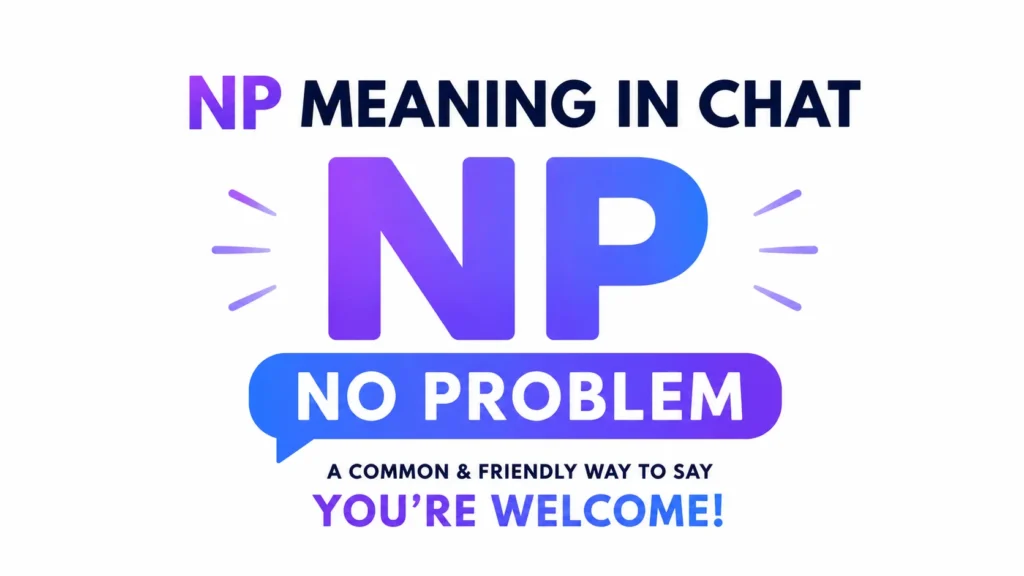
In chat and text messaging, NP usually means “No Problem.”
It is a casual and friendly way of saying:
- You’re welcome
- It’s okay
- Happy to help
- Don’t worry about it
- It wasn’t a burden
People use NP to reassure others that helping them was easy and appreciated.
Quick Examples
“Thanks for helping me finish the project.”
“NP!”
“Sorry for messaging so late.”
“NP, I’m still awake.”
“Thank you for sending the notes.”
“NP, glad they helped.”
Why People Use NP
The abbreviation is popular because it is:
- Fast to type
- Friendly in tone
- Widely recognized online
- Suitable for casual conversations
Origin & Background
Where Did NP Come From?
NP emerged during the early days of internet messaging when users wanted faster ways to communicate.
As chat rooms, forums, and instant messaging platforms became popular, abbreviations such as LOL, BRB, IMO, and NP started appearing everywhere.
Typing shorter responses saved time and allowed conversations to move quickly.
Influence of Gaming Culture
Online gaming played a major role in popularizing NP.
Multiplayer games require fast communication. Players often thank teammates for assistance, and “NP” became an efficient way to respond without interrupting gameplay.
Even today, gaming communities use NP constantly.
Social Media Expansion
As platforms like Instagram, Snapchat, TikTok, and WhatsApp grew, internet slang spread beyond gaming.
NP became a universal response that could fit almost any informal conversation.
How the Meaning Evolved
While NP originally meant a straightforward “No Problem,” it now carries additional social meaning.
Depending on context, it can express:
- Kindness
- Reassurance
- Humility
- Friendliness
- Informal politeness
The core meaning remains unchanged, but its emotional impact depends on the conversation.
Real-Life Conversations
WhatsApp Conversation
Person A:
“Thank you for helping me move yesterday.”
Person B:
“NP! It was actually fun.”
Person A:
“I couldn’t have done it alone.”
Person B:
“Anytime.”
Instagram DM Conversation
Person A:
“Thanks for sharing my post.”
Person B:
“NP! Your content is awesome.”
Person A:
“That means a lot.”
Person B:
“Keep posting!”
TikTok Comments
Person A:
“Thanks for explaining this trend.”
Person B:
“NP, glad it helped.”
Person A:
“Now I finally understand it.”
Person B:
“Happy to help.”
Text Message Conversation
Person A:
“Sorry for asking so many questions.”
Person B:
“NP at all.”
Person A:
“I appreciate your patience.”
Person B:
“Seriously, don’t worry about it.”
Emotional & Psychological Meaning
What Emotion Does NP Express?
NP often communicates reassurance.
When someone thanks you, they may worry that they’ve inconvenienced you. Responding with NP removes that concern.
It tells the other person:
“You didn’t cause trouble.”
Why People Prefer It
Many people dislike formal responses in casual settings.
Instead of saying:
“You’re very welcome.”
They may choose:
“NP.”
It feels lighter, more relaxed, and more conversational.
What It Reveals About Modern Communication
Digital communication values efficiency.
People want messages that are short while still feeling warm and human.
NP reflects that balance perfectly.
Personal-Style Scenario
Imagine helping a friend prepare for an important exam.
After hours of studying together, they text:
“Thank you so much. I know I asked for a lot of help.”
Replying with:
“NP, you’ve got this!”
does more than acknowledge gratitude.
It also offers encouragement and emotional support.
Usage in Different Contexts
Social Media
On social media, NP commonly appears in:
- Comments
- Direct messages
- Replies
- Community discussions
It helps keep interactions friendly and casual.
Friends and Relationships
Among friends, NP feels natural and comfortable.
Example:
“Thanks for listening to me today.”
“NP. That’s what friends are for.”
Work and Professional Settings
In some workplaces, NP is acceptable among colleagues who communicate informally.
However, more professional alternatives may be preferable when speaking with clients or supervisors.
Examples:
- You’re welcome
- Happy to help
- My pleasure
Casual vs Serious Tone
Casual:
“Thanks for sending the meme.”
“NP.”
Serious:
“Thank you for assisting with the legal documents.”
“You’re welcome” may sound more appropriate than NP.
When NOT to Use It
Formal Business Communication
Avoid NP in highly professional emails.
It may appear overly casual.
Sensitive Situations
When someone expresses deep gratitude during an emotional moment, NP can occasionally feel too brief.
A warmer response may be better.
Example:
“Thank you for being there during my difficult time.”
Instead of:
“NP”
Consider:
“I’m glad I could help.”
Cross-Cultural Communication
Not everyone recognizes internet abbreviations.
Using the full phrase can prevent confusion.
Important Professional Relationships
Clients, executives, and formal business contacts may appreciate complete responses rather than abbreviations.
Common Misunderstandings
Some People Think It Means “Not Possible”
This is one of the most common misunderstandings.
In chat conversations, NP almost always means “No Problem.”
Tone Can Be Misread
A very short response may sometimes appear cold.
Context matters.
“NP 😊”
feels much warmer than:
“NP.”
Different Communities Use It Differently
Gaming communities may use NP constantly.
Professional environments may use it far less often.
Literal vs Intended Meaning
People do not literally mean there was a problem.
They simply want to reassure the other person that helping was easy.
Comparison Table
| Expression | Meaning | Tone | Common Usage |
|---|---|---|---|
| NP | No Problem | Casual | Texting, gaming, social media |
| YW | You’re Welcome | Neutral | General conversations |
| NBD | No Big Deal | Very casual | Friends and online chats |
| Anytime | Happy to help whenever | Warm | Friends and colleagues |
| My Pleasure | I enjoyed helping | Polite | Professional settings |
| Sure | Of course | Casual | Quick replies |
| Glad to Help | Happy assistance | Friendly | Personal and work contexts |
| No Worries | Don’t worry about it | Relaxed | Informal conversations |
Key Insight
NP is one of the most flexible responses online because it combines friendliness, reassurance, and efficiency. Its popularity comes from making gratitude exchanges feel natural rather than formal.
Variations / Types
NP
Standard abbreviation for No Problem.
Np
A lowercase variation commonly seen in texting.
np
The most casual version used in rapid conversations.
NP!
Adds enthusiasm and friendliness.
NP 😊
Shows warmth and positive emotion.
No Problem
The full version with the same meaning.
No Prob
A shortened spoken and written variation.
No Worries
Popular alternative expressing reassurance.
Anytime
Suggests willingness to help again.
Happy to Help
A slightly more thoughtful version often used professionally.
How to Respond When Someone Uses It
Casual Replies
- Cool, thanks!
- Appreciate it.
- You’re awesome.
- Thanks again.
Funny Replies
- I’ll remember your kindness forever.
- You’re officially my favorite person.
- Hero status unlocked.
- Legend.
Mature Replies
- I appreciate your help.
- Thanks for making things easier.
- That means a lot.
Respectful Replies
- Thank you again.
- Much appreciated.
- I truly value your support.
Regional & Cultural Usage
Western Culture
NP is extremely common throughout North America, the United Kingdom, and Australia.
People often use it as a direct substitute for “You’re welcome.”
Asian Culture
Many younger internet users recognize NP through gaming and social media.
However, formal communication often favors more respectful language.
Middle Eastern Culture
NP is increasingly understood among younger generations who engage with global internet culture.
Traditional communication may still prefer complete phrases.
Global Internet Usage
Online communities have made NP almost universally recognizable.
Gaming, social media, and messaging apps continue to spread its usage worldwide.
Gen Z vs Millennials
Gen Z
- Uses NP frequently
- Prefers quick responses
- Comfortable with abbreviations
Millennials
- Understand NP well
- Use it regularly
- May alternate between NP and full phrases
Both generations generally interpret NP positively.
Is It Safe for Kids?
Understanding the Context
Yes, NP is generally safe for kids.
It is a harmless abbreviation meaning “No Problem.”
Unlike some internet slang that carries hidden meanings, NP is typically friendly and respectful.
Parents can view it as a normal part of modern digital communication.
Teaching children its meaning can help them understand online conversations more confidently.
FAQs
What does NP mean in chat?
NP usually means “No Problem.” It is commonly used as a friendly response to thanks or apologies.
Is NP rude?
No. In most situations, NP is considered polite and reassuring. Context and tone determine how it is perceived.
What does NP mean in texting?
In texting, NP stands for “No Problem” and means that helping someone was not an inconvenience.
Is NP the same as you’re welcome?
They have similar meanings. However, NP sounds more casual and conversational.
Why do gamers use NP so often?
Gaming requires fast communication. NP provides a quick way to acknowledge gratitude without slowing down gameplay.
Can NP be used at work?
Yes, but only in informal workplace conversations. Professional emails may require more formal wording.
What should I reply after someone says NP?
You can simply continue the conversation or respond with appreciation such as “Thanks again” or “I appreciate it.”
Conclusion
Understanding the np meaning in chat is surprisingly useful in today’s digital world. While the abbreviation is simple, it carries an important social purpose: making conversations feel comfortable, friendly, and reassuring.
Whether you’re chatting on WhatsApp, commenting on TikTok, messaging friends, or playing online games, NP helps communicate that helping someone wasn’t a burden. It creates a sense of ease that modern communication values.
The next time someone replies with “NP,” you’ll know they’re simply saying, “Don’t worry about it—I’m happy to help.” And when the moment feels right, you can confidently use it yourself.